


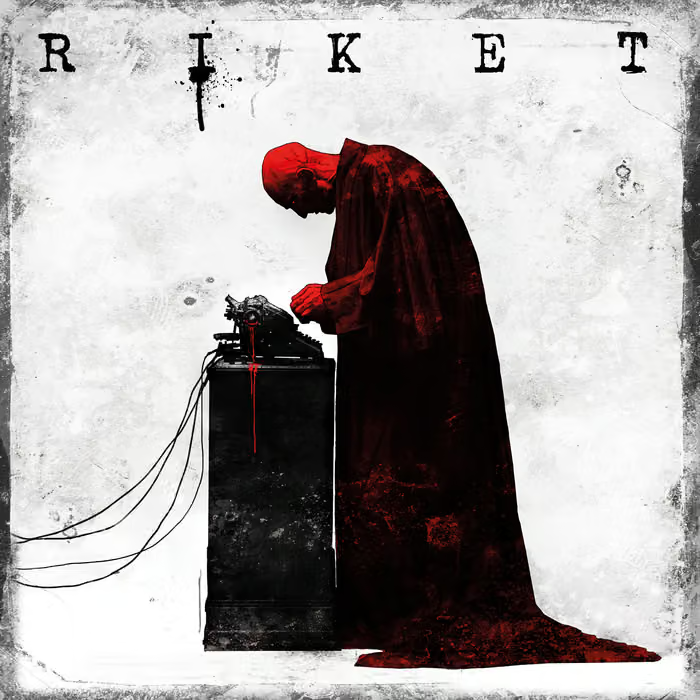
“a very competent and original debut album.”
As the saying goes, “If it ain’t broke, don’t fix it,” and Swedish band Riket knows that saying quite well. Born in Stockholm but musically raised in Gothenburg, the quintet came to life in 2016. Ten years later, they are releasing their debut, homonymous album, 2026, emphasizing various time periods of Sweden (after all, “Riket” is Swedish for “kingdom”) between 1868 and 2009. With Sweden’s rich history dating back to at least the 9th century, it’s curious to see that the band didn’t remain captive to the Vikings and instead moved toward the present. After all, the country’s motto is “För Sverige i tiden” (something like “For Sweden, with the times”).
2026 begins with “1868 – Sommar vid Vinterviken,” a track that shows Riket as they truly are: a band that plays modern extreme metal with clear influences from some of their biggest compatriots, such as In Flames or At The Gates (which makes sense, as Riket’s Adrian Erlandsson, of At The Gates, Paradise Lost, and Cradle Of Filth fame, was the band’s drummer in its early formation). However, they also include more serious and extreme moments that we could associate with bands like The Crown or The Haunted, as in “1867 – Storsvagåret,” known in Sweden as “The Year of Great Weakness.” This song speaks of the great and last famine that plagued the country. When we think the track can no longer impress us, the band makes a quick 180º turn and catches us off balance, which is refreshing.
Riket reaches epic moments reminiscent of untouchable names such as Bolt Thrower in “1965 – Höghus och kultur,” demonstrating even more ambition and remarkable musical maturity, something we had already witnessed in previous solos. The further we go, the more we encounter the band’s overall technical, epic, and violent prowess, delivered in consciously balanced portions, as heard in “1897 – Mot polen,” a song that recounts a balloon expedition to the North Pole that culminated in the deaths of Swedish explorers. It is also interesting to see that Riket pays homage to Stefan Sundström, perhaps the biggest name in contemporary Swedish folk music, with “2009 – Alla ska i jorden,” their interpretation of that composer and singer’s work. This memento mori ends up being the perfect way to close a debut album, as the song reflects on the ephemeral nature of life and the inevitability of death.
All in all, 2026 is a somewhat conceptual record that moves forward and backward in time at will, as if the band had a time machine allowing them to travel, witness, and describe firsthand everything Sweden has experienced over the last 150 years. It’s an intelligent and engaging approach that avoids typical blood, guts, and horror clichés, even while offering large doses of implicit violence within historical themes tied to a specific region. The less successful aspect lies in the fact that practically no one outside of Sweden will fully grasp what the band is referencing, potentially creating a sense of alienation or disinterest. Furthermore, the themes feel somewhat mixed and disorganized: from 1868, the band goes back to 1867 and then forward to 1965, addressing these subjects in a nearly cryptic way, which may cause confusion about this deliberate “disorder.”
Musically, 2026 is a very competent and original debut album; diverse and unafraid to show its worth. The Stockholm and Gothenburg influences are present, along with a more progressive and groovy strain of modern death metal, one that was popularized by Gojira twenty years ago but that, in Riket’s case, showcases its own identity. The production of 2026 is excellent, which is crucial, as the ambition on display demands that level of clarity and precision, helping it stand apart from other attempts at greatness. As we have seen for decades, this is a strong start within a genre being revitalized by bands like Riket, and experience suggests they will attract an even broader audience with their second album. All it takes is smoothing out a few rough edges and believing in Riket, because we already do.


