


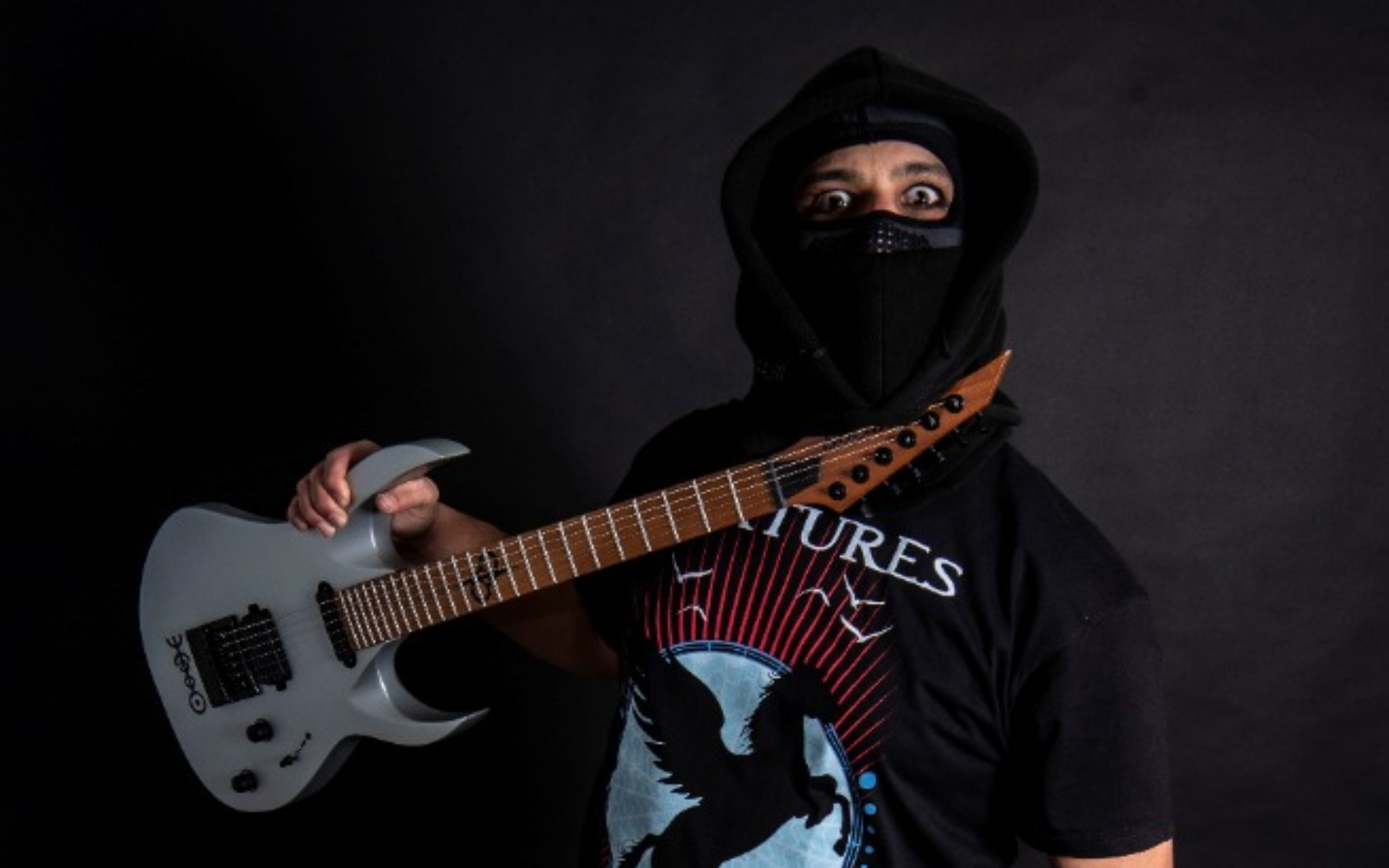
“Znous is a decolonization tool, an act of cultural revolution. Without its manifesto and its message in every song, the band would not even exist, because as musicians we don’t think the world needs new musical innovation right now. It needs humans.”
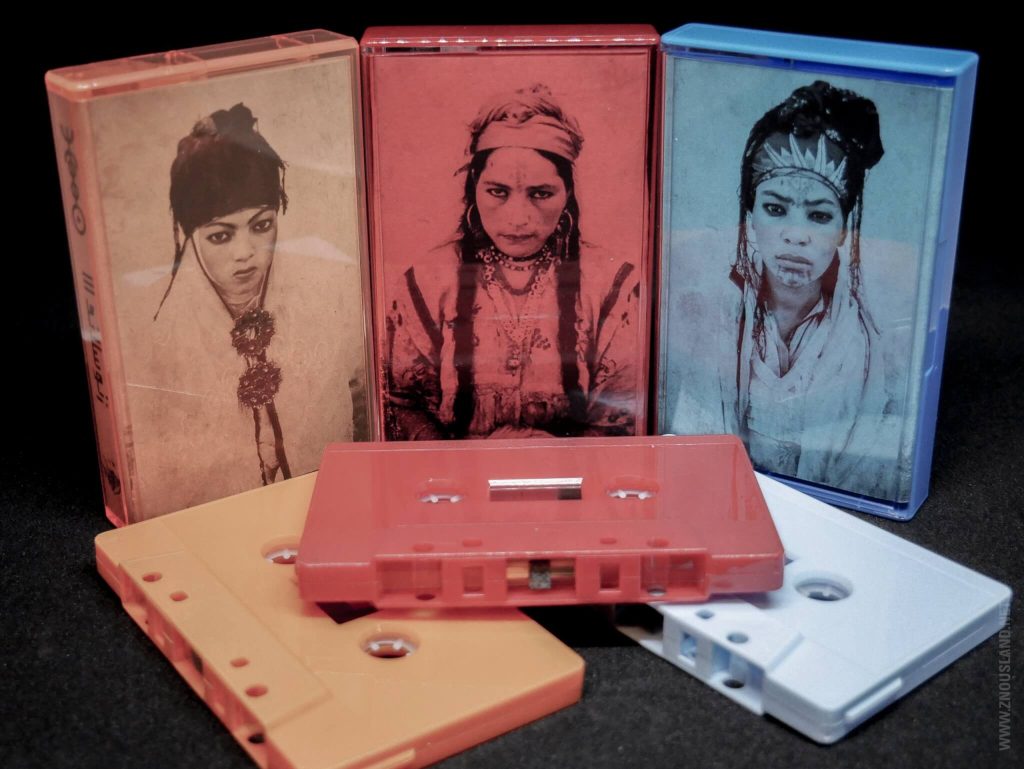
Znous keep coming back to the same place. New tracks, new wounds, new targets, but the map stays familiar. They call it Znousland, and it’s not a branding trick or a cute concept for the artwork. In their head, it’s a psychological and cultural geography rooted in Tunisia, stretching into Tamazgha and the wider Arab-Muslim space they grew up inside. The world holds together through continuity, and through those portraits and colour themes that keep showing up like recurring characters.
So I started there: what is Znousland, and why return to one umbrella identity instead of reinventing everything from record to record? Their answer goes straight into the name “Znous” itself, and into how a word can get poisoned by colonial logic, then reclaimed and repurposed as a flag. From there, the conversation widens out into the way they annotate their own lyrics in public, the frustration of lazy cultural labels like “oriental metal”, the bite and humour of Tunisian dialect that refuses clean translation, and the line they try not to cross when a song is built from real grief.
I spoke to Hamma, Znous’ guitarist and vocalist, about the practical side of survival. Anonymity, safety, and what it means to keep a project alive when big platforms pull the plug. He names Gabès, names the pollution, names the systems behind it, and he admits some of this music happens fast. Written and recorded in one night, with no real distance between the headline and the riff.
“From the start, Znous was imagined as a cartoon band, in the spirit of Gorillaz, one of our early inspirations.”
You’ve built this whole “Znousland” world across releases. What is Znousland, in your head, and what keeps pulling you back to that name instead of giving each record a totally new identity? And what can you tell us about the artwork, especially the portraits and the colour themes?
Hamma: We can’t really explain Znousland without explaining Znous itself. Znousland is our allegorical map of our historical and cultural geography: Tunisia, then the wider North African body also called Tamazgha, extending to the larger Arab-Muslim cultural space we’ve grown inside of and belong to. It’s not a tourist map. It’s a psychological, cultural and civilizational map.
From the start, Znous was imagined as a cartoon band, in the spirit of Gorillaz, one of our early inspirations. The band members were meant to be presented as characters living in a fictional reflection of Tunisia. We never managed to find the visual collaborators on such a scale to make this come true but to be brief, Znousland is “the country” of Znous, the species.
“Colonialism has a talent for poisoning even neutral words.”
The word Znous comes from the Arabic root جنس: kind, type, species, and it also touches on the idea of sex or category. Originally it can be neutral. But colonialism has a talent for poisoning even neutral words. In French you have “espèce de…” followed by an insult, and in a colonial context where pseudo-scientific racial thinking was used to justify abominations, that kind of language is not innocent. Locally, people translated and adopted the logic, and “kinds/races” became part of the local insult-pool. A similar thing happened with words like “Zoufri” coming from les ouvriers (workers). Language is not a communication code, it trains the social reflexes and shapes social realities. In this case, it implants the contempt towards “inferior” despicable “races”in the first case and the working class category in the second.
That’s why Znous as a band name is also a reclamation. Znousland is the land of “the Znous”, the ones reclaiming their difference in kind, their variations, their dignity. If you want a deeper framework for how colonization shapes language, consciousness, and self-image, you don’t get better than Frantz Fanon.
As for why we keep returning to the same umbrella name instead of reinventing every record: we wanted one continuous world with room inside it. From the start, Znous was meant to be a Znouslandic band, singing in a Znouslandic language and manner, about Znousland, for Znouslanders. Each release tackles different subjects, but it’s still the same narration. Local stories for us are never only local. They echo global human questions.
The artwork helps keep that continuity. The portraits are the glue. The reference to Marc Garanger’s colonial photographs of Amazigh women anchors the project in the central tension we keep circling: oppressor and oppressed, the male colonial lens in front of the indigenous female subject, violence and resilience, domination and resistance. The colour themes are the emotional overlays. They distinguish each release while still belonging to the same world.
“When the subject is history, oppression, violence, class, colonial hangovers, you can’t just throw lines into the world and act like context doesn’t matter.”
On your site you translate lyrics and you give context, footnotes, backgrounds. When did you decide “we’re going to explain our references ourselves”, and what have you learned from doing that in public?
We decided to explain our references ourselves because we’re dealing with real weight, not filler lyrics. When the subject is history, oppression, violence, class, colonial hangovers, you can’t just throw lines into the world and act like context doesn’t matter. When you touch serious subjects, context is not a luxury, it’s part of the ethics. A lot of music can afford to be pure mood. Our songs often can’t, because they’re tied to history, social struggles, wounds, and real lives. Also, we’re speaking to different generations. A lot of younger listeners didn’t live the background, didn’t inherit the same “shared memory”, and the internet mixes everything into one big soup. So we put the footnotes and intros there to try to avoid getting the message misread or flattened.
The footnotes and introductions are there to help the song find its place in the mind, the heart and the soul of the receiver. Not to over-explain or control interpretation, but to give the listener an overview of where the song comes from. It is basically pre-sex. A little lubrification before the impact. Hopefully you won’t make that the headline quote [he laughs]
And doing it publicly taught us humility. The internet will misunderstand you fast, but it will also teach you what people genuinely don’t know, what they misread, and what pieces of the puzzle they miss, what needs to be located in time, space and psyche. We always wish for these notes to be a bridge strong enough to carry the massage. Sometimes we wish they just become a mirror.
“We are not oriental metal” is a strong line to put in writing. What’s the most common lazy thing you see people do when they talk about North African bands, and what would a fair description look like instead?
I don’t think people even talk about “North African bands” as a real category. And that kind of answers your point about laziness, especially in Metal music, where people can subdivide the genre into a whole forest of micro-genres. The botanical garden of prog-death-symphonic-parrot-fronted-whatever… no problem.
But somehow that same energy rarely goes into cultural specificity, or into how music becomes local and global at the same time. So “North African bands” often get tossed into the rotten bag of “oriental metal”, or at best we get recognized through the recent wave of indigenous metal narratives, like Shepherds Reign or Mawiza. So yeah, laziness is a good word, but it’s not innocent laziness. It shapes perception, it flattens people, it keeps the map simple for the comfort of the center.
“If we had to describe what we do today, we’d call it Human Metal.”
We honestly don’t care about labels like that. But if we had to describe what we do today, we’d call it Human Metal. Because making music in the world we’re living in without being human about it is like pooping in outer space. Technically possible, but also ridiculous.
“Translation can give you a word, but not always the philosophy that produced it and is still embedded in it.”
Your Tunisian dialect carries a lot of bite, humour, and street-level detail. What’s a line from any song that you know lands differently in Tunisian than it ever will in English, and why?
As mentioned earlier, people tend to forget that a language isn’t just a communication code. Every language carries a whole worldview inside it: history, class, shame, pride, what’s “normal”, what’s “dirty”, what’s funny, what’s forbidden.
Even a simple word like “race” does not land the same. In English and French it carries a heavy modern history, shaped by empire, pseudo-science, and ideological ways of sorting humans. Arabic can translate the idea, but it rarely maps one to one. You might reach for عِرق (lineage/ethnicity), سلالة (line), or جنس (kind/species, also sex/category), and each word pulls the meaning in a slightly different direction. Even “racism” in Arabic, عنصرية, comes from عنصر, meaning an element or a component of a whole. That gap tells you something. Translation can give you a word, but not always the philosophy that produced it and is still embedded in it.
A very clear example from our lyrics is when we use street idioms. There’s a Tunisian saying:
طامع في العسل من زك الفرززو
Literally: “He’s looking for honey from the wasp’s ass.”
It means: you’re expecting the right thing from the wrong place, from the wrong person, from the wrong logic… and you’re not even searching the wrong insect, you’re searching its ass. It’s advice, insult, comedy, and fatalism all in one sentence.
So if someone for example is waiting for Europe to fully acknowledge its colonial past and responsibility, in our dialect we’d tell them: you’re looking for honey from the wasp’s ass.
And in “Zitskhun”, we twisted that same idiom to address it to people who treat Kais Saied (the president of Tunisia) like a savior. Like: you’re looking for honey from the ass of the “Ikhshidi”… his satirical nickname. Same structure, but now it’s local politics, local sarcasm, and local collective memory packed into one hit.
That’s why Tunisian hits differently. A lot of our slang and expressions are loaded with street culture, collective trauma, wisdom and shared memory. In English you can translate the meaning, but the taste gets diluted.
“We’re a punk band, so ‘rules’ isn’t really our language. we call them moral lines.”
“Wajhelkhata (By Mistake)” deals with grief and rage in a very specific, real-world way. When you write about a named tragedy, what rules do you set for yourselves?
We’re a punk band, so “rules” isn’t really our language. But that doesn’t mean we move without ethics. We’ve had intense, long debates about moral responsibilities, especially when we’re naming real tragedies. We don’t call them rules, we call them moral lines.
Rules and laws are for people who outsource their moral judgement to bureaucratic structures. For us it’s more direct: we pour our mind into an ethical frame the same way we pour our heart into the music. And every song is its own case. Sometimes we succeed, sometimes we miss blind spots, and we learn from our own mistakes.
It’s literally impossible to make angry aggressive music surgically. It’s meant to provoke. And unlike the “civilized West” and its Israeli army, we have morals that we actually follow, develop, and mature with time.
With “Wajhelkhata”, it was even more immediate because it was a single. Singles are fruits of the moment. That song was written and recorded in one night. There wasn’t time for “limits committees” in our heads, it was grief and rage in real time. But even in that state, the line is simple: don’t turn people’s pain into decorative material. Don’t use a named tragedy as an aesthetic or a costume. If we name something, it’s because it’s real, and because silence was not a choice. We don’t need a laisser-passer to speak from inside our own community or on behalf of our people, dead and alive. That song sits at the heart of an unbearable tragedy and injustice.
“Gabès is an environmental holocaust. people are being shot at with tear gas because they are protesting toxic gas.”
“Nahki Maa El-Hoot (slow decay)” goes straight at ecology, corruption, and exhaustion. What part of the environmental story in Tunisia do you feel people outside the country keep missing?
Right now and most urgently is the case of Gabès. A Mediterranean oasis disfigured into a modern city with a chemical industrial monster at its heart, on its shores, dumping 14,000–15,000 tons per day of phosphogypsum into coastal waters. This is happening in a gulf that is a major spawning/nursery ground for marine life.
The same chemical complex blows tons of toxic clouds on the city, with repeated leaks of toxic gases where students and residents have suffered mass asphyxiation and ended up in hospitals.
Gabès is an environmental holocaust, a crime of the state that created it and the states that sustained it. We urge the readers to check documentaries and reports on this case study of ecological terrorism by a state (and the external neo-colonialist forces that influence it).
There are tons of existential ecological threats endangering the possibility and the conditions of life in Tunisia: drought, desertification, and rising sea levels mainly. But hey, those come gradually. Today in Tunisia, 2025 and 2026, people are being shot at with tear gas because they are protesting toxic gas.
In “Sakret El-Mout”, you go from local power structures to global ones in the same breath. How do you decide when a song stays rooted in one street, and when it needs to widen out to Gaza, Congo, Sudan, and beyond?
You just mentioned the very song that marked the birth of Znous 2.0. The song where we declared the transition from a locally focused band to a global act of resistance. In a time of scarcity of artists and bands speaking about the genocide in Sudan or Gaza, which we consider, like many thinkers and geopolitical experts do, a huge shift in the historical age we are living and in international relations. It is a massive unmasking of the moral collapse of the Western block (not to mention Mr. Jeffrey). The same West that blew our heads up with international law and human rights, shit they wrote themselves and never respected. Not in Iraq, not in Cambodia, not in Zaïre, not in Yugoslavia, not anywhere. The world has always endured the laws of Henry Kissinger and the morals of Tony Blair.
“What has been going on in Gaza, and still going on, literally erased us and remade us from the womb of a civilizational tragedy.”
Not to turn this answer into a protest in itself, but what has been going on in Gaza, and still going on, literally erased us and remade us from the womb of a civilizational tragedy. It opened a wider front of the same war we were already waging internally and locally.
Znous is a decolonization tool, an act of cultural revolution. Without its manifesto and its message in every song, the band would not even exist, because as musicians we don’t think the world needs new musical innovation right now. It needs humans.
We obviously miss the times when we used to go microscopic on local socio-political events, but the shift is cosmic and it felt obvious. On one hand, Tunisia entered a phase of socio-political absurdism where the only relevant form of music we could produce about it would be pig-squeal grindcore 0:28 long tracks. On the other hand, habibi, today it doesn’t matter if you are Tunisian, Venezuelan, Chilean, Palestinian, Turkish or Māori… You’re South? You’re in trouble. You speak Arabic? You grew up in an muslim environment, carrying muslim values? You’re in triple trouble.
“Sakret El-Mout” is where we lived the transition in one song. “Menish Msemah” was the funeral ceremony of Znous 1.0.
“We’re self taught musicians. We come from that tradition of poets who didn’t learn creativity from schools, the way the Prophet was unlettered.”
Your music switches gears fast with hardcore push, metal weight, traditional colours, then something left-field. When you’re writing, what’s the sign that a “weird” element belongs in the song?
Everything happens inside a state of flow. We’re self taught musicians. We come from that tradition of poets who didn’t learn creativity from schools, the way the Prophet was unlettered. The point is that the source is not institutionalized, it’s lived.
And we don’t actively try to add something “weird” to a track. Nothing is previewed or chewed for long. Things arrive naturally, and that’s why the arrangements keep mutating: different bridges, different intros, different outros, different colours.
Once the creative process is unleashed, we don’t rationalize too much. The rational discussion happens before, like setting the mood, the tempo, the startpoint. But once we’re in that right hemisphere mode, we go all the way.
You call out names, systems, institutions. At the same time, you’re dealing with real risk. How do you think about visibility, anonymity, and safety as part of the project?
We’ve been around for seven years now. A lot has happened since we started. But we believe our anonymity did what it was meant to do, and it was a price worth paying, even with all the inconveniences it brings for artists whose voice is supposed to be loud.
It didn’t only protect our physical and moral integrity. It also gave us a kind of “freedom from being a thing”, a freedom that modern, hyper-visible, globalized life doesn’t really understand. Freedom ”from” things and from being reduced to a face, mask or profile. Freedom from being recognized by lovers and enemies alike.
That bubble keeps us focused on the mission, on the raison d’être of the band. Anonymity is also aligned with our Sufi breath: less ego, less noise, and no unnecessary violence or confrontation with a system we don’t even speak the language of.
If a journalist absolutely needs a genre tag, what’s the one you can live with and what’s the one that makes your eye twitch every time?
If a journalist absolutely needs a tag for the global market shelves, our eye would twitch less with Indigenous Metal. Mainly because a lot of bands under that flag are genuinely amazing. But “Oriental Metal”? That’s the kind of label that would twitch the journalist’s eye into orbit, with a potential shade of blue (we are not violent people, it was a manner of speech).
Tell us about the instruments and rhythms that feel like home to you. What’s one sound you’d recognise blindfolded as “ours”, even if you heard it coming from a wedding, a café, or a neighbour’s car?
The winner is Mezwed, no contest, both as an instrument and as a genre, because it’s the name of the instrument and a whole cosmology of cultural expression.
Mezwed is a goatskin bagpipe with a character that separates it from its Scottish or Greek siblings. It’s more nasal, more raw, and it usually hits with two pipes in a sizzling unison that slices your heart (or your ear) open like a scalpel. The rhythms that carry it are deeply folkloric, and the modal world around it is also very local, what Tunisian music language call ṭabʿ (طبع), plural ṭbūʿ (طبوع). Even if many of them overlap or crossbreed with Arabic maqams in theory and the instruments themselves are shared across regions with different characters (goatskin percussion, the general bagpipe idea), Mezwed as a genre feels like an archetype of Tunisian sonic identity.
If we ignore the elitist, authoritative editorial line of Tunisian official TV and radio, Mezwed is Tunisia in its loudest truth. We do love the refined legacy too, the eloquent, “politically correct” Tunisia. But hey, we’re Mzewdia (punks). And Mezwed people are more punk than punk itself: hustlers, underpaid working-class survivors, life-lovers carrying the tragedy of a one-sided love story.
Mezwed is Tunisia, the biggest part of the body, the evolution of folklore from countryside and genuine medinas into fake rough modern ghettos and infinite cubes of red bricks that not everybody afforded to even cover with grey cement. The music and the vibe of a people still haunted by the spirit of being sailors and fisher(wo)men, cratfs(wo)men, labourers of the sea and the land.
At one point your Instagram and Facebook windows into Znousland just went dark, like someone pulled the plug. What set that off, and how did it change the way you think about relying on big platforms to carry a band like yours?
It was in the middle of the Gaza genocide, one of the most documented atrocities in human history. Meta kept warning us about sharing “sensitive content” and then dropped a final verdict: ban, no real appeal path, not even the dignity of retrieving our digital fingerprint. What they call “moderation” has repeatedly meant silencing Palestine-related speech at scale.
Facebook had already become a joke as a community platform, and after a while it felt like shadow-banning was happening even on non-political posts. We’re not imagining this in a vacuum. There’s a whole public record of accusations, audits, and Oversight Board fights around how Meta restricts and demotes political content, including Palestine-related content.
So things stopped making sense. We were using these corporate platforms in a bitter “big win–little win” relationship, compromising our data and our values, feeding their algorithms, training their AI modules… for what in return? Censorship and uselessness.
We don’t belong in those platforms in the first place, except for the bitter practicality and the hopelessness of trying to stay connected to our audience. So we pulled the plug and did what we thought and still think was right. We miss a lot of amazing people we were connected to during times where we supported each other under the collective traumatic process of witnessing a genocide on children by the hands of western superpowers using the latest military technology.
“The world is changing in a way that pushes real music lovers into smaller pockets. Places like Bandcamp. People who actually care and don’t mind getting an email update or a newsletter from artists that add something to their lives.”
The world is changing in a way that pushes real music lovers into smaller pockets. Places like Bandcamp. People who actually care and don’t mind getting an email update or a newsletter from artists that add something to their lives.
Big platforms hijacked the crowds and monopolized access to audiences. I don’t think a reader who made it this far into the interview would be surprised that a band like us would never hesitate to spare the finger for the techno-fascist silicon valley corporations.
Our music will be carried by entropy, and by the hearts of the people who connect to it. That’s a bigger and better platform than any dopamine trap built for consumers with a 10-second attention span.
On Aleph Beth Gimel, what were you trying to lock in sound-wise and message-wise, and after putting that EP out, what’s the next move you’re building toward right now?
I think we already answered this question somehow when we spoke about Znous 2.0.
A Znous that, just like the doctors in Gaza, had to prioritize some “savable” patients over others and live up to the proportion of the reality we’re trapped in.
Sound-wise, on Aleph Beth Gimel we were trying to lock in a more direct language and message using the lingua franca of our age. Shorter forms, sharper turns, fruits of Qahr.
It’s a small EP but it’s built like a statement: a march, a sleepless lullaby, a protest chant, then a final judgment that follows as a single. That was the sound mission: urgency, compression, no escape routes, not to mention the psychological impact of witnessing thousands of small children blown to pieces by massive American missiles.
I really hope you and the readers are living in the same world we are all living in: a world of nuclear deterrence and a manic race toward general super-intelligence, a world of livestreamed genocides and an open Western vulgar display of power.
We believe the history of our species is under a colossal transformation, and we are the kind of creatives who are intrinsic to their reality. We had to lend our voice to our people in Palestine, with whom we share a historical bond beyond and before the flags of Islam, since the early city-states of antiquity. These are our people. A nuance of the same colour. People you would not differentiate in their profiles from Tunisians. An extension of our civilizational body since the times of Phoenicians, Aramaic and Canaanite worlds all the way to the 1211 years of sharing the same civilizational body and values-system.
The Global South, and a huge part of the globe including Western societies, started to open their eyes to the truth of the Western colonial project in Palestine.
“Palestine is not just a random geography. It is a meaningful part of the world to a majority of the population of Earth.”
And even if you toss everything above to the side, Palestine is not just a random geography. It is a meaningful part of the world to a majority of the population of Earth. Today it happens to be the moral compass of an entire species, a final test before history makes its circle. An irony of fate and abrahamic religions visions of the “apocalypse”.
If Znousland was a country you could stamp into a passport, who gets refused at the border and what’s the one thing every visitor has to understand before they’re allowed in?
Again, we are Mzewdia/punk. Passports aren’t part of our grammar. But if you want to talk about borders and conditions to visit our lands, we’d rather answer with Karim Ziad’s “Ya Rijal” song from Ifrikya, which basically welcomes all brothers and sisters in humanity to North Africa.
Our land is called Znousland because it’s been always welcoming, and it has enough love to offer to all visiting species, varieties and kinds. Hospitality is a long-time integral value of what makes us dwellers of this caring land.
What visitors will understand anyway with time, if they try to force themselves in through colonial violence and turn into parasitic extractors of wealth and culture, is what the French understood during their last visit to Znousland, and across most other colonized geographies. Many people draw false parallels between western imperialism, religious conquest, human migration, We are not going to do their homework for them.
“This is a loving land made by human movement on the carpet of the native Amazigh hospitality.”
To conclude, we don’t need to make anybody sign conditions or “terms of visit.” We keep that to the rising far right in Europe and USA. This is a loving land made by human movement on the carpet of the native Amazigh hospitality. One main political principle primes: justice before peace for those who committed crimes against their fellow humans. They should not be welcome anywhere before they face justice.
Head to Znous’ Bandcamp and grab the releases there: https://znous.bandcamp.com/.


