


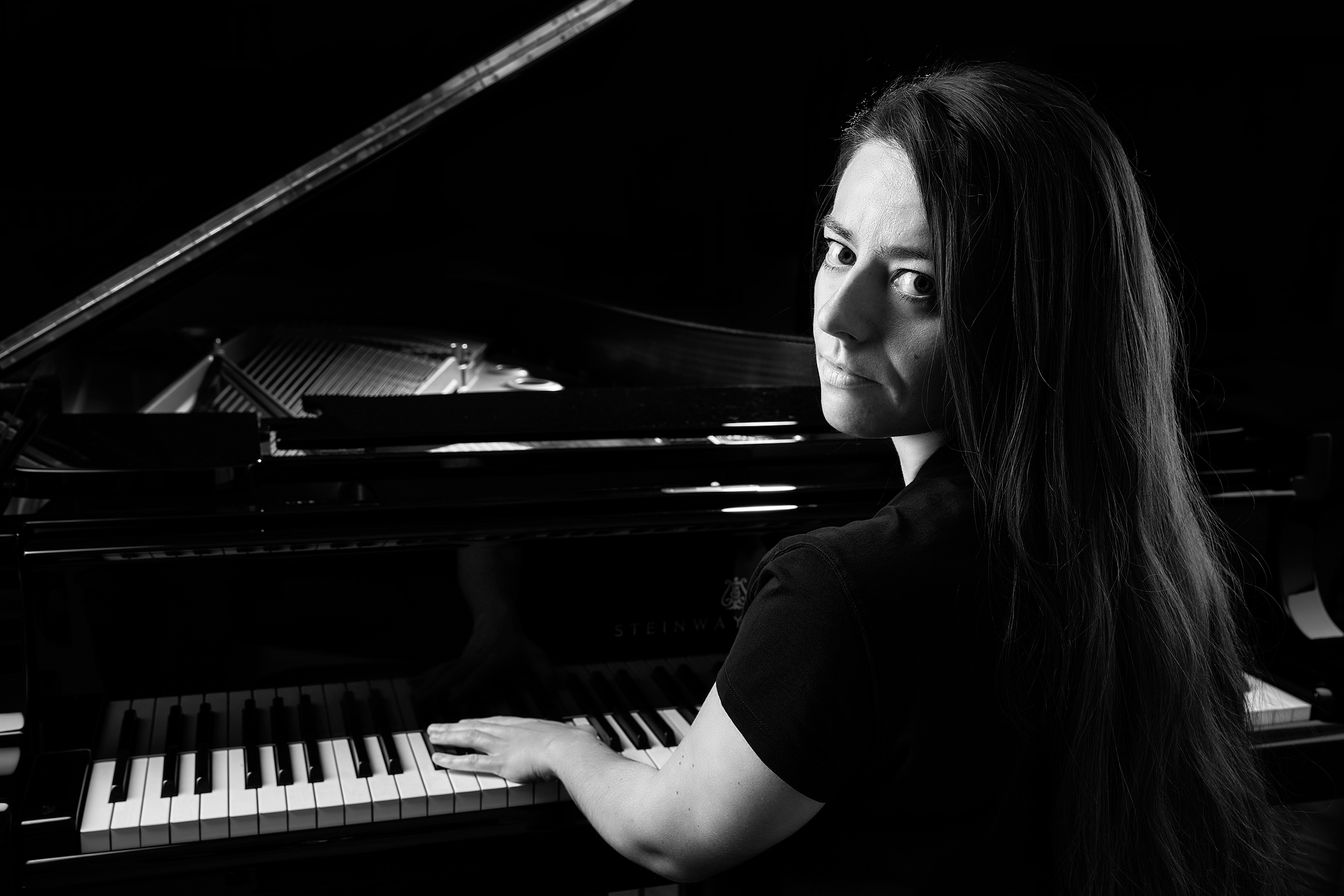
Ocinn is a personal endeavor from an artist based in southern Germany, crafting music since 2007. She creates gloomy piano pieces infused with black metal and classical elements, chasing that same eerie vibe synonymous with black metal, chilling, lingering suspense and that mesmerizing lure from minimalism.
Debut record I landed in 2020, and the latest offering, Nebelgeister, expands the narrative weaving in Germanic folklore and the notion of “fog spirits.” A couple of compositions feature vocals in German, introducing another human dimension while keeping the piano center stage.
“Through Ocinn, I can carry black metal’s cold, icy, melancholic mood into dark piano music.”
When you first started Ocinn as a solo project, what were you trying to capture that you couldn’t get from playing in bands or listening to black metal?
Ocinn has always been about capturing a specific feeling, a certain atmosphere. That’s what fascinates me most about black metal. Through Ocinn, I can carry that cold, icy, melancholic mood into dark piano music.
You describe it as “black metal-influenced dark piano.” What are the parts of black metal you translate into piano, and what do you leave behind on purpose?
It’s mainly the feeling and the atmosphere I wanted to bring into my music. I often work with a very small amount of chords. I love the hypnotic monotony and simplicity that still creates a cold, icy feeling. That’s the core of what I take from black metal.
“I explored many different cultures and how fog appears in mythology.”
When did the first clear image of Nebelgeister show up for you, and what made you commit to that “mist spirits” thread as the spine of the album?
I’ve been researching mythology for a long time, and I don’t focus only on German stories. I look at international ones too. With fog as a theme, I explored many different cultures and how fog appears in mythology. I also went into lyric poetry, literature, and visual art, like Schiller, Hermann Hesse, and Caspar David Friedrich. That’s how I came across the “fog spirits.” My fog spirits are based on stories from southern Germany, shaped by my own interpretation through research. That’s where the concept came from for the album.
What does “fog” mean to you in musical terms on this record, in pacing, dynamics, and how long you let notes hang in the air?
Fog can feel benevolent, but it can also feel eerie and oppressive. That fascinates me. To create a certain emotion or atmosphere, one or two notes can be enough. I’ve experimented with that for a long time. I like it when a single tone dissolves into the space. It creates a very specific mood. When you develop that through dynamics, the atmosphere becomes more intense. One example is “Nebel II.” It begins with a single tone that fades into space. It can feel pleasant, almost like an embrace. But it can also feel threatening and unsettling, depending on what the listener brings into it.
This album is framed as a return to your German roots. Where do you hear that most clearly in the writing, beyond the concept itself?
The “fog spirits” come from German mythology, and I wanted that to point to my German roots. I also have two songs with text, and it was important to use the German language to underline that connection. My last release, the trilogy Songs from the Past, was dedicated to my Italian roots. So it felt clear and important to dedicate the next album to my German roots. That’s how the idea developed.
You brought in voices for two German-language titles. What did vocals let you express that the piano couldn’t carry on its own?
For me, inspiration and creativity don’t only happen through music. Text is a big part of my art too. Lyric poetry and literature matter to me. During my research, I read a lot, and I’ve been writing my own poetry for many years. On my second album, The Forest, I already set one of my poems to music in collaboration with John Never. For Nebelgeister, it simply felt right to write again. On “Im Reich der Nebelgeister,” W.K., the frontman of the Austrian band In Dornen, recorded the spoken part for me. We’ve known each other for a long time, and I’ve contributed to his projects in the past too. The lyrics for “Ich eile ins Nichts” were written by John Never, who is part of the German band Dethroned. At first, I wanted him to sing on “Im Reich der Nebelgeister.” I sent him the first piece from the album, and it inspired him so much that he asked if he could also contribute a text. That’s how this collaboration started for Nebelgeister.
After Nebelgeister was finished, what did it change for you as a writer, and what parts of its atmosphere do you want to carry into the next Ocinn chapter?
Nebelgeister was a big step for me. It helped me grow musically, especially in how I build atmosphere. I can already feel that what I learned during the writing process will be part of the next Ocinn album. I never stand still. I like to challenge myself so I can develop my musical skills.
Right now I’m experimenting with a new project where I play six-string bass. In another project I’m part of, I’ll be playing organ, which is great. Everything I’ve learned through the last Ocinn album, and everything I’m doing now, will feed into the next developments and the upcoming Ocinn albums.
Follow Ocinn on Instagram at ocinn_official.


