

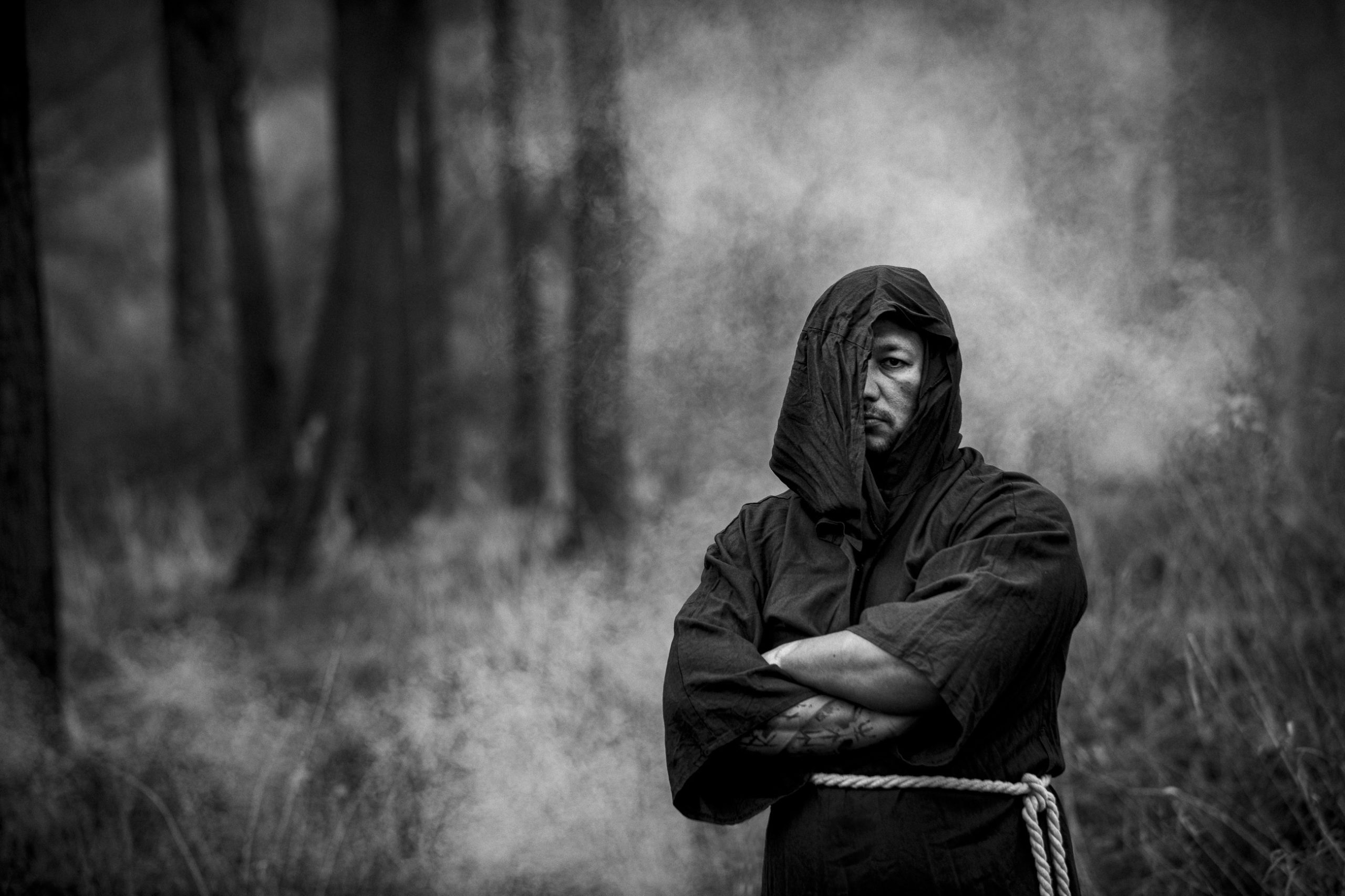
Níu líf Einars hrafns (Nine Lives of Einarr the Rave) began as a story Martin Sigurður Kajzar was writing largely for himself. Based between Ostrava in the Moravian-Silesian Region of Czechia and Ísafjörður in Iceland, Kajzar developed that story over three and a half years into SIGURÐUR’s atmospheric black metal debut album: nine connected chapters following Einarr, a six-year-old boy whose death sends his soul into the body of a raven and through a world shaped by Norse mythology.
The record also brings together several sides of Kajzar’s musical life. His background in musicology, opera and composition feeds directly into the way motifs return and change throughout the album, while Icelandic is treated as part of the musical construction. Guests including Aðalbjörn Tryggvason, BigBoss, Ashok and Veronika Rovná were brought in to inhabit specific parts of that world.
For AFRICA.ROCKS, Martin Sigurður Kajzar talks about creating Einarr, the relationship between language and music, what black metal allows him to do that academic training cannot, and what happened once a project that had lived privately for years finally reached other listeners.
“Norse mythology offers an extraordinarily rich world of characters, symbols and events.”
Einarr is your own character rather than someone taken directly from Norse mythology. What did creating him allow you to say that an existing mythological figure would not have allowed?
Above all, creating Einarr gave me complete freedom to develop my own story. Norse mythology offers an extraordinarily rich world of characters, symbols and events, but each of these figures already carries certain meanings and expectations. If I had decided to tell a story about Óðinn, Fenrir or another established mythological figure, I would inevitably have had to confront their traditional representations.
Einarr, on the other hand, enters this world as someone who does not understand it and gradually discovers its nature. Another important aspect is that Einarr is not a hero in the conventional sense. He is a six-year-old boy whose life ends in a tragic accident and whose soul subsequently enters the body of a raven. He possesses no extraordinary powers, defeats no enemies and has no ambition to rule the world. He simply wants to understand his own fate and find eternal peace.
Yet it is precisely this seemingly simple desire that brings him face to face with fundamental existential questions. Throughout his journey, he encounters various beings from Norse mythology. They offer him different answers, but at the same time expose him to new doubts and uncertainties.
Eventually, he discovers that his liberation depends on the sacrifice of someone he loves. At that moment, the story is no longer merely about death and the afterlife. It becomes a reflection on responsibility, guilt and the price of personal redemption. Does an individual have the right to seek salvation if someone else must pay for it?
The nine lives mentioned in the album’s title should not necessarily be understood as nine separate biographical episodes. I see them rather as different stages of understanding and transformation within a single existence.
Einarr also carries a deeply personal significance for me. Certain experiences are easier to express through fiction than through direct statements. Norse mythology provided me with a symbolic language, but the actual story is entirely my own.
I never intended to write another musical illustration of the Eddas. I wanted to create a story in which ancient myths become a means of exploring questions that remain relevant regardless of the historical period in which we live.
“My long-standing experience with operatic singing undoubtedly played a role here.”
Around a third of the album is sung in Icelandic. How did writing in Icelandic change the way you approached the rhythm, phrasing and vocal delivery of those songs?
Icelandic has a very different sonic character from Czech. What fascinates me is not only its connection to Old Norse literary traditions, but also its phonetic qualities. It has distinctive consonant articulation, strong patterns of stress and a particular way in which syllables combine into larger linguistic units. All of this naturally influences musical phrasing.
When composing, I wanted the language to be an integral part of the music rather than simply a text inserted into an already completed melody. The initial libretto was developed in Iceland, and only afterwards did I begin shaping the melodic and harmonic material of the individual chapters. To a certain extent, therefore, the words themselves influenced the rhythmic construction of the music.
For example, Icelandic generally places stress on the first syllable of a word, which is an important consideration when constructing melodic phrases. In faster black metal passages, one also has to take into account the articulation of certain consonant clusters. Conversely, slower sections offer interesting possibilities for working with vowel length and the overall timbre of the language.
I did not, however, approach the vocal performance with the assumption that Icelandic must automatically sound archaic or ritualistic. What interested me was its natural expressiveness. In some passages, the language reinforces the aggression of the musical phrase; elsewhere, it allows for an almost declamatory style of delivery.
My long-standing experience with operatic singing undoubtedly played a role here. In opera, the relationship between words, musical phrasing and articulation is fundamental. A singer must consider not only which note is being sung, but also which word and meaning that note carries.
At the same time, I had no intention of pretending to be a native Icelandic speaker. I therefore paid particular attention to the linguistic accuracy of the texts and their natural expression.
For me, Icelandic is certainly not an exotic decoration intended to remind the listener of the North. It is the language of a place where I spend a considerable part of my life and where a substantial portion of the album was conceived. Its presence on the record is therefore entirely natural.
“Black metal possesses an extraordinary ability to communicate through immediate energy, rawness and sometimes almost primitive simplicity.”
Your background includes musicology, opera and composition. When you are actually writing black metal, which parts of that training do you consciously use and which parts do you have to forget?
I do not think I could simply switch off my musical education when composing, nor would I consider that desirable. Musical thinking develops over decades, and all these experiences inevitably become interconnected, whether one is writing an operatic aria, arranging a traditional folk song or composing black metal.
I consciously work with harmony, modality, contrapuntal relationships and motivic development. In the case of Níu líf Einars hrafns, the overall dramatic structure was particularly important to me. The individual tracks are not isolated compositions, but chapters of a single narrative. Consequently, certain musical motifs return, undergo transformation and acquire new meanings in different dramatic situations.
In this respect, I feel a particular affinity with the principle of the leitmotif, most famously associated with Richard Wagner, whose music and work have interested me for many years as a musicologist and music historian. This does not mean that I attempt to transfer Wagnerian compositional techniques mechanically into black metal. Rather, I am interested in the underlying idea that a musical motif can carry a specific dramatic meaning.
On the album, for example, I employ the tritone in connection with elements of evil, the Dorian mode in certain more spiritually oriented moments and repetitive structures that occasionally approach a state of trance. I am also interested in shifting tonal centres and modulations, as harmonic instability can effectively reflect a character’s uncertainty.
At the same time, it is essential to know when to put all this knowledge aside.
Black metal possesses an extraordinary ability to communicate through immediate energy, rawness and sometimes almost primitive simplicity. Not every musical idea requires elaborate harmonisation or a complicated formal structure. Sometimes the repetition of a single riff has far greater expressive power than the most sophisticated compositional construction.
The same principle applies to vocals. My classical training provides me with control over breathing, resonance, vocal technique and phrasing. However, the objective in black metal is not necessarily to produce a beautiful, technically balanced sound. Sometimes the music demands a voice that is unpleasant, urgent, broken or almost on the verge of a human scream.
That does not mean abandoning technique. On the contrary, I use it to consciously explore different forms of vocal expression.
There is another point I consider important. I never wanted SIGURÐUR to sound like a project by an opera singer who suddenly decided to experiment with black metal. I have been listening to and playing this music since my youth. I do not regard it as an experiment or an academic curiosity.
Musicology helps me understand why music works. Black metal reminds me that what matters far more is whether the music actually makes us feel something.
The album follows Einarr through nine connected chapters, with musical ideas returning and changing throughout the story. Which motif changed the most between its first appearance and the end of the record, and what was happening to the character when you changed it?
I would particularly emphasise the transformation of the musical idea associated with Einarr’s fate, which also establishes a conceptual connection between the opening Formáli and the concluding Eftirmáli.
At the beginning of the story, we encounter a human being who has no knowledge of what awaits him. Einarr is a child whose curiosity and desire to discover the world eventually lead to tragedy. I therefore perceive the musical material here as the initial form of the narrative, which only acquires its deeper significance as the subsequent chapters unfold.
Throughout the album, Einarr encounters various mythological beings, each with a distinctive musical character. However, I did not want to represent these figures merely through fixed, unchanging motifs. I find it much more interesting when a familiar musical idea appears within a different harmonic environment, rhythmic arrangement or instrumental texture. The listener may recognise something familiar, even though its emotional significance has changed considerably.
From a dramatic perspective, the final part of the story is particularly important to me. Einarr returns to his family and discovers the price that would have to be paid for his liberation. In the chapter Hœnir, the narrative thus moves away from mythological encounters and enters the realm of deeply personal human tragedy.
This is followed by Ragnarök, which fundamentally changes the perspective of the entire narrative. Death, which Einarr has been struggling to understand and overcome, suddenly acquires a different meaning. The destruction of the old world does not necessarily represent absolute annihilation. It may also suggest the possibility of a new beginning.
For this reason, I wanted the musical relationship between the beginning and the end of the album to remain perceptible without turning the conclusion into a simple repetition of the opening material. What matters is not merely the return of a motif, but everything that its bearer has experienced in the meantime.
For me, that is precisely the deeper purpose of working with leitmotifs. Music can retain a memory of something that neither the character nor the listener perceives in quite the same way anymore.
Aðalbjörn Tryggvason, BigBoss, Ashok and Veronika Rovná all appear on the album. What did you write specifically for their voices or playing that you could not have achieved by performing those parts yourself?
First of all, I would like to emphasise that the album was never conceived as an opportunity to assemble as many well-known guest musicians as possible. I developed the story and the musical concept of the individual chapters first. Only afterwards did I consider whether certain characters might acquire an even more convincing identity through particular performers.
Aðalbjörn Tryggvason of Sólstafir portrays Fenrir. I have always been fascinated by his ability to sound raw, urgent and extraordinarily emotional at the same time. To me, Fenrir is not simply a monster intended to frighten the listener. He is a mythological being with his own strength, destiny and a certain tragic dimension.
Addi’s voice can combine aggression with remarkable human vulnerability. That kind of expression cannot simply be imitated.
We also share a personal connection to Iceland’s Westfjords, where he comes from. We regularly meet in Iceland, so his participation has a significance for me that goes beyond the purely musical dimension.
Jiří “BigBoss” Valter of Root portrays Miðgarðsormr. In his case, I knew from the very beginning that I needed precisely this voice. BigBoss possesses an unmistakable vocal timbre and an extraordinary ability to give even a simple phrase an almost ceremonial authority. His deep delivery creates the impression of a being existing outside human time, whose words carry an entirely different weight from those of an ordinary person.
We have also known each other for many years. Around twenty years ago, I participated in a Root recording, and we also performed together. Our collaboration on this album was therefore, in a sense, a return to an earlier musical relationship.
Marek “Ashok” Šmerda contributed the opening guitar solo to Kólga. In this case, the purpose was not to introduce another character, but to bring a particular instrumental personality into the composition.
Ashok is an exceptionally accomplished guitarist, but what I appreciate even more is his ability to understand the character of a musical phrase. I was not looking for a display of technical virtuosity. I needed a melodic introduction that would establish a particular atmosphere and naturally prepare the listener for the subsequent vocal section. His phrasing and melodic sensitivity gave the passage an individuality that my own interpretation would not have achieved.
Finally, Veronika Rovná, a soprano at the National Theatre in Prague, portrays Kólga herself. Her contribution is particularly important from a dramatic perspective. I did not want to add a female operatic voice merely as a contrast to the black metal vocals. I needed a genuine character.
Veronika is an excellent singer with considerable dramatic experience. She can express the personality of a character through her voice rather than simply perform the written notes correctly. We have known each other since our student years and have worked together on several operatic projects, so I knew very well what her interpretation could bring to the recording.
Ultimately, what matters most to me is that none of these musicians appears as an additional attraction inserted into the album. Each of them has a carefully defined place and a specific dramatic function.
Of course, I could have recorded all the parts myself. But there is a fundamental difference between being technically capable of performing something and allowing the music to acquire the unmistakable personality of another musician.
You spent around three and a half years making Níu líf Einars hrafns. Now that other people can finally hear it and interpret the story for themselves, has anything in the response surprised you or changed the way you see the album?
I have certainly been surprised by how quickly the album began finding listeners in different parts of the world. When I was sitting in Iceland a few years ago, writing the first lyrics and musical ideas, I was not thinking about whether someone would eventually listen to this music in Australia, America or elsewhere.
It was primarily a very personal project, developed alongside my regular professional responsibilities. I direct a large music and arts school, pursue academic work and remain involved in various other musical activities. Consequently, I often worked on the album late in the evenings, at night or during the time I spent in Iceland.
After three and a half years, one develops a rather peculiar relationship with one’s own recording. You know every detail, every harmonic change, every vocal layer and the circumstances in which each composition was created. At the same time, however, you gradually lose the ability to listen to it with complete objectivity.
That began to change when the album finally reached its listeners.
What pleased me enormously was that some reviews went beyond the usual observations about sound, atmosphere or individual performances. Several reviewers genuinely recognised the motivic development, compositional structure, changes in vocal expression and relationships between the music and the narrative. Some even identified connections that I had consciously incorporated during the compositional process without previously explaining them publicly.
For me, as a composer, this is an exceptionally valuable experience. It means that music can communicate through its own internal structure, even without an accompanying explanation.
I was also surprised by the reactions of certain musicians whose work I have respected for many years. For example, Blackie of Master’s Hammer and Nifelheim, as well as René Wagner of Nargaroth, expressed very positive opinions about the recording. Such personal reactions mean a great deal to me because they come from musicians whose work I have known and listened to for a considerable part of my life.
It is equally interesting that different listeners respond to very different aspects of the album. Some appreciate the raw black metal passages above all, while others are attracted by the melodies, atmosphere, vocal performances or the narrative itself. This makes me happy because I never intended to create a stylistically uniform record.
Has the response changed my perception of the album? Naturally, I cannot change the music itself anymore, nor would I want to. But I am gradually realising that a story which carried a very specific personal significance for me can evoke completely different associations and emotions in other people.
And I believe that is exactly how it should be. A work of art should not remain confined to the imagination of its creator.
At the same time, this experience has reinforced my conviction that it makes sense to continue following my own artistic direction, regardless of genre expectations. I have already written the material for the second album, Huldufólk, and I certainly have no intention of merely repeating what worked on the debut.
Níu líf Einars hrafns will always remain an intensely personal recording for me. But after three and a half years of existing almost exclusively in my mind and in the studio, it has finally begun to take on a life of its own.


