

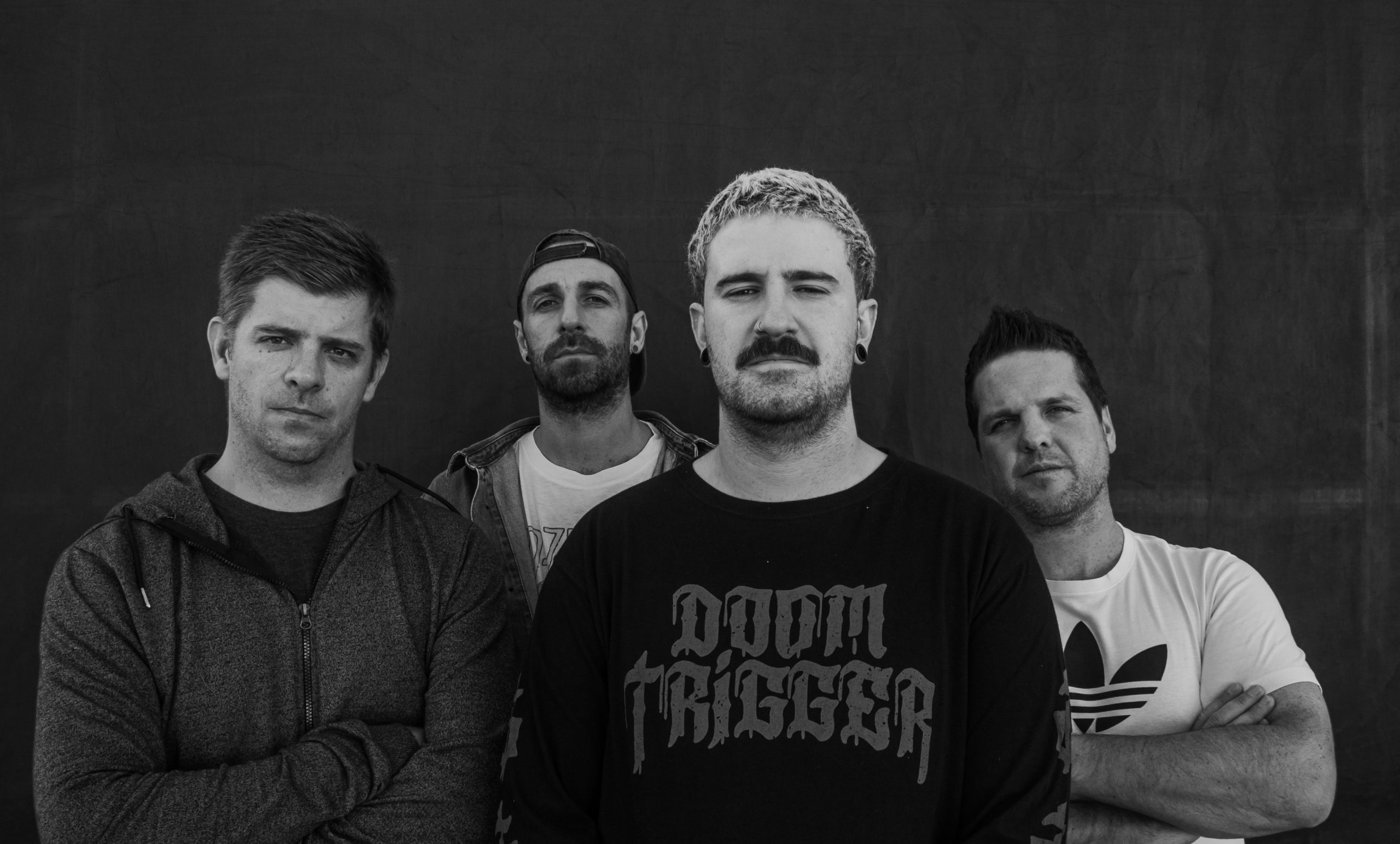
Doomtrigger have spent the last few years turning a lockdown-born studio project into a fully collaborative band, while steadily pushing their sound into heavier territory. At the centre of that evolution is Circles, an ambitious trilogy built around Dante’s Inferno and the uncomfortable ways its themes still echo through modern life.
For the Stellenbosch four-piece, the concept has become a way to explore both the darker side of their music and the chemistry that has developed between them as writers and performers. At the same time, constant touring has pulled them deeper into a South African metal scene they see as increasingly connected across cities, promoters and DIY communities.
AFRICA.ROCKS spoke with Jason Smith, Ken Loubser, Robbie Blair and Etienne Nel about the ideas behind Circles: Part II, the band’s evolution, the scene around them and what comes after the trilogy reaches its end.
“Splitting this into three separate releases has given us the time to put a lot of thought and effort into every song to make sure we deliver our best.”
Circles is planned as a trilogy inspired by Dante’s Inferno. When did you realise the idea was big enough to carry three separate releases, and what did that format allow you to do with the music?
Ken Loubser: The initial concept was tabled by our frontman, Jason. We really liked the idea because of the depth of the material and its relevance to modern-day life. There are so many aspects of this literature that are visible around us every day, which makes it highly relatable.
Musically, we also try our best to sonically convey the atmosphere and intensity of each circle to match the already vivid lyrical content. Splitting this into three separate releases has given us the time to put a lot of thought and effort into every song to make sure we deliver our best, while maintaining enough audience attention and momentum to build anticipation for the next chapter.
Circles: Part II deals with greed, anger and heresy. Which of those subjects gave you the most to work with when you started connecting Dante’s world with life now?
Jason Smith: Literally all three. Again, there is so much depth to this literature, and it is so highly relevant to life today. We see all of these themes around us every day.
And not only these three subjects. The content and subject matter contained in all nine circles of Hell are highly relevant and relatable, which is why we knew this concept could carry us for a good stretch of time.
‘Hoarders & Spenders’ and ‘False Teachers’ work as a prelude and interlude around the main songs. What role do those shorter pieces play in the story of the EP?
Ken Loubser: These shorter pieces serve as segues into the next circle of Hell, and their names allude to what Dante, or the listener, will find in the next circle.
‘Hoarders & Spenders’ alludes to the overall theme and content of Greed, while ‘False Teachers’ refers to the false teachers and heretics found in the sixth circle of Hell, Heresy. For the listener, they also serve as a calmer build-up to the next heavy plunge.
Doomtrigger began as Ken’s studio project during lockdown and gradually became a four-piece band. At what point did it stop feeling like one person’s material and start feeling like something the four of you owned together?
Robbie Blair: It started coming together a little more with our second EP, Dark Continuum. But I would say we really started getting into a cohesive rhythm with the Circles trilogy.
There has been a lot more co-writing and producing, with each member truly adding their special touch to the overall sound. This has also allowed us to develop our sound into something really distinct.
“we would not have been able to build a name for ourselves if we had not gone all out and played live as much as we have.”
You have built much of the band around Stellenbosch and the wider Cape scene, playing regularly at venues such as Aandklas. What has that local circuit given Doomtrigger that you could not have developed through recording alone?
Etienne Nel: Honestly, we would not have been able to build a name for ourselves if we had not gone all out and played live as much as we have, especially in the first two or three years.
We also knew playing our local circuit wasn’t enough to build our band to where we wanted to be. We’ve made a point of touring nationally as much as possible and have played in most major South African cities, including Johannesburg, Pretoria, Durban and Gqeberha (PE).
This has allowed us to build a fan base outside our own province and hometown. The scene has been so incredible and supportive, and we’ve really appreciated the response to our music and shows.
South African heavy music can involve bands travelling considerable distances between scenes in Cape Town, Johannesburg, Pretoria and Durban. How connected does the national metal scene actually feel from your position in Stellenbosch?
Ken Loubser: The national metal scene feels more connected than ever. Bands are supporting each other, repping each other and building each other up. And there is a genuine appreciation and respect for one another’s craft.
Beyond the bands, there are also a handful of promoters and venue owners like Tim Moolman, Conrad Jamneck, Sashquita Northey, Patrick Davidson, Jaques Olivier and Robert Pereira, etc., who are helping drive this connectedness by supporting national and African metal, putting together regular, high-quality shows, booking and flying in bands from other provinces and neighbouring countries, booking international acts and giving local bands the opportunity to play alongside them, and really punting South African and African metal locally and globally.
Not to mention local DIY crews like Breakneck Bookings, Cape Town Metal Realm, Devilnest, Emalyth, etc., who are really driving this connectedness from the ground up.
Dante wrote Inferno more than seven centuries ago. What have you found in it that still feels recognisable today, and was there anything in the text that changed the way you understood the story before starting Circles?
Jason Smith: Like we’ve said before, there is just so much depth to this literature, and it is so highly relevant to life today. The world is a pretty dark place at times, and many, if not all, of these themes in Circles are identifiable in the world, with many of them often being the root causes of the issues and evils we see around us.
It has actually enhanced the way we understand the literature and its origins because its themes are so highly relatable.
“We wanted to push ourselves and see how brutal we can go, and we’ve loved it.”
How has the balance between the heavier parts of your sound and the more melodic side changed since you started working on the Circles material?
Etienne Nel: We’ve definitely gone heavier on the Circles material. It was necessary, given the punishing themes and content of the literature it’s based on. We wanted to push ourselves and see how brutal we can go, and we’ve loved it.
So there has definitely been an evolution towards a heavier sound while still maintaining a melodic essence. We won’t ever lose that melodic essence, since melody and groove are very important to us. But we’ve definitely enjoyed the heavier stuff.
Once Circles: Part III is finished, you will have spent several years inside one large concept. Do you already have an idea of what Doomtrigger should sound or write about once that story is complete?
Robbie Blair: Believe it or not, we already have our next concept locked in. So we know exactly where we’re going next.
As much as we’ve enjoyed working on the Circles trilogy, we’re excited to wrap it up and start working on the next project. But we won’t rush it. Since Circles: Part III will serve as the finale to the trilogy, we want it to be the best it can possibly be.
We’ve been working hard on the final pieces, and we can’t wait to give you the epic conclusion.
Listen to Circles: Part II now on all major streaming platforms.


