


If you know Canada’s Obvurt, you’re already familiar with the level of precision Philippe Drouin chases. Technical death metal does not leave room for weak hands or half-finished ideas. Then his playing got ripped out from under him.
In 2016, Drouin was in a car accident and ended up unable to pick the way he had for years, so he had to rebuild his entire playing from the ground up. He restrung, switched, practiced obsessively, and taught himself how to play left-handed.
Now he’s putting that story on record in two parallel forms. One comes under Philippe Drouin Obvurt, with Le Chemin du Gaucher landing as a personal statement from a guitarist who had to re-earn every movement. The other comes as Obvurt’s An Alternate Dimension, where the writing leans into the broader project identity while still carrying the same fingerprints, the same discipline, and the same stubborn need to push forward.
“I decided to persevere, try, and ask Michael Angelo Batio for guitar lessons.”
“After the car accident back in 2016, I tried to play right-handed a lot, but I was unable to pick,” he explains. “I bought a left-handed guitar and I started to pick with my left hand. It felt weird and weak, but I wasn’t able to play right-handed, so I decided to persevere, try, and ask Michael Angelo Batio for guitar lessons. I don’t even think becoming 100% left-handed is possible, but I’ll give my best to be the best lefty player I can be.”
When people ask what the switch forced him to “unlearn,” Drouin doesn’t play along with the usual phrasing. In his head, the technique never left. The body simply stopped obeying it on one side, and he had to rebuild the same language on the other.
“I haven’t unlearned anything. I just learned it again on the lefty side,” he says. “I know how to play right-handed, but my wrist doesn’t want to listen to my brain, and the osteophyte on my right wrist is still there. I learned the exact same technique on both sides.”
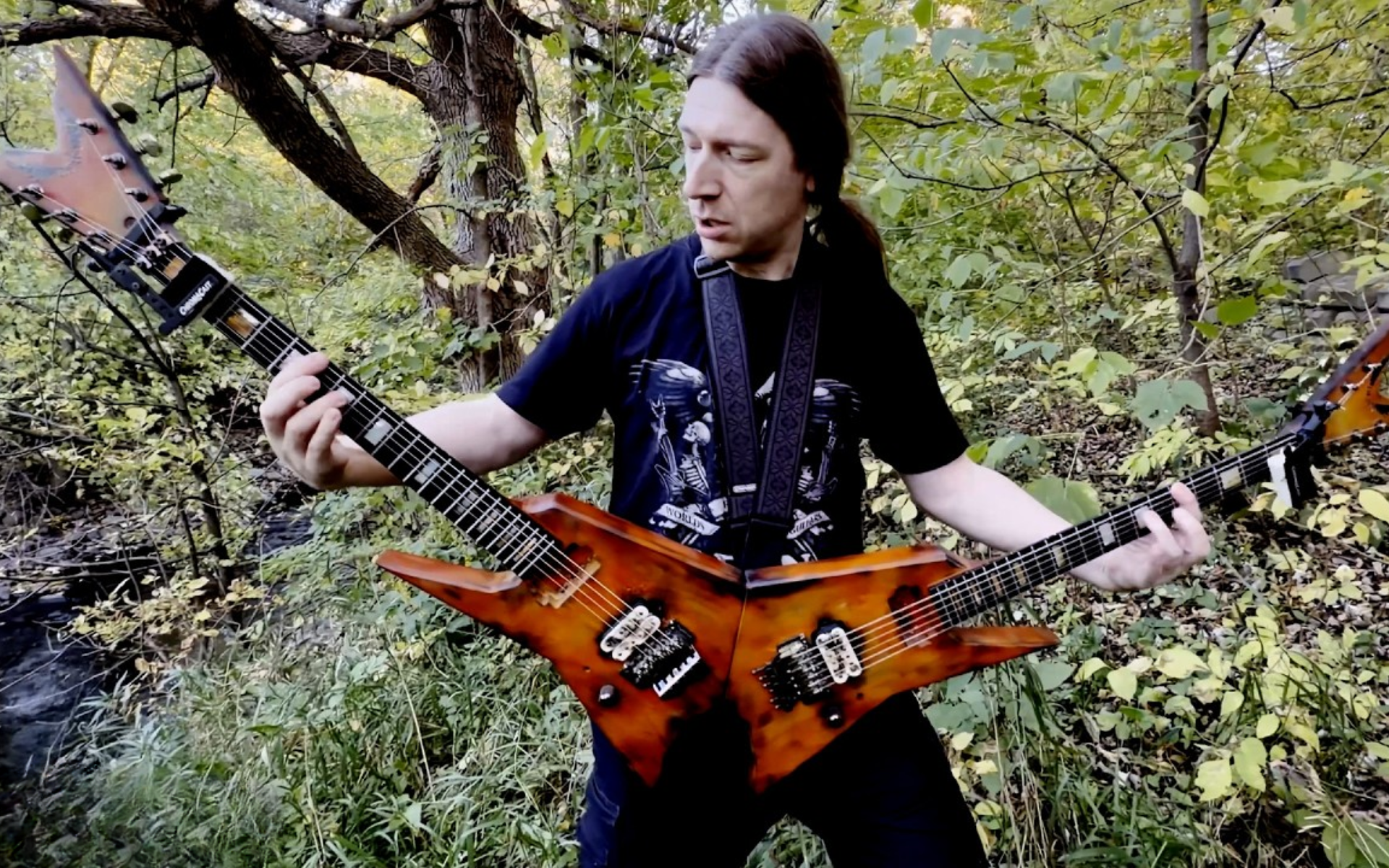
That doesn’t mean the story ends at “left-handed now.” The recovery pushed him into another instrument problem to solve, and he leans into it with the same stubborn curiosity: the double-guitar.
“The double-guitar is the new thing for me,” he adds. “My left hand on the fretboard is still playing at full speed. I’m learning to play lefty so my right hand is starting to play well on the fretboard. I bought a first limited edition double-guitar and I learned how to play it.”
“It’s a double-guitar album with blast beats, a Gojira medley, and a Bach piece.”
Le Chemin du Gaucher says exactly what it is: “The Left-Handed Path.” No metaphor needed. “This is my latest work,” he says. “It was released January 16th, 2026. It’s a double-guitar album with blast beats, a Gojira medley, and a Bach piece.”
The other release carries the full band name and the wider project identity: Obvurt’s An Alternate Dimension. It’s still Drouin’s fingerprints all over it, but the point here is progression: a new tool, a new writing approach, a new set of constraints to test himself against. “The addition of the double-guitar,” he says, when asked what he was chasing this time. “The song ‘Patience’ was supposed to be on Le Chemin du Gaucher and landed on An Alternate Dimension. This is the first song I ever wrote on the double. There are five songs played on the double and four on the lefty.”
“I had pain recording the riffs!”
The workday doesn’t look glamorous on his end. It’s not a “when inspiration strikes” routine. It’s the same unglamorous building blocks, repeated until they stop feeling foreign: “I try to get into everything when I have the time,” he explains. “Scales, arpeggios, techniques, riffs on the metronome. Adding the double-guitar to the routine. I write new riffs, learn classical music pieces, or jam my songs.”
That last line is where you hear the real shape of it. The rebuild is about expanding the instrument vocabulary while he’s already in the middle of re-learning the basics. That’s also why the double-guitar keeps coming up as more than a novelty as it has changed how he writes: “Because of the double-guitar, it forces me to write and think differently,” he says. “In fact, there is no pick playing the double, so there are no – or only a small amount of – repeated notes.”
And this is where the “inspiring story” framing starts to annoy him. Not because he’s ungrateful, but because it flattens the actual work. People hear “accident,” “left-handed,” “rebuild,” and they treat the music as a victory lap. He keeps pulling it back to the thing that matters: the sound, and the cost of getting it onto tape: “The music, the lyrics, the feelings and emotions,” he says, when asked what people miss. “I had pain recording the riffs!”
When asked if he’s come across any African bands lately that made him stop and pay attention, he doesn’t pretend. “Not yet,” he admits. “But I am curious about discovering them.”
That curiosity is the right place to end this part of the story, because the point of these Supporter Interviews isn’t to drag AFRICA.ROCKS away from Africa. It’s to pull more people into it. If someone comes for Drouin’s rebuild and stays to dig into bands they’ve never heard before, the platform does what it was built to do.
Follow Obvurt:
Facebook: https://www.facebook.com/Obvurt
Instagram: https://www.instagram.com/obvurt/
Bandcamp: https://obvurt.bandcamp.com
Follow Philippe Drouin Obvurt:
Facebook: https://www.facebook.com/Philipedrouin
Instagram: https://www.instagram.com/philippedrouin_obvurt/
Bandcamp: https://philippedrouinobvurt.bandcamp.com


