


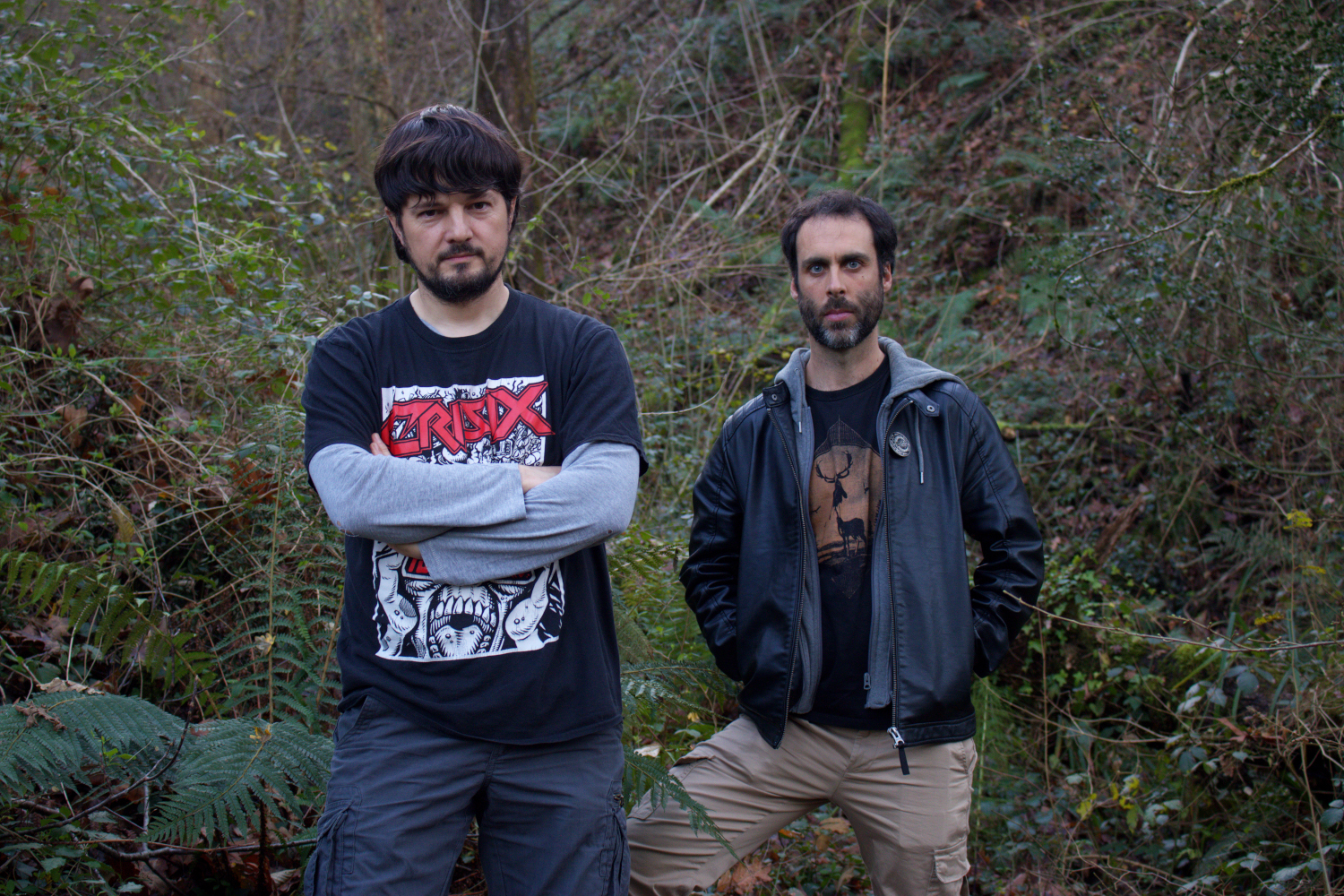
Aschen are a duo from the Basque Country, and The Never Ending Search grows out of a very personal frame of mind. The album moves between English and Basque, but its core is not about language alone. These songs deal with inner conflict, collapse and the attempt to make sense of things when nothing feels settled.
The artwork brings the album’s core idea into focus. A labyrinth shaped like a fingerprint suits a record concerned with self-exploration and with the difficult, unfinished nature of searching for answers.
The Never Ending Search is a title that says a lot about the world of this record. When did that idea become the real centre of the album for you?
Mikel Telletxea: It was not planned from the beginning. Writing the lyrics was easily the most difficult part for me, because I usually do not pay much attention to lyrics when I listen to music. I do have certain limits regarding content that would make me stop listening to a band, but otherwise I prefer the music to speak for itself.
To find inspiration, I tried to focus on what each part of the song suggested emotionally. From there, and probably because the songs follow a more progressive structure instead of repeating the same parts, I started to imagine a kind of narrative.
Once all the lyrics were finished, I realised they all pointed, in one way or another, to a personal search. A search to leave suffering behind, or to find some kind of answer in a world and a society that feel like they are decaying. In the end, I focused on things that affect me, but also everyone else.
“Black metal is often very tied to its place of origin, so using Basque also gives the band a more distinct identity.”
You write in English and also in Basque, which gives the songs a deeper personal and ancestral pull. What does Basque let you say, or feel, that would not come through in quite the same way in English?
For someone with little experience in writing, using a foreign language like English has been a big challenge. Some songs naturally asked for one language or the other. Writing in Basque, which is one of my mother tongues, felt much easier. Everything came more fluently, and I could pay closer attention to rhyme, meaning, and how the words sound.
Black metal is often very tied to its place of origin, so using Basque also gives the band a more distinct identity. On a more personal level, I am not a very outgoing person, and using a language that many people do not understand gives me a certain sense of protection. That might not be the case if I wrote in Spanish.
A lot of black metal still leans on familiar themes, but your lyrics go inward, towards conflict, collapse and the damage people carry inside themselves. What pushed you in that direction?
As I said before, I tried to put into words what the music was already suggesting. Many of the compositions carry a strong emotional weight.
I think people often try to move forward in life without dealing with their internal conflicts. That leads to repeating the same mistakes over and over again, and getting stuck in cycles that never end. It affects not only the individual, but also the wider world.
Even if the impact of a small band’s lyrics is very limited, I believe they can still mean something to someone who reads them. For me, it felt more important to address these issues than to focus on more escapist themes, even if those might be more expected in black metal.
“I started working with labyrinths, which bring in the idea of difficulty.”
The cover image ties the search for meaning to something deeply human and physical, with the labyrinth shaped like fingerprints. At what point did that image arrive, and how closely did it match what you felt the album was already saying?
The first idea I had was a journey or a path. After a few attempts, I started working with labyrinths, which bring in the idea of difficulty, of going back and forth. At some point I experimented with other natural shapes, like tree rings, and eventually fingerprints. Combining the labyrinth with fingerprints, which are a symbol of individuality, felt right. It matched the focus of the lyrics on self-exploration.
Songs like “From the Depths of Decay”, “Black Hounds of Justice” and “The Last Glow” suggest a world that is falling apart, though the album does not feel hopeless for the sake of it. When you were writing these songs, how did you find the right balance between darkness and clarity?
That balance was intentional. I wanted the songs to feel dynamic and to cover a wide range of emotions, from rage and melancholy to calm and strength. The guitar work plays a big part in that, but I also composed with the drums in mind. I focused on changes and on using different rhythms. In some black metal, fast guitar parts automatically lead to blast beats, no matter what the riffs are doing, and that can make songs feel flat.
I had that same tendency at times, but I decided to use blast beats only when they really added something to the more aggressive sections. For the rest, I looked for other rhythmic ideas that would keep the songs varied and make the album more engaging to listen to from start to finish.
Aschen is a duo, with you handling guitars, vocals and programming and Atauzz on bass. When the band is built from that kind of tight core, what keeps the music feeling open instead of boxed in?
By the time Atauzz joined, both the music and the lyrics were already written. Since he has other bands where he is the main composer, he approached his role here very naturally.
He had full freedom to rework the bass parts for the four songs that were also on the demo. Most of the time, his first ideas already worked. In a few cases, I asked for small adjustments. Overall, we understood each other well.
For the production, neither of us had a fixed idea. He trusted me, and I trusted Iñigo Irazoki at Atala Studios. In the end, both of us are very satisfied with how the album sounds.
You can stream The Never Ending Search on Bandcamp.


