


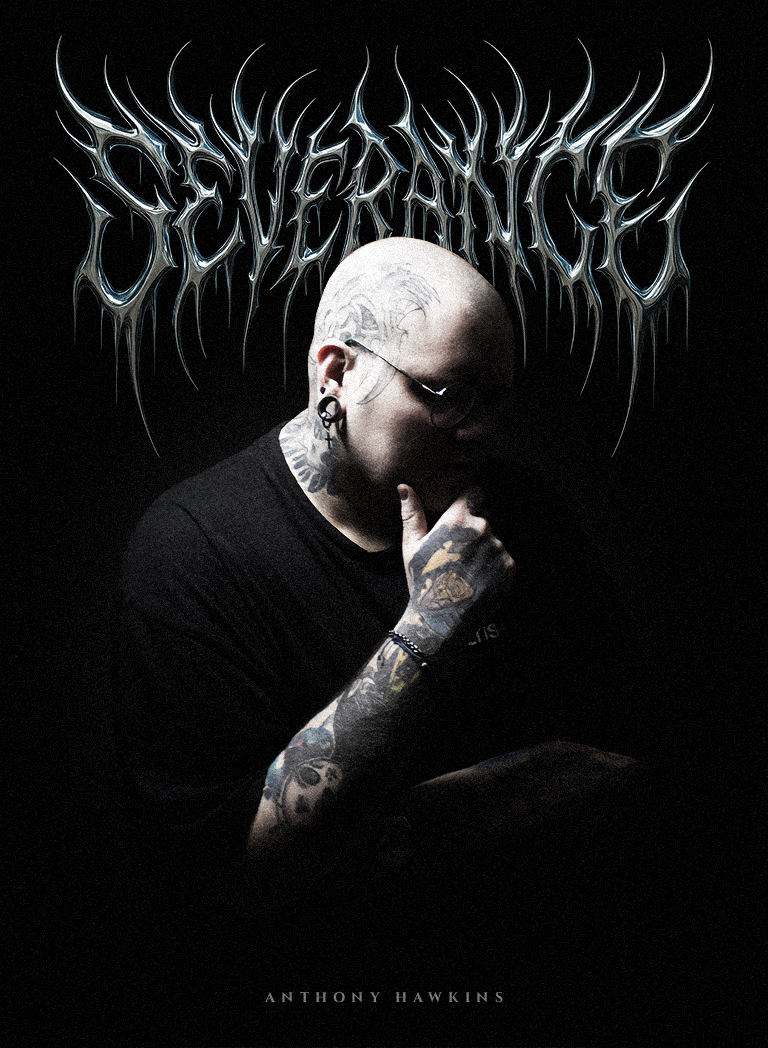
Severance is a Cape Town deathcore project built by Anthony Hawkins in stolen hours. Two jobs in the background, a month spent shaping one track, and a clear hunger to push past what he hears around him.
“The End of Impediment” is the first release, and Hawkins knows what that means. He says it’s been landing well internationally, while he’s still waiting to see how far it travels at home. The single features Sino of GOATBOi, a link that started with a DM and turned into a collaboration Hawkins still sounds genuinely proud of. The release runs under his self-built platform, Osmium Sonics, where he’s trying to keep full control of sound and visuals while building something bigger around it.
“I’ve had people tell me I’ve made my own genre of deathcore.”
Congratulations on “The End of Impediment.” Since it may be the track most people hear first, what did you want that first impression to get right straight away?
Anthony Hawkins: Thank you. It’s been doing incredibly well internationally, but I’m not sure how much of the local scene has heard it yet. The first impression I wanted was: “This is fresh as hell.” I wanted people to see that when you want something badly enough, and you believe in it fully, you can push out something that feels different. I’ve had people tell me I’ve made my own genre of deathcore, which is interesting. So yeah, I wanted to blow people away, especially locally.
I wanted to show that you don’t have to stay inside strict genre boundaries. The scene is heavily pushing hardcore right now, and there’s a doom wave coming through too. I’ve experimented with both before, and with a lot of genres outside metal as well. That’s why I can mash things together, bring hip hop into it, and add cinematic elements.
“That track will only drop once the featured vocalist sends me his videos. He knows who he is.”
When did this song start, and what was the first piece that locked it in?
I wrote this song last year, and it took me over a month. I was juggling two jobs, and every bit of free time I had went into the track. Most Severance songs take a while. This wasn’t even the first one I wrote. The first track is still unreleased, and it might be my weakest, or maybe it just needs a remaster and some changes. The featured vocalist took up a lot of space on that one, so I need to expand the arrangement and give myself room to do my vocals properly. It’s tiring, but I’m always keen to build things out. That track will only drop once the featured vocalist sends me his videos. He knows who he is.
Your bio leans into the “hybrid / cinematic” side. What does that mean in practical terms when you’re writing, arranging, and mixing?
I call it hybrid cinematic deathcore because I’m serious about merging genres to get the best end result. I work from feeling, not from stacking random ideas and hoping they stick. Even when a song sounds chaotic on the surface, every part is placed on purpose. I usually start with the organic elements: guitars, bass, drums. I need the core energy and emotion to feel right first. After that, I move into the cinematic side with pads, choirs, drones, and sound design. I mostly use Serum for that, and it’s a headache, but it’s worth it. Then I build space into the song on purpose. Sometimes that’s silence, sometimes a pause, sometimes something restrained like piano, cello, or violin. Those moments give the listener a breather so the heavy sections hit harder when they return.
Everything I write is guided by how I think it’ll land emotionally. I’m always asking what a section is going to do to the listener. Will a bass hit feel massive? Will a pause or a scratch before a drop give that stank-face moment? If it excites me, I trust it’ll excite other people too. Mastering is the final emotional glue for me, not just “make it loud.” I’m chasing balance, impact, and translation. I want the low end to hit without swallowing the mix, and I want the track to stay clear on small speakers while still feeling huge on proper systems.
“I want that feeling of, ‘What’s next?!'”
Talk me through the structure of the track. It reminds me a lot of IGORRR and I’m so addicted to it!
Thank you, I’ll take that comparison any day. I’ve heard people bring up Igorrr before, and that’s a serious compliment, because Igorrr is its own thing.
Structure-wise, it’s less random than it probably sounds. I don’t write in a traditional verse-chorus way. I think of it as a sequence of scenes that flow into each other. I start with a central mood, then let the track evolve around it. Every section has a job. It builds tension, flips the mood, or releases it. When something feels abrupt, it’s usually because I want that whiplash effect where your brain needs a second to catch up before the next idea lands.
Even when styles shift, I tie things together through rhythm, tone, or recurring motifs so it still feels cohesive. I also use short breaks and softer moments as palate cleansers. When the heavy parts come back, they hit harder. I want the listener locked in and slightly off-balance the whole way through. I want that feeling of, “What’s next?!”
“I want to bring the South African scene up with me.”
Tell me about the feature from Sino of GOATBOi. How did that link happen, and what did you ask him for before he recorded?
It started with me messaging him on Instagram. I asked if I could tour on that side with my trap metal project, because I heard they were looking for artists like that. He listened to my trap metal, liked it, and invited me to come up and play shows with him and a few other bands in Joburg. Around that time, I was already building Severance and looking for local artists to feature. Severance is my project, but I don’t want it to be a “me only” thing in terms of who gets the spotlight. I want to bring the South African scene up with me. Everyone deserves a shot, and for the first album I want to give people that chance on big instrumentals. I’m still on every track, because I’m the main member behind the project.
Sino and I clicked quickly. I gave him a short list of tracks, he chose the one he wanted, and he got his vocals and videos back to me faster than anyone else. I recorded my vocals while I was sick. I had laryngitis. Not ideal, but I wasn’t going to delay everything. I originally wanted the song out at Christmas, but I moved it to the new year. I wanted to start the year with something that feels fresh in the scene, and outside of it too.
We’re close friends now. I respect him and his band a lot, and his performance blew me away. I didn’t micromanage him. I told him to do his thing, go all in, and bring something unexpected. He delivered more than I expected.
You put out an official vocal playthrough with the release. Why lead with that format, and what do you think it shows that a standard video doesn’t?
The vocal playthrough was pre-recorded and we lip-synced to the final track, but the point was to put a face to the vocals instead of dropping a visualiser. It gives people something human to connect to straight away. You get presence and performance, even without a live take. It also works well for short-form content, because people react faster when they can see a person performing. It felt like a strong way to introduce the track before I go deeper into concepts and full visuals later.
The next song has a proper music video, because it’s with an up-and-coming Cape Town band, Aliens in Oceans, and they live around the corner from me. For features from Joburg, Durban, and elsewhere, I’ll probably stick to pre-recorded performance videos more often. If someone doesn’t want to be on camera, then I’ll go the visualiser route. Visualisers don’t always do justice to a first release.
“I’m chasing uniqueness. I feel like things have stalled creatively, and I want movement.”
You’re coming from Cape Town. What does it look like to build something like Severance there in 2026?
I’m chasing uniqueness. It’s hard to talk about this without sounding like I’m taking shots, because that’s not what I’m doing. I’m down to earth, and I still support local bands and my friends. From my perspective, I’ve watched the same cycles repeat in Cape Town for a long time. The scene is dominated by hardcore right now, and a lot of what used to give it an edge has faded. Breakdowns barely exist here anymore. Deathcore and slam are almost non-existent. Black metal has fallen off. Metalcore has dipped too. Doom is rising, and I don’t have an issue with that, it’s just another shift.
There’s also a very specific South African metal sound that’s become common. That’s not a knock on anyone’s talent. It’s just not my personal preference. I feel like things have stalled creatively, and I want movement. South Africa has the talent to do something that competes internationally, and that’s what I’m trying to be part of. I want to push the scene forward, across the country, not just Cape Town.
This single is out through Osmium Sonics PTY LTD. What’s the setup behind the release?
Osmium Sonics is a self-run art and sound house I’m building alongside the music. It’s the wider platform behind everything I do. Severance sits under that because it gives me full control over sound, visuals, and direction. Right now, it’s independent with digital distribution. I’m spending my own cash to get the song heard. I’ll be running Google ads soon, and I’ve been in contact with big reaction channels, promo channels, and Spotify playlist curators. I’ve also noticed that when someone really likes the track, they share it hard, so the momentum starts to build on its own. Still, I had to put in work for this first release.
I co-own Osmium Sonics with a close friend, PJ Silavwe. He puts out huge mixes. He’s stronger than me on mixing, mastering, and sound design, but he has no direct role in Severance. I do ask him for help sometimes when I’m swamped, like mixing vocals. We want to work with bands locally and internationally, helping them get a refined, international-level sound, and a solid visual identity. Logos, artwork, branding, the full picture. A lot of scenes have talent, but they don’t always have resources or guidance. That’s the gap we want to help close. There’s also an Osmium Sonics website in the works to bring everything together and make it easier for artists to understand what we do.
What’s next and how soon?
Next up is “Mirrors of a Broken Reality” featuring Ross Sinclaire of Aliens in Oceans. The track is about psychosis. It’s getting a full music video. It’s heavier than the first track. There are no clean vocals. It leans deeper into deathcore, and it’s a fun one. It’s dropping in February. I don’t have the exact date yet, because I’m releasing it through BVTV this time, not Slam Worldwide. It’s a banger, I promise.
Follow Severance on Instagram at @severance.ig


