


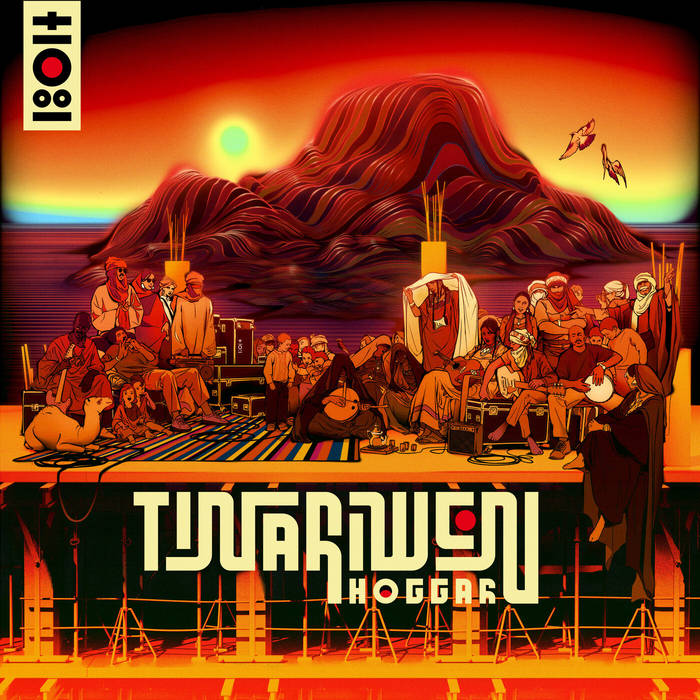
One of the most interesting African bands, with a distinct history, Tinariwen has released a new album, Hoggar. Singing about friendship, connection, and hope for a better tomorrow, the band is made up of Tuaregs, children of a nomadic Berber tribe that has roamed the Saharan desert for thousands of years. However, because of colonialism, the ancestral territory of the Tuaregs has, over the past centuries, been split across Mali, Algeria, Niger, and Libya. As a result of these borders, the Tuareg have become known as ishumar, a term used to describe displaced people searching for a homeland that has been lost to them.
Their sound can be traced back to the late 1970s and to their founding father, Ibrahim Ag Alhabib. As the son of a Tuareg rebel, he witnessed the execution of his father at the hands of the Malian government. He went on to build his own guitar out of a tin can, a stick, and a bicycle brake wire, and taught himself to play. While drifting through refugee camps and towns in search of work, he met fellow Tuareg musicians around campfires. There, they wrote songs that they would later play at parties and social gatherings.
People call them Kel Tinariwen, which, when translated from their native Tamashek, means “People of the Deserts” or “The Desert Boys.” Today, they are known as a multi-generational, Grammy-winning band whose music has been described as a mix of West African traditional music and electrified rock ‘n’ roll. The essence of their sound speaks to a distinct feeling of longing, and they are now considered pioneers of “desert blues.”
Their new album is sung mainly in their native language, Tamashek. I believe that music transcends language, and even though I may not have understood the language Tinariwen were singing in, I could clearly identify the feelings they were trying to evoke. Never let a language barrier stop you from experiencing different cultures and music. However, they do provide English lyrics for each song uploaded to YouTube, which are worth reading, as they place the album in a broader context.
The first couple of songs instantly hit you with a rock-and-roll blues feel, complete with guitar breakdowns, pounding drums, group chants, and different vocalists chiming in. There is a melancholic, nostalgic feeling that comes with it, along with a sense of freedom, as if you were driving down a dirt road with the windows rolled down. For instance, track 2, “Imidiwan Takyadam,” with its strumming guitars and clapping hands, features lyrics that are deep and meaningful. It points to how their people are scattered across many lands, that they “barely exist,” and asks whether they have forgotten the mothers and sisters they left behind, who are still living under tyranny. It feels as though they are asking those who are far from home to remember where they came from; that, at the end of the day, we are all under the same sky and sun. This song is a call to bring people together, much like the band itself, which, although shaped by traditional West African music, has a universal sound that resonates with people across the globe.
That sentimental feeling quickly changes in the next song. “Erghad Afewo,” track 3, features its own music video, created by Axel Digoix, and takes on a darker tone. Images flash across the screen, beginning with a bird and a red rock, then a baby, and a set of animal bones. The sound itself becomes ominous as a brother and sister dance on a trash heap, their sense of wonder destroyed by armed, masked men. They quickly grow up, and we see the world crush them under its weight, and how they turn to music to reclaim their land and freedom.
Purposeful in tone, the lyrics suggest that the Sahara Desert is no longer safe. It is “ablaze,” filled with men who have betrayed their people and with rotting carcasses. Instead, the song shows people fighting back through music in the hope of creating a safe space once more. Guest vocalists on the album, including José González, a Swedish-Argentine singer-songwriter, and Sulafa Elyas, a Sudanese singer and oud player, add even more variety and complexity.
Track 4, “Tad Adounya,” and track 5, “Asstaghfero Allah,” move toward something softer. In “Tad Adounya,” clapping hands add more dynamism and are perfectly synchronized with the guitar, which carries a sad, almost pleading quality. In that sense, they match perfectly, as the lyrics ask for compassion for the poor man, “who lives in need, and endures so much.” “Asstaghfero Allah,” meanwhile, is about praying to Allah, repenting, and asking to be made an heir to paradise.
Just as quickly as they raised the energy, Tinariwen slows things down with lyrics that are a little cheeky. Translating to “new model,” “Khay Erilan” explores the dream of owning the latest model of Land Cruiser. “Happy is he who owns the latest model of Toyota Land Cruiser,” they begin in the opening line. Living in the desert, it makes sense that owning a car like this would be incredibly useful and necessary, but also financially out of reach for most residents. This track feels very soulful, with the cymbals chiming along as the vocalist sings in a gruff voice; there is a sense that all is right with the world.
The next two songs quickly pick up the pace again. Kicking off with their trademark blues, “N’ak Tenere Iyat” moves faster, which feels appropriate, as it captures the dangers of travelling across the desert. “Amidinin Wadar Nohar” is also more upbeat and whimsical, as it asks a long-time friend to remember their shared painful memories and reminds them that they will get through it all together. Beginning with multiple vocalists instead of one, the beat is heavier and paired with a slow guitar, making it a perfect track to dance to around a campfire.
This lightheartedness is replaced by something more introspective in the final track. Slow and moody, “Aba Malik” hits close to home for Tinariwen. It seems to call out the Russian-backed mercenary group Wagner, which failed to eliminate terrorist groups in Mali, with the line, “Curse you, Wagner. Curse your mother!” The song accuses the country and the group of enforcing scorched-earth tactics, but despite all of this, they are still there. New elements are introduced here, such as metallic clanging, whirring, and sound distortion. These amplify the message, which at its core is a proud proclamation of their continued existence.
With more and more people being displaced by war and climate change in 2026, this album captures something ethereal and free about being a nomadic entity like Tinariwen. It reflects the eclectic energy that comes from roaming desert lands while also capturing the dangers that come with it. Living in this part of Africa is not easy; from wars to famine, there are numerous issues people have to contend with. Even so, there is a pure spirit running through the album, like the winds blowing through the desert sands and across the sea.
Buy/stream Hoggar on Bandcamp.


