


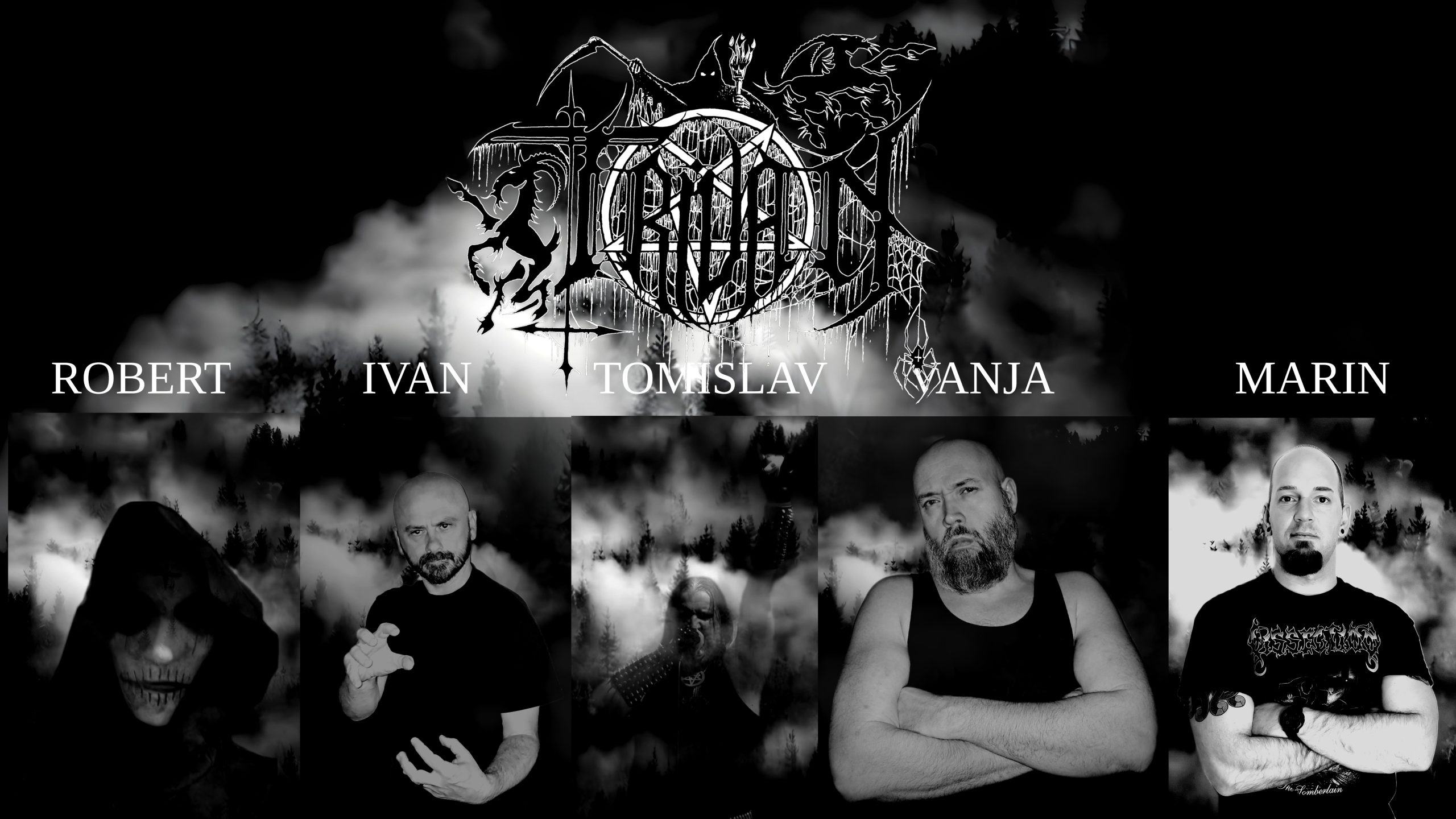
Trivan come from Croatia and work from a black metal foundation, with melody, atmosphere and a strong emotional pull running through the music. For Vanja Šantak, the band is tied to darkness, truth, inner conflict and transformation. It is where he puts the things that hurt, the things that stay hidden, and the things that cannot be faked.
That is where “Abyss Of Crawling Shadows” begins. The song was written after the death of Amon, Šantak’s black Cane Corso, who had been part of his life for almost thirteen years. At first, the loss was too heavy to shape into anything. Later, it became something he needed to give form to, so Amon’s memory could live inside Trivan.
The song also comes from a rebuilt version of the band. After the COVID-19 years forced Trivan to pause, the current line-up brought the project back with Tomislav Žiljak on vocals, Robert Vlašić on drums, Ivan Bertović on bass, Marin Buljan on rhythm guitar, and Šantak as lead guitarist, co-founder, main songwriter and lyricist.
In this interview, Šantak talks about grief, Amon, black metal language, the current Trivan line-up, and the work behind a song that turns private loss into something dark, heavy and defiant.
“He was not just a pet to me. He was my best friend, my companion, my shadow and a huge part of my daily life.”
“Abyss Of Crawling Shadows” comes from the loss of Amon after nearly thirteen years. When did you realise that grief had become something you needed to turn into a song?
I think I realised it almost immediately, but I was not ready to face it right away. Amon was my dog, a black Cane Corso, and he was with me for almost thirteen years. He was not just a pet to me. He was my best friend, my companion, my shadow and a huge part of my daily life. When I had to let him go, something broke inside me in a way I had never felt before.
At first, I could not turn that into anything. It was just pain. Real, physical, heavy pain. But after some time, I understood that if I allowed that pain to stay only as pain, it would consume me. I needed to give it form. I needed to turn it into something that could carry the weight without destroying me.
That is when “Abyss Of Crawling Shadows” started becoming necessary. It was not written because I wanted to write a sad song. It was written because I had to survive that grief and give Amon’s memory a place inside Trivan.
“Ordinary words like sadness or loss were too weak for what I felt.”
The lyrics use very dark, almost apocalyptic language, but the story behind them is deeply personal. How did you find the right distance between the real loss and the more extreme imagery in the song?
For me, the extreme imagery was never a way to hide the real loss. It was the only language strong enough to describe it.
When you lose someone that close, even if that someone is an animal, the world does not feel normal anymore. Everything becomes darker, heavier and distorted. Ordinary words like sadness or loss were too weak for what I felt. The experience felt like being dragged into something vast and black, something alive, something crawling around me and inside me.
That is why the lyrics became apocalyptic. I did not want to exaggerate the pain. Grief itself felt apocalyptic from the inside.
The distance came from transforming the personal experience into symbolic language. I did not want to write something too literal or sentimental. I wanted the song to remain black metal, to remain Trivan, while still carrying the truth of what happened. The real loss is the core, and the extreme imagery is the vessel that carries it.
You describe the line “I rise unbound, defiant in abyss” as a promise to yourself and to Amon’s memory. What did that line change for you once it was written?
That line changed the direction of the song, and in a way, it changed my direction too.
Until that point, the song was mostly descent. It was grief, darkness, collapse and the feeling of being surrounded by shadows. But when that line appeared, it became something else. It was no longer only about falling into the abyss. It became about standing inside it and refusing to be destroyed.
“I rise unbound, defiant in abyss” is not a happy line. It is not comfort. It is not healing in a soft way. It is a vow.
For me, it meant that Amon’s death would not become the end of my strength. His memory would not be reduced to suffering. It would become part of the fire that pushes me forward. Once that line was written, the song stopped being only a wound. It became a pledge.
Trivan had to pause during the COVID-19 years and later returned with new members. How did the current line-up shape the weight and atmosphere of this single?
The current line-up gave Trivan new life. The band originally started before the pandemic, but COVID stopped everything. Like many bands, we lost momentum, time and stability. After that period, Trivan had to be rebuilt. The current line-up brought back the feeling that this band has a future and that it can become something real.
Tomislav Žiljak’s vocals brought a very strong presence to the song. His voice carries the feeling of pain, rage and command that the lyrics needed. Robert Vlašić on drums gave the song power and movement. Ivan Bertović on bass gave it weight and depth. Marin Buljan on rhythm guitar is also an important part of the new Trivan structure because he brings dedication, will and the right spirit.
For me, technical skill is only part of it. The most important thing is whether someone understands the soul of the band. This line-up understands that Trivan is about carrying something heavy and making it real.
The song was recorded, produced and mixed at Studio Wormwood by Dave Kaminsky, with mastering by Ryan Williams. What did that production setup bring to a track built around such a private experience?
Working with Dave Kaminsky at Studio Wormwood gave the song clarity, power and emotional space. That was very important because a song like this can easily become either too raw or too polished. It needed to be heavy and atmospheric, while still clear enough for every part to have meaning.
Dave understood that the song was personal, but he also treated it like a serious black metal track. He helped shape the sound so that the emotion was not buried. The guitars, drums, bass and vocals all had to serve the same atmosphere. Nothing could feel disconnected from the core of the song.
Ryan Williams’ mastering gave the final version the strength and balance it needed. The song became bigger, but it did not lose its darkness. That was important to me.
For a private experience like this, production is about trust as much as technique. You are giving someone something very personal and asking them to help turn it into something that can stand on its own. With this setup, “Abyss Of Crawling Shadows” became exactly what it needed to be: dark, heavy, personal and defiant.
Buy/Stream “Abyss of Crawling Shadows” on Bandcamp.


