


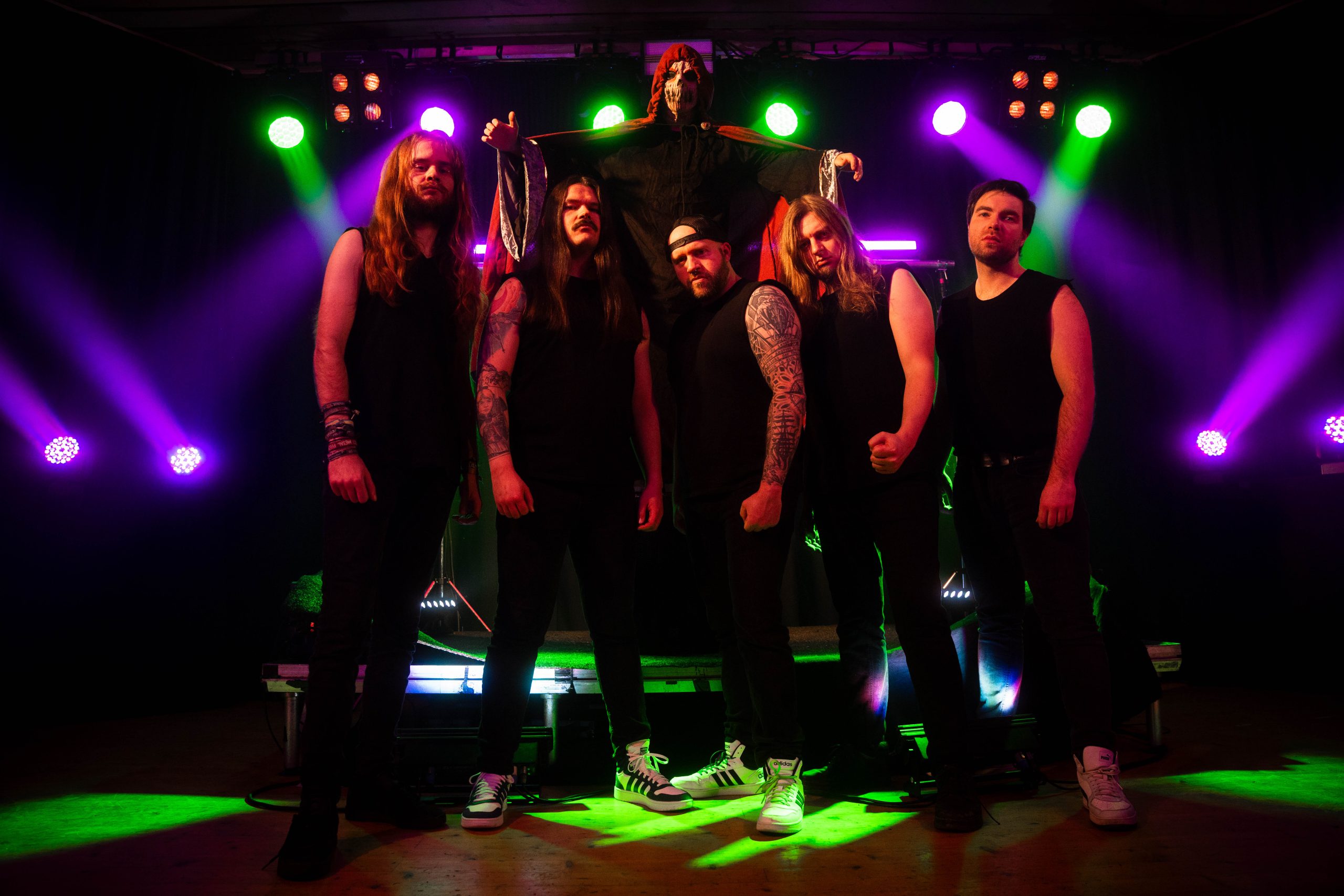
If you’re meeting Germany’s Taskforce Toxicator for the first time, Dominik Rothe (guitars) has a simple suggestion: press play on “The Necromancer”. For him, that track is the clearest snapshot of where the band are right now. They’ve been active since 2017, and he feels everyone involved has grown as a player and as a writer. The difference, in his words, is focus. The songs are tighter. If a part doesn’t help the song, it goes.
That mindset runs through “The Necromancer” too. It’s a track they’ve carried for a long time, reshaped across different phases of the band, and used as the first new release since Laser Samurai (2023). It also lands inside the wider “space adventure” frame that Taskforce Toxicator have been building for years, not as a strict concept, but as a world that keeps pulling them back in.
“we felt we could get this song to another level if we gave it more time. And so we did.”
“The Necromancer” landed as a standalone single on 30 January 2026. Why was this the right track to drop now?
Dominik: Because it’s the perfect blend between the style of songs we wrote for Laser Samurai and the songs we recorded last year for our second album. “The Necromancer” was already part of the demo phase for our first album. But we felt we could get this song to another level if we gave it more time. And so we did.
We reworked the chorus since that first demo and completely threw out the pre-chorus to make the song flow better. The long time we worked on “The Necromancer” means the song is influenced by multiple phases in our development as individual musicians and as a band. That’s why it was the perfect choice for our first new song since the release of Laser Samurai in 2023.
What did you want this song to do that Laser Samurai didn’t already do?
With our new song material we aimed for songs that are just pure and relentless thrash metal, with no unnecessary length or breaks. That was the direction we wanted to take for our second album.
The songs on Laser Samurai tend to be a bit long overall. Looking back now, we often identify parts that could have used some trimming, or could have been erased completely. This time we put a lot more thought into the structure and dramaturgy of our songs, and the upcoming album as a whole.
We are still very proud of all we accomplished on Laser Samurai. But I’m sure pretty much every musician would tell you that after an album is out for a while, you always find stuff about it that could have been better. For our next album, which will be out later in 2026, we wanted to write a cohesive record where all songs can also work on their own. But if you listen to them in the order we put them in, you can hear a clear dramaturgy between those songs.
“Every so-called life coach who promises to fix all your problems if you just give them enough money can be a ‘Necromancer’.”
Lyrically, who or what is “The Necromancer” in your universe, and what are you really talking about underneath the character?
Within our sci-fi universe, “The Necromancer” is a supernatural being who created an army of the undead to invade the world of the living. His summoning process is also part of the music video for the single.
In the end, the song is about how the masses in our time are manipulated and more or less brainwashed by constant audio-visual assault through social media, TV, and so on. Every so-called life coach who promises to fix all your problems if you just give them enough money can be a “Necromancer”.
“Those politicians try to revive a past that should stay dead and buried. Instead, they exhume the graveyards of hateful ideologies and try to re-establish them in today’s world.”
Also, all those right-wing politicians like Donald Trump, Viktor Orbán, or our chancellor Friedrich Merz are what “The Necromancer” is about. They spread hate against the weak, against people who do not have strong representation in our society and are therefore often overlooked and not heard out. Those politicians try to revive a past that should stay dead and buried. Instead, they exhume the graveyards of hateful ideologies and try to re-establish them in today’s world. We summed them up in the fictional figure of “The Necromancer”.
Your music sits in thrash, but you’ve built a very specific “space adventure” world around it. How did the idea come up?
Most of us really love old sci-fi movies and stories, especially the likes of Star Wars, Alien and Blade Runner. So we made those three movies the basis for our visual language.
It was also a way for us to differentiate ourselves from other bands. We are very aware of the fact that our music doesn’t cover any brand new ground, and it’s not meant to do that. So we developed a clear visual style for all our artworks to give ourselves a distinguishing feature. Our shirts shine the brightest at every merch booth because of those neon colours. We wanted visuals on our shirts and records that really stand out.
And on the other hand, this sci-fi world gives our lyrics some sort of overall direction. It’s not a strict concept that has to be reflected in each and every song. But it is something we regularly pick up to create a common thread in our lyrics.
What’s the biggest thing you learned from making Laser Samurai that directly shaped how you approached this new single?
Before we went to record our new songs, we reflected on Laser Samurai a lot. The first thing we did was create a clearer vision for how we wanted our second album to sound. On Laser Samurai we more or less let our producer Corny Rambadt do his thing and sent him some adjustments afterwards. This time we gave him clear references for how we want the new songs to sound in terms of the guitar sound, the drums, and the overall direction for the vocals. We also discussed the different mixes way more and gave feedback until we were completely satisfied with every aspect of the production.
This time we also got more feedback on our songwriting. On Laser Samurai we worked out the songs pretty much on our own and then went to record them. This time we consulted a professional songwriter, Milan Steinbach of Pointbreak Recordings, who is specialised in metal, for feedback, which was very valuable.
“Now we really know how to create songs that we are absolutely happy with.”
We learned a lot about how to structure a song, how to create a kind of narrative arc for each song, and also for an album as a whole. He made us question our creative decisions, but in a good, productive way. That helped us a lot, because now we really know how to create songs that we are absolutely happy with.
I personally feel really good about our new songs. That honestly wasn’t always the case in the past. Before, we often had a mentality of, “If we don’t know how to make it better, it is good enough.” Now we work on songs until we are 110% satisfied with the end result, and we try out a lot more different ideas on how to approach a riff or a melody before we settle on a final decision. We have grown a lot as musicians and songwriters, and that will be reflected throughout our new album.
The album cycle in 2023 brought you new attention. What changed for the band after that, day-to-day?
We most definitely played a lot more gigs per year since the release of Laser Samurai. And we played a lot bigger shows too, like support slots for Sodom and Tankard, or at the Metal Frenzy festival.
This year we’re also playing our first proper tour with Knife and Warrant, which we’re really looking forward to. We also meet a lot more people who know about us and our music when we go out to watch metal shows ourselves, which is a fantastic feeling. We always love to meet the fans and have a chat with them about metal and whatever else comes up.
If all goes as planned, we will play more shows in 2026 than ever before. That would not be possible without Laser Samurai and the great reactions we got for the album. The support of our fans and partners like Iron Shield Records means the world to us.
But the impact of Laser Samurai also led to some difficult decisions. Our former drummer Lysander, who played on the album, realised that he doesn’t want to put as much effort into the band as would have been necessary to get the band to the next level. So he left the band in late 2024. That was really difficult for us, because Ly is not just a great drummer, but also a great friend to all of us.
Luckily, we quickly found a worthy successor in Bela Schlieper, who played the drums for our upcoming album. Success in whatever form sometimes also brings its own problems with it. But that helps you stay humble and thankful for all the stuff that works out well.
You’ve shared stages with bigger names and you’ve done the grind yourselves too. What does “a good year” actually look like for Taskforce Toxicator right now?
A good year is one where we play gigs on a regular basis to reach more and more people with our music. In such a year we play multiple support slots for bigger bands, like we’ll do in March and April this year when we are on the road with Knife and Warrant.
A good year also means working on new songs, planning releases, and just being creative together. We have found a good working process for the band, where everyone contributes and brings in their own perspective. The sum of the five of us is what defines Taskforce Toxicator on every level.
And of course a good year also means we reach more and more fans with our music. We want to take this thing as far as possible.
Sonically, what part of your sound is non-negotiable at this point, even when you try new ideas?
We once had a drummer at our rehearsal for an audition. He talked about the guitar solos in our songs, and I told him one rule is that every song has to have at least one of those [he laughs]. That has been non-negotiable to this day.
I don’t want to rule out the possibility that we might do a song here and there that doesn’t contain a guitar solo, because never say never. But I think with the kind of old school thrash metal we play, guitar solos are mandatory. And I don’t care about people who say guitar solos are no longer “in” or needed in music. If we cared about trends and stuff like that we would play a whole different genre [he laughs].
“I think some musical choices on the next album will surprise people.”
Besides that, there aren’t really any rules we imposed on ourselves. I think some musical choices on the next album will surprise people. What’s important to us is that when we try out new things, it always fits into our existing sound and doesn’t feel forced.
For example, I can even imagine having a rap part in one of our songs if it fits. But we would never try to cram a rap part into a song just to do it. If we try out new ideas and give a song a unique twist, we only do it if it feels natural to us and fitting for the song.
“We don’t want to be a band like AC/DC that pretty much makes the same record again and again.”
We definitely want to stay true to our sound. So we most likely won’t do a record like Lost Society did with No Absolution, when they changed their sound from thrash to modern metal or metalcore altogether. I don’t think we will ever do a change in direction that radical. But we also don’t want to be a band like AC/DC that pretty much makes the same record again and again. We want to evolve with every album and surprise people, but in a manner that doesn’t clash with the core musical identity of Taskforce Toxicator.
Have you spent time with any African metal scenes yet, or is that still new territory for you? What would you like to discover there?
A year or two ago I read a book called Metallisierte Welt by German music journalist Moritz Grütz of metal1.info. The title can be translated to Metalized World. In that book Moritz interviewed bands from all over the world, but he only chose bands from countries that typically don’t get that much international recognition in the metal scene.
That was a very interesting read because it gave a lot of different perspectives that are often not represented in established metal media like Rock Hard or Metal Hammer. So while reading this book I checked out a lot of those bands, some of whom were from African countries.
Besides that I have to admit I’m not that familiar with the African metal scenes. But I’m always open for new recommendations to check out. There’s also a book called Scream For Me, Africa! about the different metal scenes in Africa that I plan to read one day to learn more about it.
What’s next after “The Necromancer”? What are you building towards in 2026?
Throughout March and April we play almost every weekend. Besides “The Necromancer” we will play another brand new song at these shows. That one will be released as a single in March as well.
In addition, we have four more singles planned, which will be released over the course of the next six to seven months. And as some people may have seen on the flyer of this year’s Ragers Elite Festival, we will release a new record in September 2026. More details as soon as possible.


