


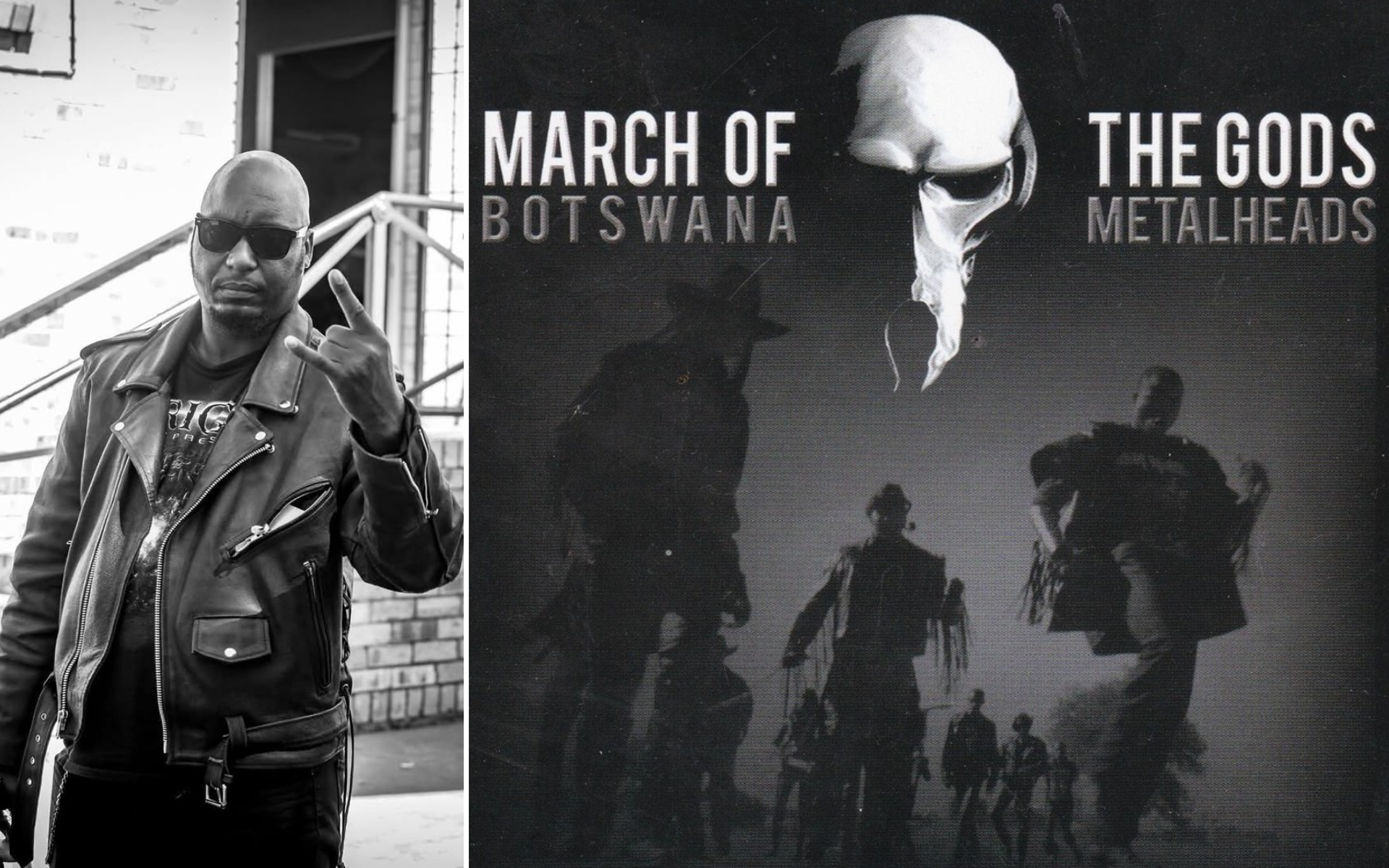
Back in 2014, a documentary focusing on Botswana’s metal scene sent a ripple through the metal world. And why wouldn’t it? Before the production and release of March of the Gods: Botswana Metalheads, most people had no clue the landlocked country had a metal scene.Viewers were surprised to discover that not only did the history of rock music in Botswana date back to the late ‘60s, but also how deftly the members of said scene avoided heat stroke and crotch rot given the year-round heat and the layers upon layers of denim and leather local headbangers would wear while tearing it up in the venues and on the streets.
Using death thrashers Wrust as a narrative focus, the film followed the band as they rehearsed, gigged occasionally and prepared for the release of their second album, Intellectual Metamorphosis at a record release show in their hometown of Gaborone, introducing other Botswana bands and their fans along the way. There’s a scene in the movie where the members are posting flyers around town, guerrilla marketing style. As they paste up one of the largest of their gig posters at what appears to be one of the city’s central roundabouts, keen-eyed viewers will have noticed that one of the openers were a bunch of then-relative newcomers called Overthrust. Over the past near-two decades, Overthrust have gradually grown from a plucky band that started as a hobby and played locally to one that has toured Europe on multiple occasions, including a slot at Wacken Open Air in Germany in 2016, host their own Winter Metal Mania charity festival and are celebrating the release of their second album, Infected By Myth. This, in addition to a split with US black metallers Hessian and Nation of Dark Majesty, an international four-way split featuring the band alongside Hessian, Colombia’s Bruja and Scotland’s Sàtànŷa, due February 1, 2026.
Overthrust’s latest album comes on the heels of their previous release, a split with Kenyan post-black metal outfit Chovu entitled African Warriors, and itself has a story behind it that no one would have ever imagined when the band began life as a hobby back in 2008.
“I had to sell my motorbike to invest in equipment so we could be active.”
“When we started it was something done for fun, to keep us busy and to help with stress and other stuff,” begins bassist/vocalist Tshomarelo “Vulture Thrust” Mosaka. “I was inspired by Morbid Angel, Deicide, Cannibal Corpse and Mortician, and wanted to do something like that; not for money, but just for fun and to satisfy my desires. I approached my cousin Spencer [guitarist Shalton “Spencer Thrust” Monnawadikgang] who had the same feelings. He loved Chuck Schuldiner and Death, so we had that in common, then we invited our late drummer, Suicide Torment [Gakeitse Bothalentwa, who was killed in a 2018 car accident] who was a family friend. We started the band in 2008 and I had to sell my motorbike to invest in equipment so we could be active. From where we started to where we are now, it’s been progress, but it’s progress that I never saw coming because this was something we did as an escape from our problems and to make ourselves happy.”
To the average metal fan, stories of a band recording an album in another country and having it issued by a record label are about as commonplace as seeing drunk people falling over at gigs and football matches. But for a tiny band from a tiny scene in a country hardly known for rock music, let alone the sort of old-school death metal Overthrust ply in, it’s exciting, almost unbelievable stuff. And the excitement in Tshomarelo’s voice is palpable as he discusses the current state of his band. This involves the band doing a destination recording in Capetown, South Africa, Mosaka travelling to Florida to finish up his vocal tracks, working with producers Jethro Harris and Howard Wulkan, having their album mastered in California and having it released by the Indian River Music Company — a label backed by the deep pockets and even deeper support of owner/operator, Jason Banning.
“The new record was not easy,” Mosaka laments. “It has taken almost a year to record. There were a lot of struggles here and there. Currently, we live in different parts of the country, so meeting up wasn’t easy and we were writing songs, but not using the gear we wanted to use or the gear we were using to record. We recorded in Capetown and it took longer than we thought it was going to take.”
The isolation of Botswana’s metal scene was shaken off when March of the Gods: Botswana Metalheads started making the rounds in arthouses, film festivals and online back in 2014. While a small coterie of bleeding hearts inexplicably viewed the film as exploitative — isn’t exposing audiences to the previously unknown what documentaries are supposed to do? — Mosaka continues to be 110% thankful for the existence of the film. He’s fully aware, and grateful, that the opportunities Overthrust have had thrust before them (sorry…) have come in very large part because of the doc.
“The documentary had a very positive impact on the Botswana metal scene. Here, most people who thought metal was for people who were crazy or violent were surprised to see them on TV. They saw that they were just people who enjoyed music and alcohol, but they’re not assholes,” he says with a laugh. “But also a lot of big media arms caught on to it through Europe and America and bands like us, Wrust and Skinflint were discovered and able to play overseas.”
In addition to shining a light on what was going on in a place most of us thought nothing was going on, March of the Gods: Botswana Metalheads acted as many things: motivator, history lesson, eye-opener, prejudice murderer and exposé on all sides of the coin.
“We had a few people who we knew or were related to who went to school in the U.S. and Europe and they would bring us metal magazines and tapes.”
“Our discovery of metal wasn’t easy, especially back in the day,” he explains, thinking back to his youth and how he stumbled across a style of in a place where it had no foothold. “We had a few people who we knew or were related to who went to school in the U.S. and Europe and they would bring us metal magazines and tapes. In Botswana, there was interaction between the country and the British and because of that there were a lot of working relationships, people from both countries getting married and moving and that’s when metal was spread, through the interactions between the countries. Also, you had people from around the world visiting places like Maun, which is the ‘tourism capital’ of Botswana. And you had people from Botswana working in the mines in South Africa with people from other places who were also into metal. The metal scene in Botswana actually goes back to the 1960s with a rock band called the Nosey Road Band, formed by the Sbrana brothers who were the sons of a psychiatric doctor who moved here from Italy. After them it was Metal Orizon, then Wrust, then bands like us appeared.”
He then goes on to analyse the pre-and-post documentary differences in the Botswana metal scene and how it helped grow the profile of metal in one of the most sparsely populated nations in the world.
“Before the documentary, it was a small, hopeless scene that was mainly about fun and having a sense of belonging. We didn’t put too much into our thinking because we thought, ‘Well, this is it.’ After the documentary, most of the bands that had given up or broke up came back. They see there is a hope for the future of the metal scene and the improvements. There were a lot of upcoming bands with new faces and more people who were interested in supporting the scene. It helped a lot to spread not just the Botswana metal scene, but southern African metal and African metal as a whole.
“After the documentary,” he continues, “there began communication between bands from everywhere and a few bands have come here from overseas: a rock band from the US called Ghetto Song Bird came here three times, a black metal band from Switzerland called Gravpel played here and most recently an Italian band called MatraK AttaKK played a show we did called the Overthrust Winter Metal Mania Fest with other African metal bands from neighbouring countries like Angola, South Africa, Mozambique and Namibia.”
Despite being more than a decade down the line, the doc is still having its impact. It’s not only brought Overthrust from the small town on the western edge of the nation called Ghanzi (pop. 21,420) to the big stages of the European festival circuit, but also allowed for Mosaka and his band mates — Monnawadikgang, guitarist Tshepho “Dawg Thrust” Kaisara and drummer Balatedi “Beast Thrust” Folai — to believe that the sky’s the limit and that there is no limit to the sky. Touring in Africa, as we know it, is very uncommon — there are huge distances between countries as well as the cities/scenes in each country, mid-week shows are unheard of, expenses to rent venues and gear ordinarily surpass the money made — but there are small and dedicated pockets of ‘bangers in Mozambique, Namibia, Angola and Zimbabwe as well larger numbers of fans and bands further north in Egypt, Algeria and Tunisia. This has allowed Overthrust to shift to the hope that they can get back to Wacken, open for any of the American bands on his wish/play/bucketlist should they ever come to Botswana and, most importantly, one day tour America.
“all these opportunities have given us a decent life.”
“As I said, when we started the band it was us doing this as an escape. Now, we realise it’s more of a business and we’re trying to adjust. It’s something that automatically happens. We used to have the kind of life where we were doing a lot of irresponsible drinking and stuff,” he laughs. “You start to realise how much work is waiting for you with a band, family and work and you have to decide what to cut out and when to behave like a professional. No more funny stuff. You have to give your family some time, you have to give the music some time, you have to give your wife some time, and it’s all about balance and discipline. And it’s a challenge because you always have people who think you’re arrogant because you’re not the same person and you’re not doing the same things you did in the past. At festivals, we used to be extremely crazy and wild. We’d get drunk and even pass out on stage and get into fights after the show. No more. The presence of Indian River Music Company and all these opportunities have given us a decent life and this is what we see: we’re here, we’re no longer there.”


