


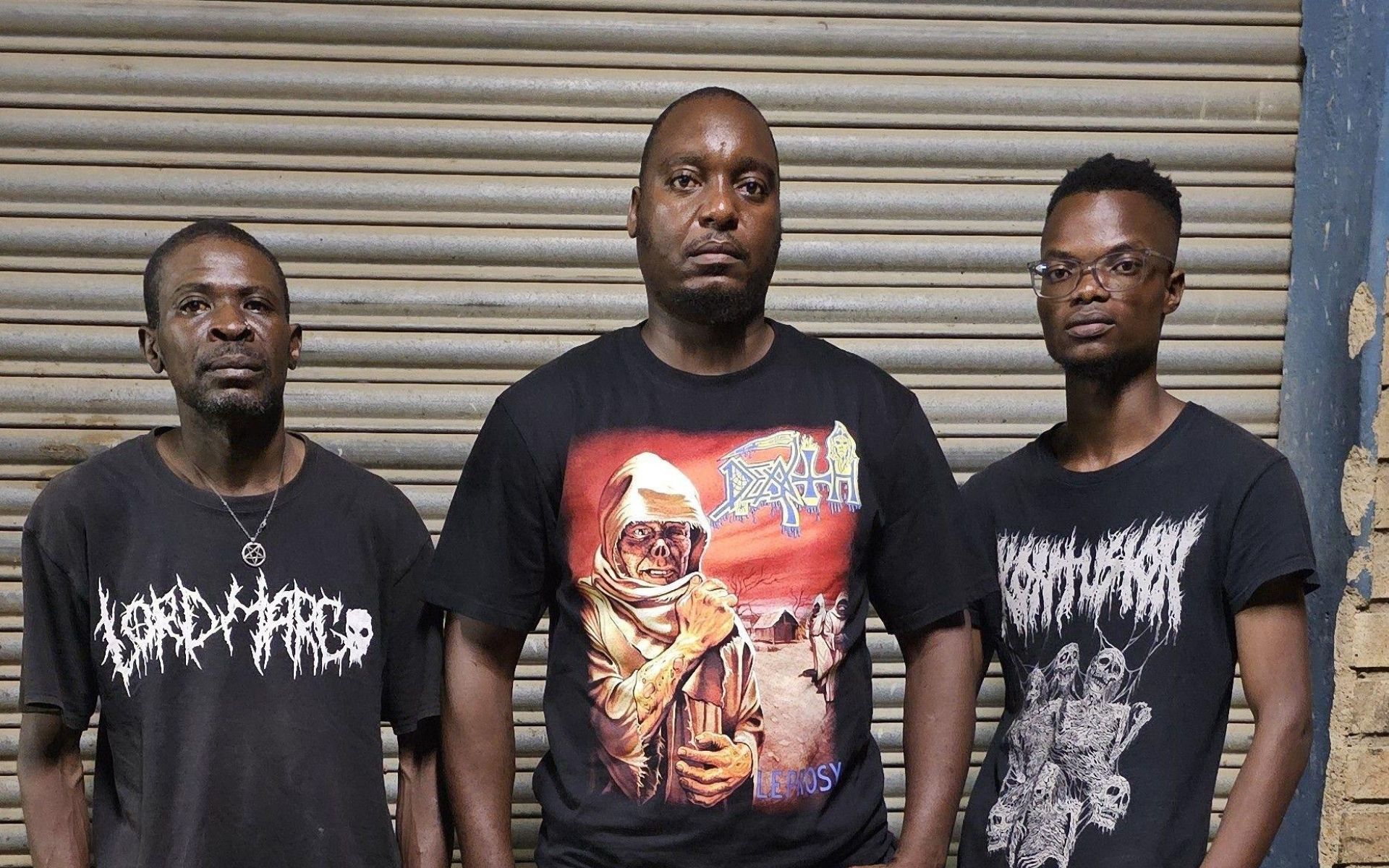
Overthrust have become one of Botswana’s best-known heavy exports, partly because of the look that people remember first: leather, chains, cowboy hats. And partly because the band never separated the music from the place it comes from. They formed in 2008 in Ghanzi, in western Botswana, and they’ve carried old-school death metal far beyond the country’s borders since then, including a landmark appearance at Wacken Open Air in Germany in 2016.
The story often begins with Ghanzi, but Vulture wants the first line to be accurate: “I was born in Rakops. That’s where I come from,” he tells AFRICA.ROCKS. “Ghanzi is my second home. It’s where I spent most of my time working as a police officer from 2007 until October 2017. I went there when I was young, and the community welcomed me. They treated me like family, like a brother, like a son. I learned a lot in Ghanzi. I experienced life in Ghanzi.”
He talks about the place like it shaped the band before the band even existed: “Ghanzi is a special township with a special community. They’re open-minded and very supportive of different talents,” he says. “It’s the heart of the Kalahari Desert region, with different tribes living there in harmony and peace. It’s rich in history.”
“A few religious organisations accused us of playing satanic music. That never stopped us.”
Overthrust started there in November 2008, built around friendship and a shared obsession with heavy music. Vulture arrived in 2007 for work and met the late drummer Gakeitse Bothalentwa, known as Suicide Torment, who became a central figure in the band’s early life: “We decided to start a band because we were like-minded people who loved the same music and the same bands,” he says. “Death metal wasn’t common in Ghanzi, but the community supported us. At first, it was a challenge for some people. A few religious organisations accused us of playing satanic music. That never stopped us. Eventually, people supported us, and the metal scene in Ghanzi became big.”
The band began putting work back into the town through Winter Metal Mania, a festival they’ve run as a charity event since 2010, supporting disadvantaged children and wider community causes: “It had a positive impact in the community because we did our annual charity event there,” he says. “It attracted people from across the world.”
“Police work showed me the tough challenges of life, the reality and the brutality.”
“I worked as a police officer from January 2007 until October 2017, then I got a job in the mine,” he tells AFRICA.ROCKS. “Working in security for most of my life influenced our discipline and how we operate. It taught me professionalism, how to work with people, leadership skills, calmness, and how to handle different characters.”
He connects that directly to the lyric themes that Overthrust are known for, including death, purgatory, and false prophets: “Police work showed me the tough challenges of life, the reality and the brutality,” he says. “I attended incidents that stayed with me. I saw bodies. I saw suicides. I saw horrific road accidents. That gave me a heart of steel and a solid mind. It had a huge influence on my lyrics. It pushed me to write about the brutality and reality of life, morbid subjects, death and torture. Police work taught me that life is tough. It’s about survival and happiness. If you waste time complaining and blaming people, you suffer.”
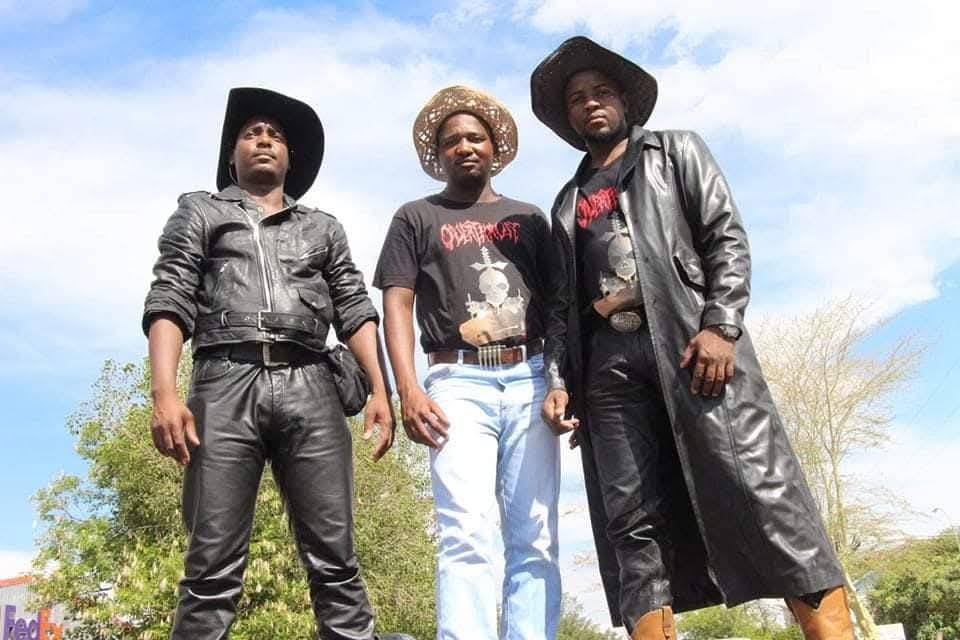
Death metal cowboys
Overthrust’s “death metal cowboys” tag has travelled almost as far as the band. Vulture describes it as a collision of heavy metal influence and Botswana’s own history with cattle culture, riding, and workwear: “The title ‘death metal cowboys’ is another name for Overthrust,” he says. “It describes our love for death metal and the Botswana metal cowboy outfit, leather jackets and pants, sometimes spikes and decorations, plus cowboy boots.” He credits Motörhead’s Ace of Spades artwork as a key inspiration point, then takes it back further: “This outfit has always been there from our forefathers,” he says. “They were rearing cattle, farming, riding horses. They used cow skins to make horse-riding attire, general clothing, hats, even shoes. When rock and roll spread here, we combined the cowboy outfit with heavy metal t-shirts. That became our Botswana metalheads identity.”
In Botswana, “rockers” and metalheads are often known locally as Marok, and the subculture’s visibility is tied to the clothing as much as the sound. The look also becomes psychological, especially when the band take it abroad: “Wearing heavy outfit in hot conditions has never been a problem for us. We come from extreme high temperatures,” he says. “Sometimes what feels like normal cool weather in Europe feels cold to us. I remember Wacken in 2016. Everyone was wearing t-shirts, and we were in full metal jackets, leather pants, cowboy boots and hats.”
He calls it a kind of armour, without turning it into a slogan: “This outfit is not just identity. It became part of our system,” he says. “It gives us spirit to face harsh conditions of life. It’s comfort. It’s heaviness. It’s power. I can’t fully explain it, but it feels metal.”
Family, first contact, and Morbid Angel on repeat
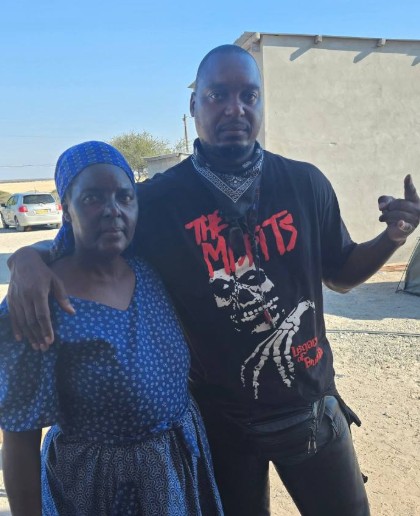
“My mother was against me being a metalhead at first,” he says. “She didn’t like the loud music my uncle and cousins introduced me to when I was 13. I spent a lot of time with my metalhead uncle and cousins. After school, I’d go to my uncle’s room to listen to metal, even when they weren’t there. I got addicted to it.”
He remembers the exact moment it clicked: “That was around 1996. The first band I got into was Morbid Angel,” he says. “I loved Altars of Madness. I kept ‘Immortal Rites’ and ‘Visions of the Dark Side’ on repeat.” His mother’s worry, he says, was the behaviour around some of the people who were feeding him the music: “My mother’s fear was my association with my uncles because they drank a lot, smoked, and caused problems in public bars,” he says. “She didn’t want me around that. She thought it would influence me negatively and I wouldn’t do well at school. But I was doing well at school. I passed my examinations. That’s when she realised I wasn’t being pulled off track, and she let me enjoy metal in peace.”
His father, he adds, had his own version of heavy music culture: “My father was also a metalhead, more into bikes and horses, and listening to softer rock and glam metal,” he says. “He didn’t have a problem with me enjoying metal. He wasn’t pushing me into it, but I think he loved seeing me growing into a metalhead.”
Pushback, petitions, and the government saying no
Overthrust’s lyrics and imagery have drawn backlash in the past, especially from religious groups, and Vulture describes a very specific clash that took place around 2014, with attempts to shut down shows through petitions: “In 2014 they did a petition against us and our music and metal shows,” he says. “They wanted us to be banned, but the petition was rejected by the government, reminding them that Botswana is a free country with a fair constitution.” He remembers how the protest moved from paperwork into theatre: “After they got frustrated, churches gathered opposite our event premises,” he says. “They were singing songs of praise, saying they were casting evil spirits out of us. The metal show was on, louder than hell, while gospel was across the road.”
He says it eventually stopped because the wider community got tired of it: “Ordinary people started criticising the church people’s attitude, and it stopped,” he says. “From that time, we enjoyed our metal in peace.”
Loss, grief, and the record made as a tribute
In December 2018, Overthrust lost Suicide Torment, a death that hit Vulture hard. “It wasn’t easy to cope with his passing, especially for me because I was closest to him. We did everything together. He wasn’t just a bandmate. He was a friend and a younger brother. His family treated me like their son,” he tells AFRICA.ROCKS. The loss also changed his life offstage. “After his passing, my drinking got worse,” he adds, a struggle he says he is still trying to get under control.
Overthrust released the Suicide Torment EP as a tribute, and he frames it as a release valve as much as a memorial: “We did that EP to pay tribute, but also to release anger,” he explains. “The lyrics were directed at the culprit, as a verbal attack, because Suicide was hit by a car and died on the spot.”
Winter Metal Mania
“Our major challenge is financing the event,” Vulture tells AFRICA.ROCKS. “We don’t have sponsors, even though we try to apply. At some point we tried giving up, and we realised it’s not just about enjoying music. It has turned into a metalheads pilgrimage, a tourist attraction, a uniting and cultural exchange centre,” he says. “It’s a bridge between the African metal scene and the world. It’s an event with a purpose. Charity.”
From Wacken to judging the next wave
Wacken remains a reference point because it showed what was possible, and because it plugged Overthrust into a wider network. Reuters reporting around the band has also highlighted the significance of that 2016 appearance for Botswana’s scene and Overthrust’s visibility: “Wacken gave us experience, exposure, and networking,” he says. “We learned a lot and gained confidence. We gave our best performance, and it brought more followers and more opportunities.”
He also judges Wacken Metal Battle Africa finals, and he talks about performance like someone who’s watched bands lose rooms before they even play a riff: “When I’m judging, I look at confidence first,” he says. “I want to see if they really know what they’re doing. Stage performance matters most. I look at the response from fans, audience interaction, stage work. I look at balance and musical communication between the players. If a band puts on a solid performance with energy and good interaction, they make judging easy.”
The latest chapter: Infected by Myth and a sound split between Cape Town and Florida
Overthrust’s latest full-length, Infected by Myth, was released in June 2024, with recording and mixing split between Milestone Studios in Cape Town and Farmadelica Sound in Pine Island, Florida. Vulture says the upgrade they wanted was sound, but not cleanliness: “The biggest upgrade we chased was sound, but not in a modern sophisticated way,” he tells AFRICA.ROCKS. “We wanted a bigger, clearer, more dangerous old-school death metal sound that still felt filthy, raw and alive from the grave. Something that hits hard but breathes, where every riff, every drum hit and every growl cuts like a razor blade.”
He describes the cross-continental process in terms of what each place gave them: “Cape Town brought raw energy, sweat, and underground spirit,” he says. “Florida, being the spiritual home of death metal, brought discipline and weight, that classic depth and low-end power without sterilising the chaos.” It changed how he approached writing, too: “Songwriting-wise, it pushed me to be focused and deliberate, with no filler,” he says. “Every riff had to earn its place. Speed and heaviness came naturally, but now they were controlled weapons, not just blasts of aggression.”
“In the end, ‘Infected by Myth’ sounds like Overthrust with one foot in Africa and the other in the death metal graveyards of Florida.”
Then he lands on the line that sums up what Overthrust keep trying to do, even when the story around them threatens to become bigger than the music: “In the end, Infected by Myth sounds like Overthrust with one foot in Africa and the other in the death metal graveyards of Florida,” he says. “Raw, ugly, violent and honest. No compromise. Just Overthrust death metal.”
Overthrust’s image makes headlines, and the Wacken story makes a neat hook, but Vulture keeps returning to the same place. A band formed through friendship in Ghanzi. A community that argued about death metal, then learned to live with it, then started turning up for it. A festival built on stubbornness, charity, and the idea that scenes survive when somebody refuses to let them die.


