


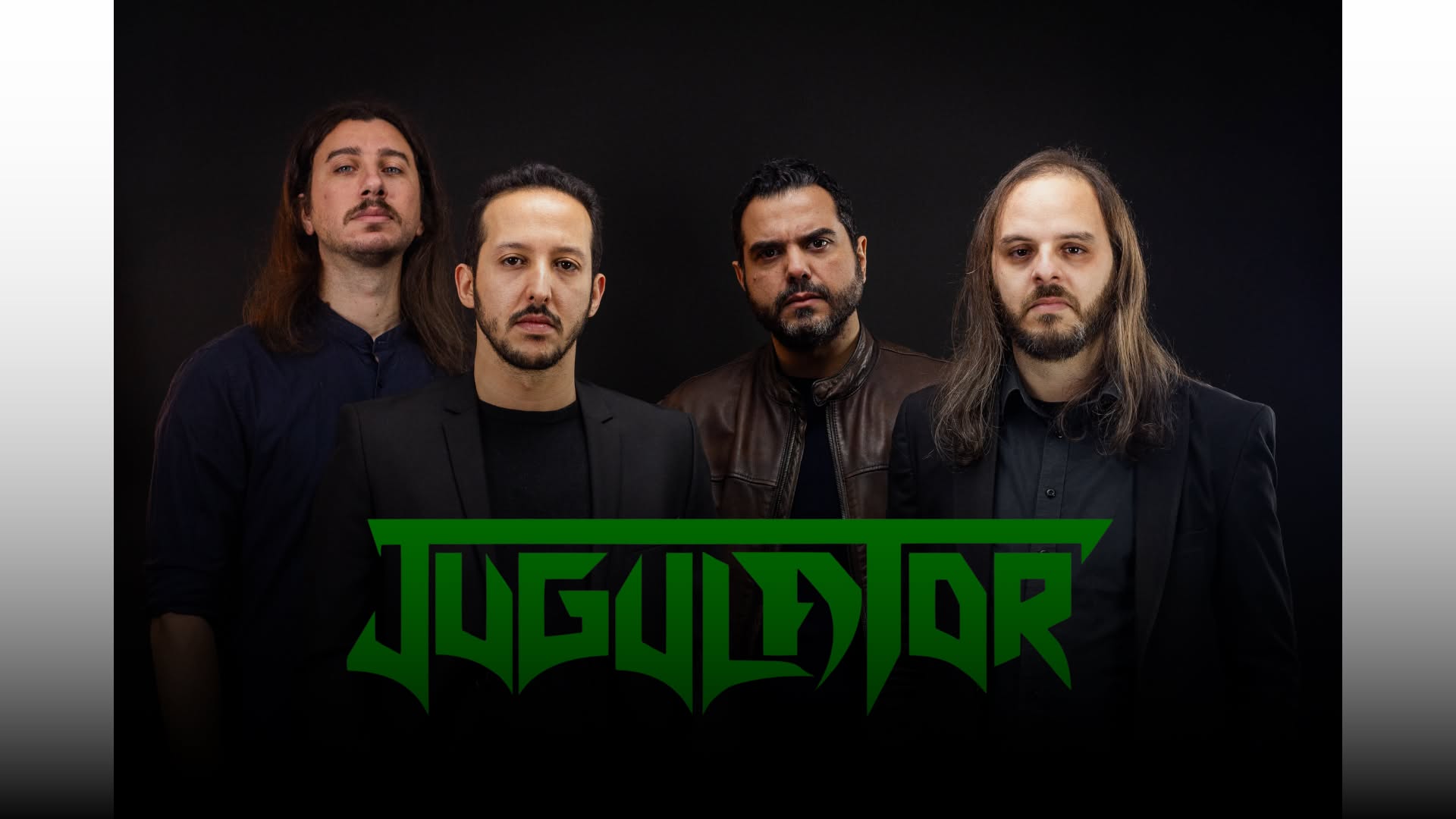
Citizens of Earth! Note this important notice, taken from the website of Algerian thrash metal squadron Jugulator, recast here for informational purposes. And as a warning…
“*IMPORTANT ANNOUNCEMENT: At the beginning…Ad Exitium… the events of the first album brought us to the ultimate judgment and we were Under the Verdict, but the question is ‘what was the verdict?’ After the ‘Nuclearus,’ the radioactive waste from nuclear bombs gave birth to abominations, repugnant creatures who are determined to make us pay for everything we did to them and everything we did to the planet. These creatures were simple insects in the past, watching our actions without saying anything, and if they disturbed us, we crushed them, we sprayed them with toxic chemicals which prevented them from breathing and made them suffocate and die in terrible suffering.
“After their contact with this radioactive waste caused by our fault, they became bigger, more intelligent, stronger and more resistant. Their skin is as hard as steel, their pliers are like swords, and [they have] decided to take their revenge on us, to massacre us, to invade us and to remove us from our domination on this planet. All this guided by their leader, their warlord, the one on whom they placed all their hopes. He is their saviour, their chosen one of prophecy: the Imperator Insector!
“They say that we don’t deserve to live on these lands, this land which gave us everything, and what do we do to thank it? We throw our waste at it, we pollute it, we hurt it with our weapons, our bombs. The operation will soon begin. Are we up to this enemy? Are we ready? Are we up to this threat? Can we defend our land?”
“humanity destroys itself, and the insects we used to kill every day for no reason come back as mutants in a post-apocalyptic world and turn against humanity.”
Jugulator have issued the above caution, one which rallies for the (admittedly fictional) battle humankind is about to find itself engaged in, in conjunction with the release of their concept-based third album Imperator Insector. As we find ourselves under attack — and as world and military leaders engage in circuitous debates not about whether to defend their citizenries from the mutant attack, but about how it’s going to impact their popularity, public image, polling numbers, stock options and grifting opportunities — Jugulator, led by guitarist/vocalist Ramzy Curse (née Abbas) has mobilised eight arthropod-ripping sonic blasts of torment. The songs are meant to aid in the repelling of that which inexplicably doesn’t enjoy the galloping power of classic Bay Area-meets-Teutonic thrash metal — sure, they’re exacting their revenge, but surely their poor taste in music should be cause for extermination in the first place? Those eight tracks are bolstered by an additional seven songs featuring 21 guests and default conscripted members of the Jugulator army. As the band themselves say in a variety of online notices announcing the release of their third album: you are not prepared.
This is our long-winded and overly dramatic way of saying that Algiers-based thrash quartet Jugulator — obviously taking their name from Judas Priest’s 1987 album — have a new album out. Imperator Insector is an album that is the third in a trilogy of the band’s full-lengths and features a 47-minute main program and a deluxe version with a barrage of guest appearances — everyone from traditional Algerian artists like Samy Guebouba and prog-jazzbo Abdelmalek Benchefra to members of metal bands like Rivergate, Nehandertalia and French tech-death wizards Gorod — contributing to transformative versions of the album’s tracks.
“We recorded it mostly at home,” explains Ramzy. “We just used a PC, a soundcard, a guitar, a bass, electronic drums and taking the MIDI sound and applying a good VST plugin and we were okay. But because of the 21 guests, it took us more time than what we had planned.”
Imperator Insector is the landing point for the triptych that began with the band’s previous two full-lengths. It can be traced back to 2021’s Under the Verdict and their 2019 debut Ad Exitium before it.
“In the beginning, my target was to do a concept album, but I wasn’t sure how to do it or how to write it.”
“It was planned like that from the beginning, but it has evolved,” he says. “In the beginning, my target was to do a concept album, but I wasn’t sure how to do it or how to write it. When I did Ad Exitium, I said to myself, ‘Now, that we have the first album, what’s next and what can we do better than the first?’ The first album had songs like ‘Arabic Nightmare,’ ‘Hellgeria’ and ‘Cemetery of Memories’ which were talking about real, historic events. I’m also really big fan of cinema, books and sci-fi and I wanted to write about an alternative future of those events. So, we wrote Under The Verdict, the second album, where I imagined the next set of events. After that, I thought, ‘Now, I have to go into pure fiction!’ I like films like Alien, Planet Of The Apes and video games like Fallout and the last song on Under The Verdict was called ‘Nuclearus’ which talked about a nuclear war between humanity. So, humanity destroys itself, and what happens is that the insects we used to kill every day for no reason — simply because we thought we were superior — come back as mutants in a post-apocalyptic world and turn against humanity.”
Before Ad Exitium, Abbas traces his musical journey back to both his early recollections of the Algerian metal scene and to when he first picked up an instrument in the ‘90s and got proficient enough to where he was able to fulfil one of his early dreams: to be in a band. That early goal was satisfied easily enough, but not to his satisfaction as his aspirations changed with time and experience.
“Before Jugulator I played in many bands in Algeria. My first band was in 2006 and was called Curse Of Pharaoh. We were young and when you’re young you have dreams about wanting to be like Metallica and stuff like that. We were really ambitious and wanted to do really big things with zero money and poor conditions, but we had belief. We did a demo and stuff like that. After the band split, I continued to write songs while looking for a good lineup to continue what I started with Curse Of Pharaoh. It took me six years to find a good enough lineup and during those years I played with a lot of bands until 2014 when I found the lineup to start Jugulator. When we started I had targets and goals: to do albums, video clips, play shows and do it all seriously. And the proof of that is that we started in August 2014 and by December we played our first gig.”
“Well, we had the material I composed along the way,” he replies when asked how much of Jugulator was a remnant of Curse Of Pharaoh versus how much was started from scratch. “The songs were waiting in a drawer until we were ready. It was like the ring in Lord Of The Rings; he’s waiting for the Call of Sauron. The songs were waiting for the Call of Jugulator. We wrote songs, played shows until we did the first album Ad Exitum in 2019.”
Given Ramzy’s recounting of his personal history within the Algerian metal scene (he’s also a member of death metallers Lelahell who have released two full-lengths and toured Europe extensively), it would appear there’s a healthier community and more opportunity in Algeria when compared to the comparative isolation and lack of infrastructure that bands from the western and Sub-Saharan parts of the continent find themselves having to content with. Jugulator face some of the same challenges many other bands, African and otherwise, have faced since the beginning: finding a decent studio to record in and producers/engineers who won’t turn their nose up at their sound and style, for example. But they have been able to surmount challenges with home recording technology and using online portals to skirt around distribution. All this has generated moderate success. Imperator Insector was released via German label Witches Brew, they have completed two mini-tour of Algeria and performed on two different national television programs in the process. Ramzy is, however, careful to temper Jugular’s triumphs with the knowledge that things, while they are “pretty good,” still don’t hold a candle to how things once were. In explanation, he begins, providing a truncated history of metal in Algeria.
“You have to realise the context of the Algerian metal scene, which is a great story. It started in the ‘90s when Algeria, and specifically Algiers, was in what we called the Black Decade.”
The Black Decade, which outside of Algeria is better known as the Algerian Civil War, began in 1992 and was a ten-year conflict between the Algerian government and Islamist rebels following contested elections. The war was notable for its extreme violence, involving neutral civilians caught in the crossfire and children used as pawns by rebel groups to the tune of a six figure death count over the course of the conflict.
“heavy metal was something weird [to the state] and they ended up blocking most of the bands. The bands became unmotivated, stopped and split up and it ruined the rhythm of the scene.”
“That was ten years of terrorism,” he continues. “There were a lot of difficult times and difficult days, but in the same period the heavy metal scene in Algeria was really active. The majority of bands were young people and university students and it was like a resistance movement, a cultural resistance movement that continued during a dark environment. The motivation for the bands was there. After the end of the terrorism into the 2000s the scene became bigger. We had more bands, more concerts, bands started to do demos, EPs and albums. After that, there was a blackout. The majority of the venues are public venues and run by the state. So, you had to do a lot of administrative stuff to get the okay from the venue. The administrators didn’t understand arts and music, so when they saw heavy metal it was something weird to them and they ended up blocking most of the bands. The bands became unmotivated, stopped and split up and it ruined the rhythm of the scene. Afterwards, there was a revival, a small revival. Many musicians retuned and new musicians came up in the scene and now it’s pretty good, but not like in the past. In the ‘90s, Algeria was advanced when compared to our neighbours in Tunisia, Morocco, Egypt or the Middle East and other north African countries. Now, it’s the inverse.
“These days it’s a little bit difficult to book dates and gigs. In 2019, we had a popular revolution in Algeria called Hirak.”
Hirak, also known as the Revolution of Smiles, was a series of peaceful protests over the course of 2019 following Abdelaziz Bouteflika announcing his candidacy for a fifth presidential term. The pacifist uprising resulted in his eventual resignation, investigations into government corruption, the arrest of power brokers and deposed members of the Bouteflika administration followed by constitutional amendments.
“During the Hirak, the public institutions opened the doors for a lot of cultural and musical activity to win the sympathy of the population.”
“During the Hirak, the public institutions opened the doors for a lot of cultural and musical activity to win the sympathy of the population. They’ve called us many times to play since 2019 and it’s a lot less difficult than the past to play shows, but it’s not enough. The first tour [in 2023] we did was through the French Institute of Algeria. They had five venues in five towns available and I went to speak with them and we got the okay to do the tour. The tour was actually for our second album because it was released during COVID and we weren’t able to do shows at the time. That was done at the first opportunity when venues and clubs reopened.”
The Jugulator story is one of perseverance. Despite the forces of everything seeming to push back against the band, Abbas, drummer Hafid Abdelaziz, bassist Zaki Bouabdallah and guitarist Lamine Amrane have adopted Ramzy’s original notion of the band being a serious proposition that will fight fire with fire till death. They’ve survived cultural revolutions, domestic terrorism campaigns, overcome the death of guitarist Abdelwahab Merzouk, who lost his battle with cancer in 2023, and will likely never shake the spectre of religious persecution regardless of any amount of liberalisation of Algerian society. It’s also the story of top-shelf thrash metal that deserves a listen. They’re far from reinventing the wheel — more like applying a new and improved Armor All formula created by Testament, Megadeth, Kreator and Heathen to the wheel to make it even shinier — but very much demonstrate the endurance and artistic value of the genre when it’s done well. Extremely well.
“Jugulator hasn’t been outside of Algeria, but it’s a target for us. With this album we wanted to go on tour out of Algeria, in Europe, or South America or North America. We want it, so this year we will start to do what is necessary for this to happen.”


