


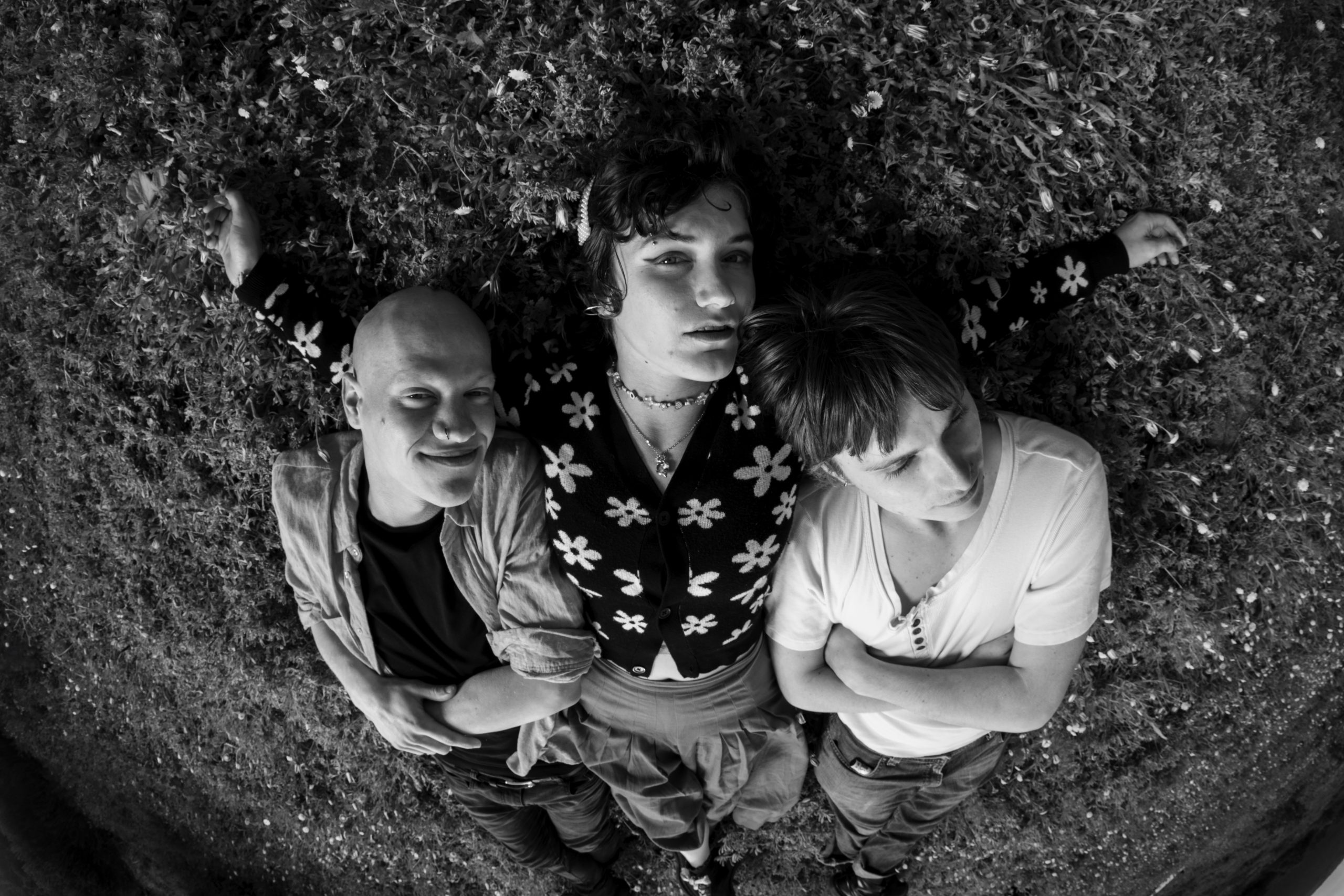
Cistamatic’s Fear Is the Weapon comes from a very clear place. These are songs about power, control, anger, relationships, and the pressure of living through systems that keep grinding people down.
In the interview below, the Cistamatic guitarist and vocalist talks about the ideas behind the album, the different voices inside her writing, and the realities of making this kind of music in Cape Town. We also got into how the band works as a trio and what she wants these songs to leave behind.
“anyone with half-decent ears who hasn’t been living under a rock can hear that we have a politically progressive message.”
I first came across you through your Spinäl Sessions performance. When you went in to record that, what did you want it to say about Cistamatic to someone hearing the band for the first time? And why was “Gutter” the right song to open with?
Gabbi le Roux: Look, Cistamatic is open to interpretation, but anyone with half-decent ears who hasn’t been living under a rock can hear that we have a politically progressive message. Some people might call it “woke punk.” With every performance, the main thing we’re trying to get across is our musical and moral values. We believe in radical freedom, radical expression, and radical empathy.
We opened with “Gutter” for two reasons. First, it’s a pop song, so it’s an easy way to bring people into the band’s world. Second, even though it looks like a breakup song on the surface, it is political. It’s about desire, bondage, and empathy. It’s about how people can drag you down with them if you let them. It’s vulnerable, but it also has a defiant edge. Just because I love you doesn’t mean I’m going to ruin my life for you, even if women have historically been taught to do exactly that.
And yeah, we were very happy to do Spinäl Sessions. Spinäl Täp is my favourite bar, and I sometimes work there too. When Carl asked us to do it, we were excited. Free beer, free recording, and free video? Fuck yeah. We’re really happy with how it turned out, and Marla, Carl, and Nick made the whole thing fun. Shout out to Spinäl Täp. They’re great.
“If the riff doesn’t hit on its own, it doesn’t matter how many guitars are playing it.”
As a trio, what do you rely on to make the songs hit that hard without a second guitar?
Honestly, I don’t think more instruments automatically mean more punch. Look at the White Stripes: two people, an octave pedal, and huge songs. They made me realise you don’t need to overcomplicate things for the music to hit hard. It’s about contrast. You palm-mute the guitar in one section so the next riff lands harder. You use the negative space. And you build the song properly. If the riff doesn’t hit on its own, it doesn’t matter how many guitars are playing it.
James and Ethan are also masterful players. They create a lot of rhythmic texture and melodic flair by filling the space where an extra instrument would usually sit. That also means you can actually hear what everyone is doing.
We joke about this a lot, but it’s kind of true: Ethan is basically playing lead on bass. He’s doing most of the more complex melodies and riffs while I’m chugging along and concentrating on singing.
“Capitalism and technofascism want you to fear dissent, fear speaking out, fear being left behind, fear connection, fear other people, fear empathy, and fear community.”
The album is called Fear Is the Weapon. In your world, who is using fear that way, and what does resisting it actually look like in real life?
Fear Is the Weapon is about modern capitalism and the rise of technofascism. Capitalism and technofascism want you to fear dissent, fear speaking out, fear being left behind, fear connection, fear other people, fear empathy, and fear community. The point is to isolate us so we’re all sitting alone in our rooms, staring at AI slop on our phones instead of going out into the real world and taking part in it.
We’re exhausted by shitty jobs and too busy trying to survive to fully think about what’s happening to us. While we get lonelier and more apathetic, the things that make life meaningful are stripped away.
Resisting that means building communities, speaking out, and actually engaging with each other in real time. It means supporting local businesses and local artists. It means making things for meaning, not for the algorithm. It means refusing to dumb things down or play along with whatever is trendy or profitable at the expense of real creativity and real change.
“we live in this weird panopticon of control where we submit to being watched all the time because our lives are validated online.”
“Invisible Beast” clearly has a target. What is it, and why did you want to hit it that hard?
The invisible beast is a metaphor for capitalism. It eats us alive. The whole song is about what I was talking about before: we live in this weird panopticon of control where we submit to being watched all the time because our lives are validated online. Then we do the same thing to other people, while big tech and big corporations make money off our backs and radicalise us into fearing and hating people who aren’t like us – gay people, Muslims, feminists. Just look at 4chan and neo-Nazism.
Then we’re sold policies that oppress us even more by dividing us through moral panics, which stops us from working together against the system itself. It really does feel like some mind-flaying, thought-controlling monster that eats everything in its path. It is destroying the world literally, through the environment, and also by crushing human potential.
“This is life-or-death stuff.”
Part of my job is to put these ideas into language most people can understand without getting buried under terms like techno-feudalism. I think the song gets that urgency across both musically and lyrically. This is life-or-death stuff. I’m not being dramatic. Under this system, if you don’t pay, you don’t play, and that’s fucked up. We already have more than enough resources and technology to provide for everybody on this planet. So why don’t we? Because of this invisible monster we’ve convinced ourselves we can’t defeat, so we keep capitulating to it.
“I think Kurt Cobain would have respected what we’re doing musically and intellectually.”
I’ve compared you to Nirvana more than once. Does that make sense to you, or does it miss what you’re actually trying to do?
Yeah, that makes sense. Nirvana were the first band I was ever obsessed with. I learned guitar by playing Nirvana songs. James, our drummer, is also a massive Nirvana fan, so the comparison is not random. They were formative for both of us as young musicians.
The fact that they were a three-piece and politically progressive also lines up. We don’t mind that comparison at all. I think Kurt Cobain would have respected what we’re doing musically and intellectually.
“‘Psycho Bitch’ is me putting on my big, angry, scary feminist boots and threatening to beat up fascists and rapists.
Your songs move between the personal and the societal. Do you think of your writing as confession, commentary, character work, or a mix of all three?
It’s a mixed bag. But I personally think everything is political, even the personal. As a woman living under patriarchy, every moment of my life is coloured by power dynamics. So I don’t really believe people when they say they’re apolitical. You’re affected by power. That’s political. And if you have the privilege to call yourself apolitical, that usually means those power dynamics are working in your favour. Sorry for the rant.
Some of the writing is very earnestly confessional. On the first album, songs like “Masochist” and “Gutter” come out of intimate relationships. Then there are songs that work more through commentary and character. “Psycho Bitch” is me putting on my big, angry, scary feminist boots and threatening to beat up fascists and rapists. I’ve never punched anyone in my life, but it captures that wild, hysterical anger I feel towards racists, homophobes, and men who abuse women.
“Yapping” is sung from the point of view of a bored partygoer who is frustrated by the shallow side of rock subculture, and “Judgement” comes from a similar place. “Forgiveness Is a Dove” also comes from a character perspective, a bit like PJ Harvey: the rambling ghost of a woman scorned, with something esoteric mixed into the violence of heartbreak. Then songs like “Invisible Beast” are straight calls to political action.
I think I’m a pretty dynamic writer. Certain themes keep coming back, which gives the album a cohesive feel, but I get there in different ways. Sometimes it’s tongue-in-cheek, sometimes it’s very earnest, sometimes it’s more mysterious. I like giving people work they can find multiple meanings in.
“A lot of our fans are young women and queer people who feel seen and understood by the music.”
What do you want people to leave with after hearing these songs?
Catharsis, mostly, in a very frustrating world. A lot of our fans are young women and queer people who feel seen and understood by the music. One thing people seem to appreciate is that we say things plainly. We don’t dress them up and pretend everything is fine. It isn’t fine. We’re all struggling. We’re living in a dystopian hellhole, and it’s refreshing when someone actually acknowledges that instead of trying to placate you.
I think almost everybody can relate to the frustration and the desire for freedom in these songs. Ideally that becomes some kind of push, whether that’s getting more politically educated, showing more empathy to people who are different from you, taking part in your community, or fighting for real systemic change.
“we got to be part of building a new scene from the ground up, one that feels a bit more progressive and a bit less predatory than what was there before.”
How has being based in Cape Town shaped the way you write and the way you build Cistamatic?
It’s interesting. We started Cistamatic as a band just after COVID, when the scene in Cape Town was basically dead. I always joke that everyone from the old scene had either had babies, moved to Germany, or gone to rehab, sometimes all three. But it meant we got to be part of building a new scene from the ground up, one that feels a bit more progressive and a bit less predatory than what was there before.
Cape Town is also a deeply unequal and politically violent place. At least for me, growing up here made it impossible to ignore that, and it shaped my philosophy and motivations in a big way. Our little rock scene has improved culturally, but it’s still largely made up of white, economically privileged men. That’s not just a scene issue. It’s part of a bigger political reality.
I do see small changes: more diverse lineups, more genre mixing, fewer people being cagey about genre purity. But it’s hard because the scene is tiny, and the economic infrastructure to support musicians and artists just isn’t there. Most of us have to do this on the side, and that takes time, labour, and money. Most people in South Africa can’t afford to put that into something that isn’t profitable.
Cistamatic’s Fear Is the Weapon is out now.


