



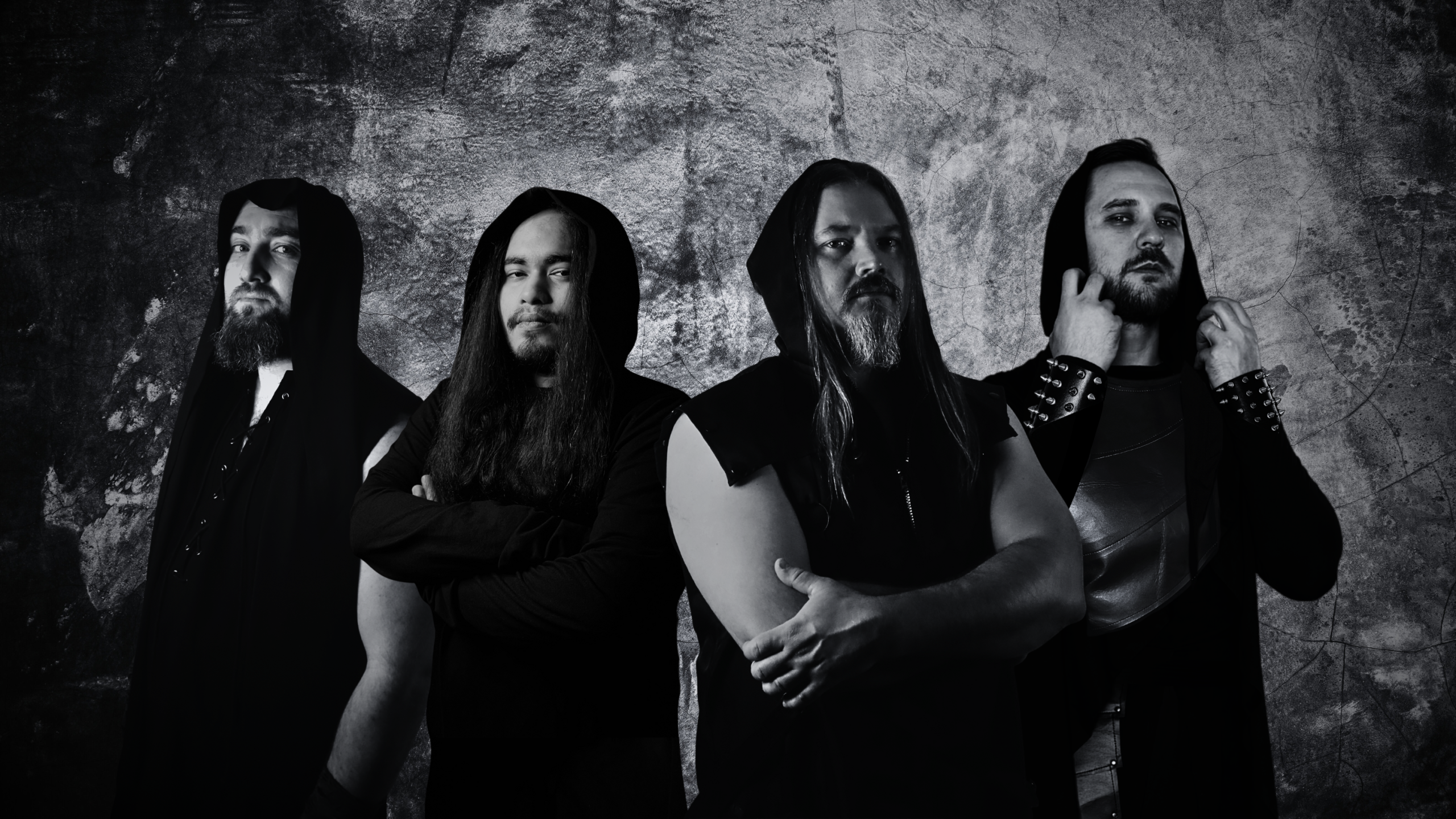
CULT OF THE MOON describe themselves as melodic black metal built on dark atmospheres, lunar imagery, and a steady push-and-pull between aggression and melody. Lunar Eclipse is their first full-length, and it’s also the clearest statement of what they’re trying to do, musically and conceptually.
The band began in Israel, but the lineup and the work quickly became international. Members are spread across different countries, files move back and forth, and the album took shape without the usual “everyone in the same room” routine. What comes through in this conversation is how personal the record is, and how much of it is tied to memory, grief, and the need to turn private feelings into something you can actually play.
You started in Haifa and later spread across Washington and Kolkata. What did that shift do to the way you write, rehearse, and stay connected as a band?
Andrey: We did start in Haifa, Israel. After our bass player Artyom relocated to Canada, we needed a new bassist, so we contacted Alfred, who was already following us on Instagram. Alfred lives in Kolkata, West Bengal, India. We’d chatted in DMs before about music, and I remembered seeing a video of him playing bass. He had these sick clips. I messaged him right away to ask if he could help us finish the album. He jumped in and completed the bass lines that were still missing. Even though he’s in India, we communicated in a really productive way, so we offered him a permanent spot. He’s awesome.
As for Washington, DC, I moved here about a year ago, so I’m in the US now. Roman is a digital nomad and works from different places. Morax is the only member who currently lives in Israel. We formed in Israel, but at this point, “international band” is the most accurate way to describe us.
“It took us three years, across four countries (Israel, India, the US, and Italy), to finish it, but we got there.”
Lunar Eclipse is your first full-length. What did you need your debut album to achieve?
Alfred: For us, Lunar Eclipse was more than a collection of songs. It was our introduction as artists. Since it’s our debut, we wanted it to reflect our sound, our emotions, and the stories we’ve carried for a long time. We weren’t chasing popularity as the main goal. We wanted listeners to feel something real when they heard it. We also wanted the album to show our dedication, and to prove we can build a complete experience together. If people listen and understand our journey, then we feel it did what it needed to do.
Andrey: It was a complicated process. Roman and I started by writing riffs and demos. We sent them back and forth until we felt we had a direction for the album. Then we contacted Morax. He was an old friend, but he wasn’t our drummer at the time. We sent him demos, met for a rehearsal, and he connected with the material, so he joined. We rehearsed a lot, jammed, wrote, and kept editing both new and older ideas.
Then our bass player left during the recording process and couldn’t finish his parts, so we had to solve that. On top of that, all the recordings were done at home. We didn’t use a studio because we didn’t have the budget. This debut is total DIY. There are advantages to recording at home, mainly because you save money, but it can also be a trap. When it feels “free,” you can take it too slowly. No deadlines, no pressure. If you don’t stay disciplined, you can get stuck. And we’re grown men with jobs and responsibilities, so we had to balance work, family life, rehearsals, and recording. My move to the US also slowed things down for a bit, but I was still able to finish my parts remotely from here.
For production, mixing, and mastering, I want to give a shout-out to Francesco Sebastiani from Okhema. He’s a friend from Italy, and he shaped the sound of this album. He mixed and mastered it remotely and suggested ideas that made the record more interesting.
It took us three years, across four countries (Israel, India, the US, and Italy), to finish it, but we got there. We learned a lot, and we’ll apply it to the next one. We’re genuinely happy with the final result, and Francesco was patient and supportive the whole way.
“The moon motif appears in almost every ancient culture and religion.”
What does the lunar theme mean to you on Lunar Eclipse, and why did it need to sit at the centre of this record?
Andrey: The name CULT OF THE MOON and Lunar Eclipse are a bit at odds with my original vision and what the project became. Before we were even a band, when I was thinking about the music I wanted to make, I was focused on atmospheric and mystical black metal. The moon theme came from a very personal place for me.
I’m a historian by profession (Middle Eastern Studies and South Asian Studies), and I research ancient cultures. The moon motif appears in almost every ancient culture and religion, from Akkadian and Sumerian traditions to Hinduism, Judaism, paganism, Christianity, Islam, and many others. There are endless stories about the moon, its power, its energy. I’ve always wanted to explore that mystery and translate it into black metal.
“The moon is my mother, and the eclipse is her death.”
What was the first piece you wrote for this album, and what did it set in motion?
Andrey: I had this vision for atmospheric, nocturnal, mystic, magical “lunar” metal. I wrote the first song for the album in 2018 or 2019. It’s “Lunar Eclipse,” and that’s why the album carries the same name. The intro to that track is the clearest example of the band’s initial vision. But in 2021, I lost my mother to cancer after a long battle, and everything changed. I felt like the thing I loved most had been eclipsed and disappeared, so the name Lunar Eclipse took on a different meaning. The moon is my mother, and the eclipse is her death.
Very quickly, grief became the main inspiration I deal with through our music. That first song, and her death, set the tone for the album. It deals with pain, longing, inner struggles, bereavement, loss, and sorrow.
I think that’s why Roman connected with the atmosphere too. He wrote songs for the record as well, and he could pour his own inner world into it, in a way that matched what I was feeling.
The record leans hard into atmosphere. What were you doing in the writing to make atmosphere feel structural?
Alfred: Because we play melodic black metal, atmosphere was our starting point, not something we added later. A lot of tracks began with tremolo melodies, ambient passages, and guitar tone, and we built the structure around that mood. Layered guitars, space, and dynamic drumming helped the emotion guide the transitions. The vocals were placed to sit inside the soundscape.
Roman: The atmosphere and the structure came naturally. We wrote the songs to express what we felt at the time. We did worry that the tracks might be too different from each other, but in the end they feel cohesive. Each song stands on its own, but it’s still part of a bigger picture.
Andrey: I agree with Roman and Alfred. I’d add that we did want some kind of continuity between songs, emotionally and musically. When you listen to tracks separately, they really are different, but when you play the full album from start to finish, each song feels like part of a larger puzzle. The atmosphere comes from what each member was feeling while making the record. And on the musical inspiration side, I want to thank bands like Summoning, Agalloch, and Alcest. They had a huge impact on me and the way I think about atmosphere.
“When you travel through Africa and see how different countries are, and you start to understand why, you realise how magical the place is.”
You mentioned Arka’n Asrafokor and the African countries you visited in our first conversation. How did your time in Togo change the way you look at scenes outside the usual European/North American spotlight?
Andrey: Arka’n Afrafokor are great. Their music really carries the feeling of where they come from, and they do it in a creative way. I’d love to see more bands like that. Even before I went to Togo, I always knew there were amazing musicians outside Europe and the US, especially in Africa. I’m a big fan of Khaja Nin from Burundi, and Miriam Makeba from South Africa. They’re two of the greatest singers of all time for me.
I went to Togo because before that I was in Senegal, filming a video clip for a cover and tribute to the legendary Senegalese singer Ismael Lo. I travelled from Israel, with stops in Ethiopia, Mali, and Togo, to pay tribute to a West African singer. I crossed the continent for that. It still feels crazy when I think about it.
Togo is very different from Senegal. When you travel through Africa and see how different countries are, and you start to understand why, you realise how magical the place is. The people, the landscapes, the music.
Africa has been on my radar for a long time. One moment that stuck with me was back in the early 2000s, when the Israeli band Betzefer was linked to the idea of touring South Africa with Sepultura. I don’t even remember if it actually happened, but the idea alone blew my mind. An Israeli band, Brazilian legends, playing in Africa. It made me think: if big bands go there, there must be an audience. And if there’s an audience, there must be local bands too. I’ve always felt Africa has huge potential, and I hope the world catches up to that.
AFRICA.ROCKS exists because African metal gets ignored by the standard map. From your perspective, what decides who gets seen and who stays invisible?
Andrey: I don’t think African bands are ignored on purpose. Metal is underground almost everywhere, even in the US and Europe. It’s not mainstream. Even big European metal bands are still living in a niche world. A handful of extreme metal bands might reach a few hundred thousand monthly listeners, but next to mainstream music that’s nothing, and we’re talking about genre giants. For smaller bands, the numbers drop fast.
Most bands are touring constantly to play for a couple hundred people and keep things going, even in places where metal is accepted. So imagine how hard it is in countries where metal was never part of the musical culture.
I think the African scene is still small, so the exposure is small too. It reminds me of Israel and other Middle Eastern countries, except Israel has had metal since the mid-80s. Even with pioneering bands like Salem, Melechesh, Orphaned Land, and Betzefer, people still act surprised when they hear there are metal bands in Israel.
In Africa, the boom is newer, so it will take time before African bands become a normal part of the global metal conversation. I hope it happens soon, because there’s so much potential.
“For us, it would be a failure if everyone felt the exact same thing we do. Music is personal. It should stay personal. We hope each listener connects spiritually and emotionally in their own way.”
What do you want African listeners to hear in Lunar Eclipse beyond genre and aesthetics?
Andrey: We want them to hear the album as a full piece, from start to finish. We’re careful about explaining and interpreting our music, because we want the connection to come from a personal place for each listener. There’s meaning behind every song, every riff, every sound, but we don’t want to dictate what someone should feel.
For us, it would be a failure if everyone felt the exact same thing we do. Music is personal. It should stay personal. We hope each listener connects spiritually and emotionally in their own way.
What’s moving behind the scenes right now for CULT OF THE MOON?
Maor: We’re getting ready for upcoming shows and writing new material.
Andrey: Right now we’re pushing the album as hard as we can. We’re promoting it in every direction, and we hope that helps us reach festivals, shows, and new audiences. At the same time, like Maor said, we’re writing for the second album. It should be more mature, more solid, more polished. We plan to record it properly this time, in a well-known European metal studio. We can’t promise which one yet, but it will be a strong, direct second record. And yes, we really hope we get to perform in Africa sometime soon.
Support CULT OF THE MOON and pick up Lunar Eclipse on Bandcamp.


