


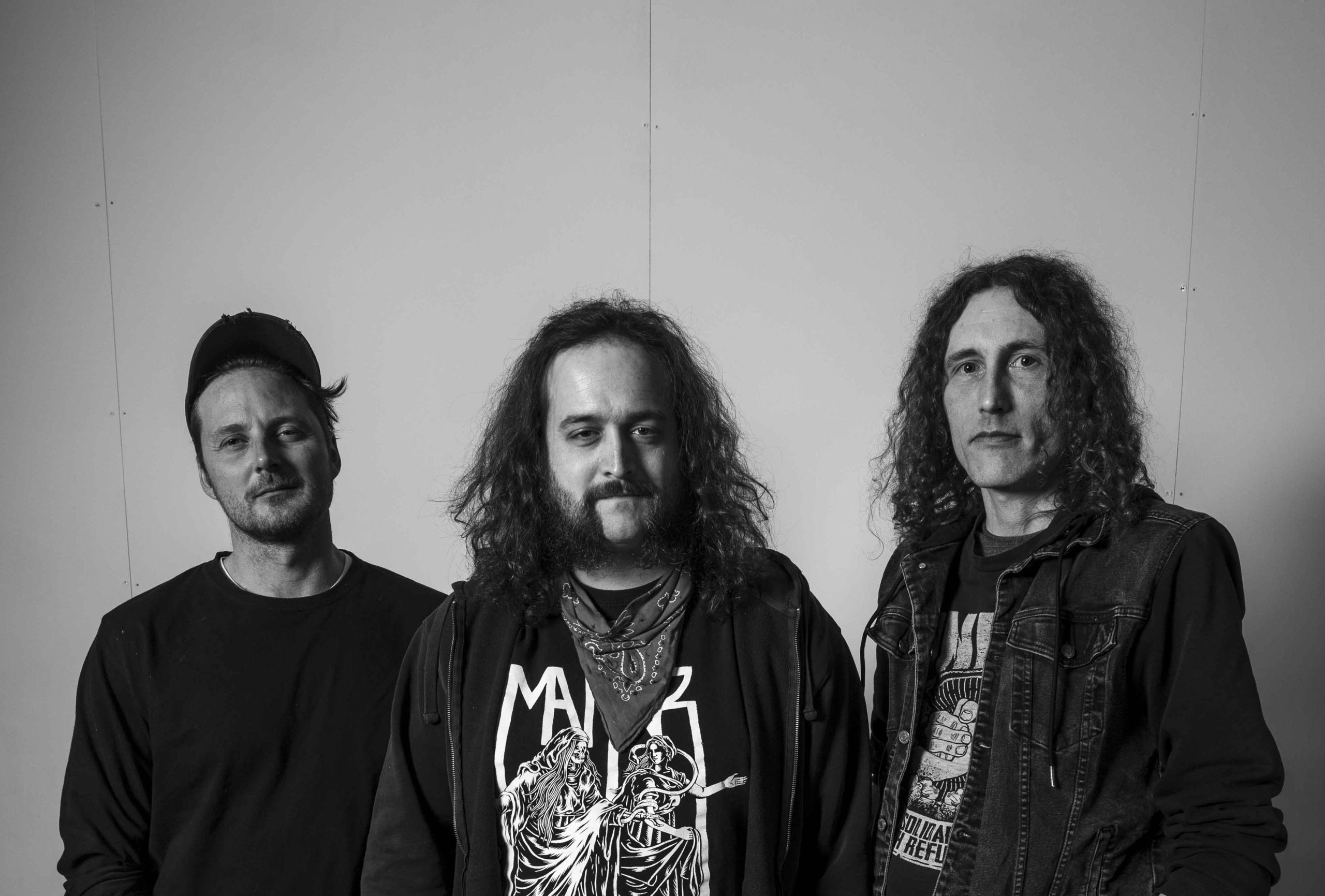
Skullpriest have spent the last ten years making heavy instrumental music from a small town in Switzerland. The band started in 2015, with Martin coming from punk and metal, Roman from hip-hop and electronic beats, and Patrick from prog, space rock, krautrock and stranger guitar music. Those three paths still come through in the way Skullpriest write.
Their new album, Collapsing Walls, carries that range into five long instrumental tracks, moving through heavy psych, stoner rock, doom, progressive structures and post-rock atmosphere. The record was written by Martin and shaped by the three musicians in rehearsal. It was recorded and mixed by the band at iNi Studio, which has become part of how Skullpriest work.
In this interview, Martin and Patrick talk about writing instrumental heavy music, working without vocals, recording on their own terms, the band’s wider progressive side, and how heavy music can still speak across borders without needing words.
“If you do instrumental music, I feel you have to go to different places within a song to keep it interesting. You cannot just write verse, chorus, bridge, paste it together and call it a day.”
Skullpriest move through instrumental heavy psych, stoner rock, doom and more progressive sounds. How would you introduce the band to AFRICA.ROCKS readers coming to you for the first time?
Martin: If I had to label our music in terms of genre, I would place it somewhere within the realms of instrumental heavy psych, stoner rock and doom metal. We try to transcend the barriers of genre definitions and explore wherever our creativity leads us. But, after all, we are just three friends from a quite insignificant small town in Switzerland who have been making noise together for ten years now.
Patrick: We never really cared about genre or felt the urge to adhere to any genre conventions. Yes, our music has a strong stoner and doom foundation. Looking back at the time when we got together, this seems more like a coincidence to me. Actually, we have quite different musical backgrounds. Martin has his roots in punk and metal, Roman comes from the hip-hop and electronic beats corner, and I am a long-time fan of prog, space rock, krautrock and other weird stuff.
When we started to write songs in early 2015, Martin and I were already stuck in the stoner-doom swamp. At that time, we were going to a lot of concerts and festivals together, and before Skullpriest we had tried similar stuff with a different project. So, we were already in the thick of it, but we never deliberately decided to form a stoner or doom band.
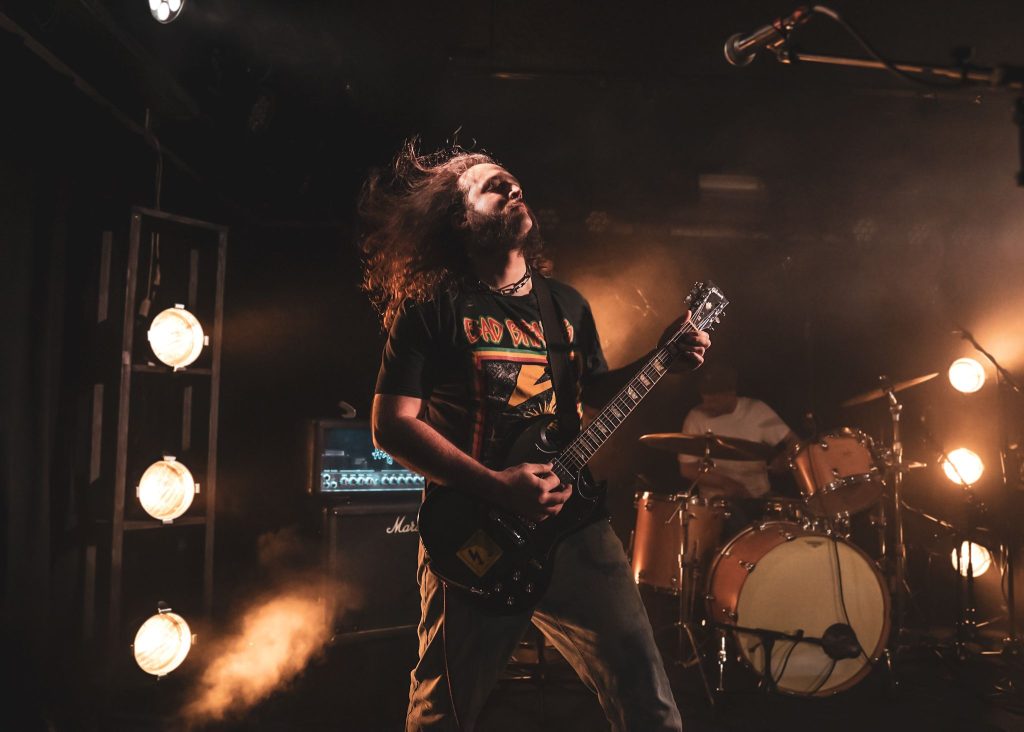
Collapsing Walls moves through very different moods across its five long tracks. When you were writing the album, how did you decide what each piece needed in order to hold together without vocals?
Patrick: This has to be answered mainly by Martin, because all the tracks were written entirely by him, as they were on our former album, On the Verge. Our songwriting process has changed over time. Martin always brought the better part of the riffs and ideas into the band, but earlier we mapped out many tracks together.
Martin: When I write songs, I usually start to noodle around on my guitar without any clear intent. When a good riff comes out of my fingers, I start working on it. As for the different moods within the tracks, I enjoy contrast and dynamics in music. For instance, when there is a fragile melody, I like to contradict it with a ridiculously primitive and heavy riff, or vice versa. If you do instrumental music, I feel you have to go to different places within a song to keep it interesting. You cannot just write verse, chorus, bridge, paste it together and call it a day. If you repeat a section, there must be something different when you play it the second time.
Patrick: Rehearsing the songs together plays a crucial part in our creative process, especially when it comes to contrast and dynamics. We often record our sessions and discuss them afterwards: how do we shape transitions, where is a drum fill needed, where should we add an additional layer on bass?
You record and mix your music yourselves at iNi Studio. What does working that way let you keep under your own control that you might lose in a more external studio setting?
Martin: That is hard to answer, because we have always worked DIY style. I guess that in an external studio, other people could mingle in the creative process and insert their opinion or taste, and I would not like that. That aside, it is a hell of a lot cheaper.
Patrick: And you do not have a strict time limit to get things done. It does not work for us to record our tracks swiftly in a few sessions to keep costs low. Working that way also enables us to try things or add last details to a song while recording.
Martin: I also work with other bands in our studio. As a recording engineer, I try to restrain myself from bringing in my own ideas or personal taste. Occasionally, when I think I might know how to fix a “problem”, I make suggestions. But I only act with the band’s consent, and I am totally fine if they reject my proposals. At the end of the day, it is their record. My job is to help them capture their vision.
“After years of playing together, our musical abilities have grown, so we can play a bit more complicated stuff by now.”
Skullpriest have gradually brought more progressive and post-rock elements into the band’s sound over the years. At what point did that wider approach start to feel like a natural part of the music instead of just an extra layer?
Martin: That came pretty naturally. Patrick and I had been listening to prog and post-rock, alongside doom and stoner, long before Skullpriest came into existence. So that influence has always been there. Patrick introduced me to lots of Italian progressive rock bands from the 70s, and bands like King Crimson and Frank Zappa.
When I first came up with odd time signatures, I was not even aware of the fact that I was not in 4/4. It just felt right that way. Patrick had way more knowledge of music theory, so he could count all the stuff I was playing. After years of playing together, our musical abilities have grown, so we can play a bit more complicated stuff by now. The wider scope of our music comes partly from that, I guess.
Patrick: There always was a certain post-rock or space rock vibe in our sound. You can hear it quite clearly already on our debut album, Fake but Real. Take tracks like “Contamination”, “Borderline Fence” or “Cosmic Swine” as examples. It never felt like an extra layer to me, and I think it was an organic part of our music from the start. But as Martin said, after years of playing together, our musical skills and vocabulary have developed, and this allowed us to bring a wider range of different sounds and styles into our music.
“there is a whole lot of feeling and emotion packed into our music, and a great deal of it flows into it when we play together.”
Instrumental heavy music often leaves more space for listeners to project their own meanings onto it. When you write a track like the ones on Collapsing Walls, how much are you trying to guide the listener emotionally, and how much do you prefer to leave open?
Martin: This may sound a bit pretentious, but I do not have the listener in mind when I write music. I really enjoy the fact that people listen to our records and come to our concerts, and I am grateful for all that. But at the same time, for me it is mostly about getting out of my head what bangs against my skull. When writing a song, I am inspired by the things going on around me and the feelings that are triggered by them. That may be music I am listening to, stuff I see in the news, or things I live through.
But apart from our own creative intent, I like the thought that people can find their own meaning in our music. Trying to explain what we try to express with the song would destroy this. I think art in general gets more interesting the more it allows people to perceive it in their own way. This is something we try to achieve, for example, when we name our tracks and albums. We try to avoid being too explicit in order to leave room for various interpretations.
Patrick: It never starts with a plan to guide the listener emotionally or in any other respect. But there is a whole lot of feeling and emotion packed into our music, and a great deal of it flows into it when we play together. I guess music functions as some sort of self-therapy for us, and we use it to let off steam and to cope with all the things that bother us. Consequently, for the most part, negative emotions are in the game, and that comes through quite clearly, I think. But it is not a clear-cut emotional picture that our music conveys, more some sort of raw and undefined chaotic energy.
On the other hand, how a piece of music is perceived, or how people are affected by it, is a highly subjective thing. As I see it, artists have only limited control over how their art resonates with the individual listener. Maybe, then, there is no point in trying too hard in the first place. But anyway, we prefer to leave things open, so it is easier for the listener to relate to our music in their own personal way. And we could not be happier if people can somehow find themselves in our music, and if it helps them to get along with their life, as it does for us.
“heavy riffing can work as some kind of language that operates without words and that can be understood by everyone who is willing to engage with it.”
AFRICA.ROCKS is interested in how heavy music scenes speak to each other across borders. From your side in Switzerland, what have you learned from playing with bands from different countries, and how do you see instrumental heavy music connecting with audiences beyond language?
Martin: I think that, despite cultural differences, humans around the globe are pretty similar. We all share the same basic feelings that we try to express through the creation or consumption of art. I also think that most people who are into heavy music have to cope with some hardship in their lives. Of course, my individual experience as a Swiss citizen is different from that of a metalhead in Botswana. But heavy music allows us both to gain strength and to endure our hardships, wherever they may come from.
Patrick: To me, meeting up with bands and artists from other countries always feels like a reunion with friends, although I have never met those people before. It is uplifting to see them rocking the stage and spreading vibes with their music that feel incredibly familiar to me. This might sound a little cheesy and sucked dry, but I think heavy music in general has the power to connect people from all over the world. And I believe this is even more valid for instrumental heavy music, as it does not rely on words and language, which may form an obstacle in this regard.
So, I might have to revise to some extent what I said earlier about subjectivity in art. I think that, on a very fundamental and transcultural level, heavy riffing can work as some kind of language that operates without words and that can be understood by everyone who is willing to engage with it.
Buy/Stream Collapsing Walls on Bandcamp.


