


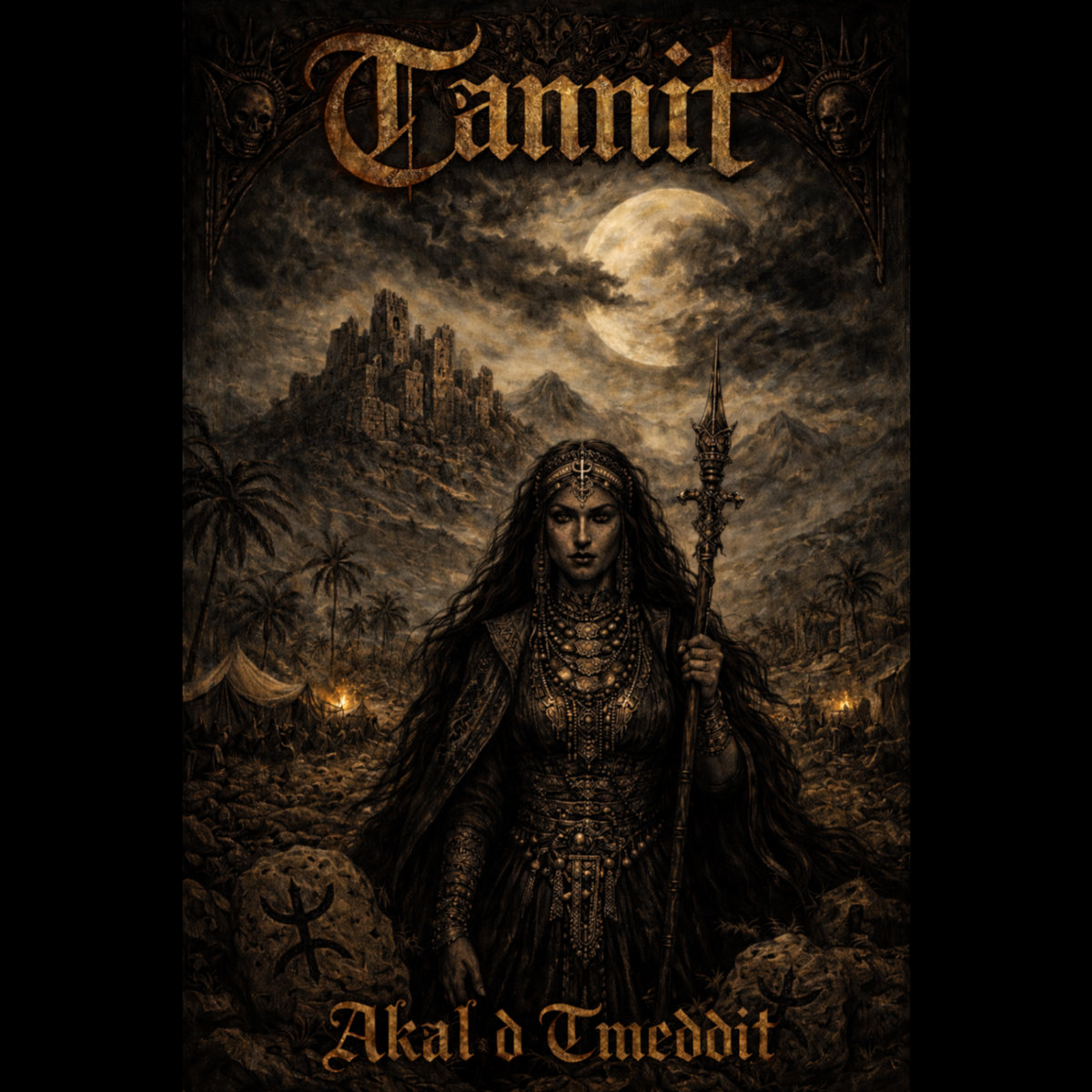
At first, North Africa and Scandinavia might seem worlds apart, but they share something that makes black metal feel at home in both. There’s the same mix of harsh, spiritual landscapes, the same pull toward ancestry, and an identity rooted in a time before organized religion. In North Africa, the pagan Amazigh and Berber spirit holds that same raw essence you find in the old Norse and Sámi traditions: a deep respect for the land, for the people who came before, and for the rituals that never really died.
Within this context comes Tannit, a black metal project from Morocco that channels the rawness and austerity of those origins with surprising clarity. Black metal, despite its long history, remains the only subgenre of metal that can still draw genuine interest with an unpolished, old-school format in 2026. And this recording is a perfect example: direct, simple, and guided by instinct.
The EP offers only two tracks, but they tell two very different stories. The first, “Tislit n Tafukt”, benefits greatly from the presence of vocals, giving the song shape and intent. By contrast, the second and last track, “Abrid n Itran”, almost entirely instrumental, loses some of that force. Here, the double kicks speak instead of words, and the raw and jagged riffs feel like they were pulled straight from an ancient demo tape. This roughness, intentional or not, becomes part of the music’s charm. Listening to Akal d Tmeddit is like discovering an old cassette from the late ’80s or early ’90s, recorded somewhere deep in the true North, when black metal felt more like a statement than a product.
Still, one can’t help feeling this project might have gained more by releasing “Tislit n Tafukt” as a standalone single, rather than stretching it into a two-track EP that loses its edge when the vocals disappear. The voice gives identity; the silence leaves space that the instruments can’t fully fill.
Even so, Akal d Tmeddit captures something rarely found; a genuine bridge between two cultural poles that mirror each other in spirit. It’s black metal stripped to the bone, guided by land and lineage rather than trend or nostalgia. And though brief, it’s a clear reminder that the fires of both the North and the Maghreb still burn for the same reason.


