



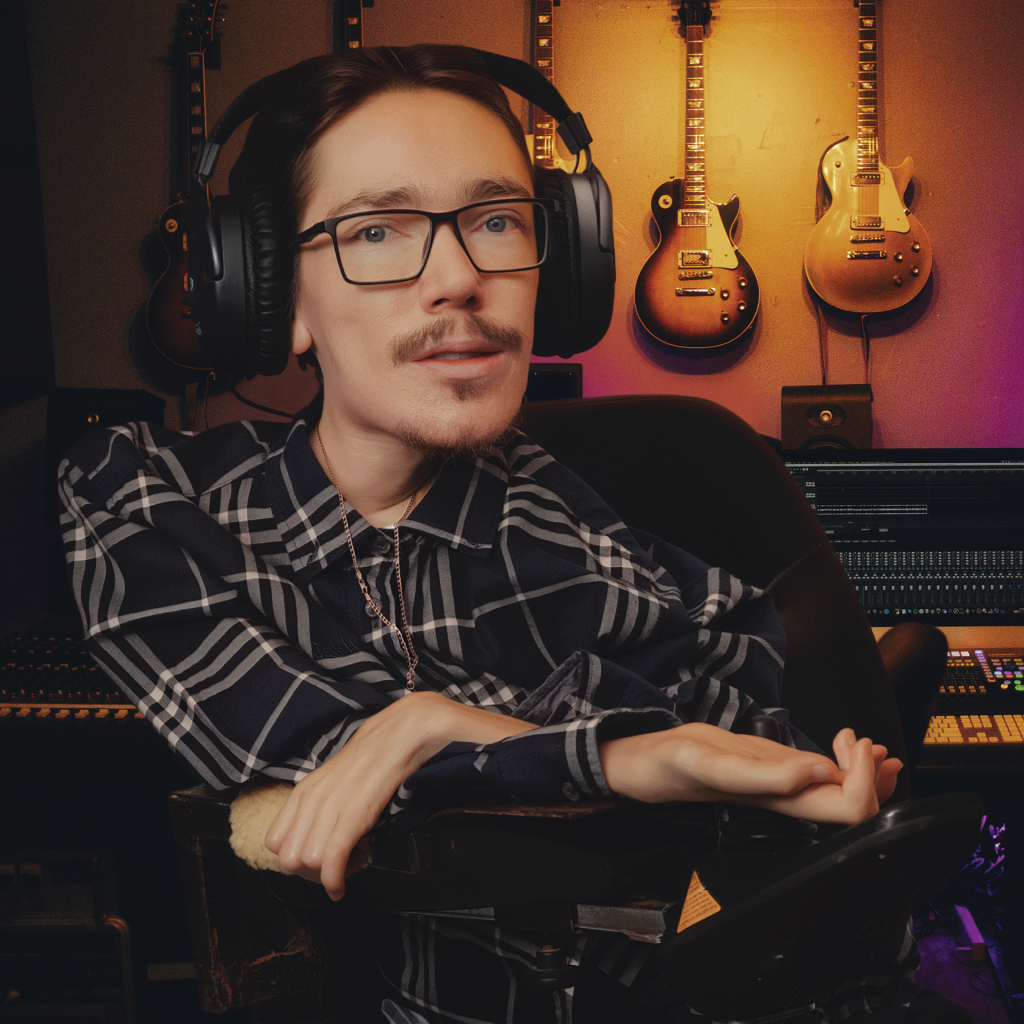
Meet Stephen Gawking, the alter ego of artist Ijay Swanepoel. Despite living with Spinal Muscular Atrophy Type 2, it did not hinder him on his way to achieving his goals. Stephen has attracted critical attention as a songwriter who fearlessly tackles topics that inspire and provoke thought. He writes about things such as mental illnesses, grief, faith, patriotism, creativity in the age of artificial intelligence, and much more. He has created a platform where performers could tell their stories to the world via songs. We asked him many questions concerning the topic and his ideas in general.
“it was like a mindset of imposing my will over whatever obstacles or struggles that are in my way and making the best of it.”
Your stage name is extraordinary and provokes curiosity and interest. How did you come up with it? What does it mean to you?
Thank you so much. It’s a play on Stephen Hawking, the astrophysicist, who had a massive impact on me in terms of inspiration. To see someone who looked similar to me become so influential and respected really gave me a spark of hope that it was possible. Even though I don’t agree with everything he believed as an atheist, it is still like an ode to him. That is why I went with Stephen Gawking, The Nuclear Lyricist, with the latter part meaning that we will always try to write powerful lyrics.
You have Spinal Muscular Atrophy, which certainly shapes your worldview. Still, your songs rarely focus on your disability; instead, they encourage people to believe in themselves, have hope and dream. Did this attitude come naturally to you, or did it develop over time?
To be honest, I have never really seen my disability as a defining factor in my life or who I am in a negative way, but rather as, well, this is me as a whole, and I don’t know any other way of being. Obviously, there were, and still are, times when one gets down and frustrated, but everyone goes through that. At the end of the day, we all have that in common as humans. That is why I don’t only write about my own struggles, but more about our struggles as humans and how it is important to acknowledge them before we can overcome them.
Before you became Stephen Gawking, you were Ijay Swanepoel, a man who fell in love with music and storytelling. If you could talk to your younger self, what would you tell him? What was the moment when you realised your feelings for music were something greater than your own needs?
This is a very good question. I would tell myself to embrace creativity and the arts much sooner and pursue them, because that has always been my number one passion and escape. However, I just saw myself as a consumer and not a producer. I can’t really say when the exact moment of realisation came, but all I know is that it was always there, and I just didn’t have the confidence or belief to go for it.
You say that “your life is a portrait, and you are holding the brush”. Where did you get this idea, and how does it help you?
[He laughs] Yeah, looking back, it sounds arrogant now, but ultimately it was a mindset of imposing my will over whatever obstacles or struggles were in my way and making the best of it. However, after coming to faith in Christ, I now know that it was pride talking, and everything I achieve or do that is good is all by the grace of God and Jesus.
When songwriters create their work, they often reflect their inner world, trying to reach out and connect with listeners. But you seem to be trying to understand your audience and what they need. Is this assessment accurate, and how does it affect your creativity?
Yeah, it’s actually a combination of both, or an attempt to find a balance between my perspective and a worldly perspective, so that I can accurately tell a story that can reach and resonate with most people. At the end of the day, there is always common ground in any narrative that is positive or good, but you will lose people when you push an agenda rooted in your own personal ego.
“I would rather focus or be part of a solution than to keep falling deeper into to a hole of hopelessness.”
It seems that all your songs have something in common, like a thread that connects them. No matter what themes they explore, for example grief, mental health, rugby or faith, your music always carries hope. Why is this feeling so important to you?
Because there is always hope and a silver lining. That is what keeps us going as humans, especially in times like these, when negativity is arguably at its highest. So, I would rather focus on, or be part of, a solution than keep falling deeper into a hole of hopelessness.
People describe you as a songwriter, but your work extends far beyond the role of creating music. You bring people together, develop concepts and, in many ways, direct the project. Does this mean that you are not only a songwriter but also a director of your collaborators?
Yeah, look, I don’t like to label myself with a certain title because it sounds arrogant. However, a more accurate title would be “Creative Director” of the Stephen Gawking project, much like the director of a movie or film, which I draw a lot of inspiration from, except that it is in the medium of music.
You compare yourself to the likes of Professor X and Nick Fury, using your “superpower” to gather an extraordinary community of artists around you. This analogy seems entirely accurate, given the calibre of your collaborators. How do you recognise the people you want to work with?
There is no real formula or strategy that we use, and each song has a different approach. Sometimes, we more or less have a certain artist or vocal in mind that we want for a song, while at other times it is very much a creative freedom approach. For example, with “Manna”, it was initially only going to be Eva as the vocalist, but when we recorded at Mark’s studio, he liked the song, and we asked him whether he would be willing to record something that he felt inspired by. Ultimately, it evolved and elevated the song to a new level.
The calibre of the artists working with you would be desirable for any musician. It seems that each of your songs speaks a different language, coming from an entirely different genre. What have you learned from working with so many different people, and has anyone surprised you with a new approach to music?
I think that is the beauty of South Africa and our diversity, which inspires and speaks through Stephen Gawking as a reflection of it. We are in a privileged position to be able to draw inspiration from that diversity and not be limited in terms of creativity, adding elements that push the boundaries of genre, but not so much that it becomes a mess, while still remaining commercially accessible. To go back to “Manna”, Mark Haze added a rock element that surprisingly worked better than one might have expected for a commercial pop song.
“I think all artists and creatives should take responsibility for what they use their platforms for.”
You seem to strive to inspire people to break down the boundaries between genres and look beyond disability, mental health problems, social stigma or other difficulties. Do you think music can help people reevaluate their lives and look at the world around them differently?
Yes, I think that all forms of entertainment can, in many ways, influence and mould us towards a certain direction or mindset, which can be positive or negative depending on the message behind it. So, I think all artists and creatives should keep that in mind and take responsibility for how they use their platforms.
If you had the opportunity to speak to your younger self just before the launch of your career, what would you tell him? What lessons have you learned that you wish you had known earlier?
I was very naive and ignorant about the whole industry and how it works. I thought that focusing only on the creative and artistic side was all that was required, and I completely neglected the business and marketing side, which is equally, if not more, important. I should have paid more attention to that from the beginning. And, like a message from The Terminator, I would say, “Find Devo from Devographic Music Agency,” [he laughs].
You always seem to have ideas for your songs, no matter what you write about. Where do you find inspiration for your creativity? Is it personal experiences, observations of other people or something entirely different?
It’s literally all of the above and more. Sometimes, it’s something simple that creates that lightbulb moment, while at other times it’s a big or serious personal experience or observation. However, what I feel keeps my inspiration meter filled is mostly other art and artists, and of course sport, which is also an art form.
It seems that your early work, such as the song ‘Cheslin Kolbe in an Office Cubicle’, drew inspiration from sport and Kolbe’s courage, turning him into a metaphor for perseverance. Where did the idea for this song come from, and why did you decide to pay tribute to a rugby player?
It was ultimately inspired by Kolbe’s father telling the story in Chasing the Sun. When he was younger, people would say that he was too small and would never be a Springbok. Fortunately, he never listened to the naysayers and is now probably one of the best to ever wear the green and gold. How many others have listened to the naysayers and given up on their dreams? I hope this song can serve as a reminder of that.
“I just love this country and all its people.”
It seems that the whole nation wears its heart on its sleeve. South Africans are united, enthusiastic and ready to celebrate any victory, no matter whose team wins. How has that affected you and your music?
I just love this country and all its people. I truly believe that being South African has made me who I am today in terms of not giving up and continuing no matter what the circumstances are. That is what defines us. We are a resilient bunch and, as Dricus says, “Hulle weet nie wat ons weet nie!”
‘Andria the Angelic’ is described as a very personal song for you, written in tribute to your late sister, who had the same condition as you. You managed to translate your feelings beautifully into words and music. Was writing this song the key to your healing, or was it something else?
It was more of a tribute to her memory, as I was very young when she passed away. However, even after all these years, it has still left a void that is hard to explain and a sense of survivor’s guilt. Yes, it was very therapeutic to write a song in her memory, not only for me but also for my parents.
Your song ‘Demons and Disorders’ is a call for honest conversation about mental health. It seems that this topic cannot be exhausted in just a few songs; people need a more practical guide on how to deal with their grief and disorders. Why didn’t you take that approach?
It’s told from a first-person perspective, which is key to reaching a point where you can get help. We have all faced these struggles at some point, and the only way to get on the road to healing or dealing with them is to acknowledge that something is wrong and then ask questions.
In your song ‘Remember the Dream’, you write about times when it seems that nothing can go well, yet you still hold on to hope. Was this your message to your audience, or is it a song about your personal experiences?
This is still my personal favourite song that we have released so far. It’s a proudly South African anthem that speaks to the resilience and character of the people. No matter the obstacles or challenges we face, we just keep on keeping on.
It seems to me that you do not seek to follow trends. Was there a need to insulate yourself from trends and make your own mark on the industry?
We just try to stay true to ourselves and to what the Stephen Gawking brand stands for at the end of the day. That being said, we don’t completely ignore industry trends because we still have to remain relevant. We just won’t jump on a trend for the sake of it, but will instead see what aligns with our vision for the Stephen Gawking brand.
‘The Way’ is a song you wrote with actor and musician Clint Brink, and it has a unique vibe. How did you come to work with Clint, and how did you create the track?
This was probably the most experimental song we have ever done in terms of vibe and genre: a commercial pop song with Amapiano elements and a faith-based message. Bobby Johnson, my co-producer, had worked with Clint previously and, because Clint is also a man of faith, we felt he was the perfect fit for the song. I also have to give a shout-out to Clint, whom I call Doc. He is probably one of the best examples of what a Christian should be, especially in the entertainment industry. What a gentleman!
Your recent song ‘Bubblegum Milkshake’ with Eva Morgan is more commercially orientated and did very well. Is there something more significant within the track? Did you intend to keep it hidden, or does it reveal itself automatically when people look deeper into the song?
We went into this one with a completely different approach from what we normally do. There was no overthinking in terms of the lyrics or the message behind it. We just focused on creating a very commercial pop song that people could enjoy and that could make them feel better. That being said, there is still a deeper meaning within it for those who have ears to hear.
You work with a wide variety of musicians, from rock and rap singers to gospel and pop performers. Do you hear the music in your head while writing, knowing exactly which instruments and voices will be needed for the track?
Each song is different, and we mostly approach each concept with an openness to creative freedom. Sometimes, we more or less know what type of vocal we want for a song. At other times, as with ‘Bubblegum Milkshake’, we initially considered a male vocalist, but then something told me that a Pink-type vocalist would be a better fit. Bobby agreed and recommended Eva Morgan, which worked out beautifully.
You have achieved a great deal by working with remarkable people such as Mark Haze, Nathan Blur, Eva Morgan, HemelBesem, Clint Brink and many others. How did you earn the trust of so many artists so quickly?
Yeah, I really don’t know. Sometimes, I still can’t believe it. It really humbles me to this day that we have worked with so many talented artists. So, yeah, I can’t answer that question. I’m just very humbled and grateful for the opportunities.
Bobby Johnson has become your constant collaborator in the songwriting and production process. Do you feel that you and Bobby understand each other so well that you no longer need to explain every idea? How exactly does the process work?
We have come a long way since the end of 2018. Bobby and I have grown this brand and its sound and vibe together from scratch, and we are now at a point where we almost have a kind of cosmic connection between us. On a technical level, Bobby is brilliant at what he does, especially when it comes to commercial pop. I am the dreamer, and Bobby turns it into reality. Without Bobby, none of our songs would have become what they are.
It appears that the essence of brilliant collaboration lies in the absence of ego. Does it become easier to create when everyone is focused on the work itself rather than individual success?
Yes, most definitely, because at the end of the day, the Stephen Gawking brand and what it stands for as a movement of storytelling that aims to inspire and make a positive impact are bigger than each individual and our egos.
Is there a song you wrote that changed you as a person? It does not matter whether it was a hit or not; the main thing is that afterwards, you looked at the world around you and your place in it differently.
That would definitely be ‘The Way’, as it was the first song we released after I survived a health scare during which I thought I was not going to make it. By the grace of God and Jesus, I did make it, and for the first time, I found true faith in Christ based on a relationship rather than ritualistic religious traditions.
Your latest song, ‘Manna’, features rock icon Mark Haze and also sees the return of Eva Morgan. It asks an interesting question in the context of modern society, with its rapid digitalisation and reliance on technology. Rather than rejecting the concept, you ask whether artificial intelligence can take away the uniqueness of human creativity. What prompted you to pose this question?
Yeah, it is told from the perspective of a relationship that looks and sounds perfect on the outside, but on the inside, something is missing. There is a disconnect, which is an allegory for the human spirit and soul. That is the driving force behind true creativity. Therefore, it is not an anti-artificial intelligence song, but a call to embrace it, because at the end of the day, true art is a reflection of the human soul and cannot be replaced.
Technology has opened many doors for people with disabilities, allowing them to achieve things that were previously impossible. For you, this has meant having the chance to do what you love despite your physical limitations. How did this affect the creation of ‘Manna’? Did you feel that technology contributed to your creativity in this project?
Yes, that is very true, and that is why I am probably more pro-artificial intelligence than other artists, because I am disabled and technology has made my life easier. Don’t get me wrong, though, because I also understand where they are coming from, as it is a threat to their livelihoods. So, the song does not choose a side, but merely tries to make the case that there is a middle ground.
‘Manna’ also asks whether human consciousness can be transferred into other forms without experiencing physical life. Do you think that great songs are born from human experience or natural talent?
I believe that art reflects the human soul and the journey through life, experiencing all the different emotions, whether good or bad, because that is what being human is all about and why we create art.
You invited South African rock icon Mark Haze to perform on your song. How did you come to work with him, and why did you choose him for the track?
Initially, it was only going to be Eva Morgan as the main vocalist, but because of the conflict in the Middle East and rising fuel prices, we could not afford to fly Eva to Bloemfontein to record at Bobby’s studio, Rebirth Music. So, we had to record in Cape Town at Mark’s studio, Courtyard Studio. As the recording engineer on the day, Mark really liked the song and its message, so Bobby and I asked whether he would be willing to come on board as a vocalist and contribute wherever he felt he could.
Your songs urge people to see the light at the end of the tunnel. You encourage people not to be afraid of being themselves, no matter what problems they face. Why is empathy so essential to you?
We live in a very superficial and, plainly put, fake society, where people are more afraid than ever to be themselves or to come across as vulnerable, ugly or boring. That is completely wrong, because we all have a uniquely interesting story to tell. By doing so, more people will resonate with you for being a flawed human being, because at the end of the day, nobody is perfect. That is a false standard to live up to, so just be yourself.
“I am blessed to be in a privileged position where I am able to pursue my dreams.”
You are about to launch The Nuclear Lyricist Foundation, which is positioned as a venture that will expand your impact beyond music. How do you envision the development of this project, and what role will music play in it in the future? How do you see your legacy in South Africa and the rest of the world?
I came to realise that I am blessed to be in a privileged position where I am able to pursue my dreams, and not everyone is that fortunate. With this foundation, we aim to empower others and give them the opportunity to do the same in any way we can, even if it is something small. Music and the Stephen Gawking brand will always play a vital role in the future, as the foundation will ultimately also benefit the growth and sustainability of the brand, and therefore my legacy as a symbol of hope and inspiration.
If there is one thing you want every person who has heard your songs to take with them, what should it be?
Inspiration and motivation, because no matter your circumstances, there is always something you can do that can have a positive impact.
Whether you are ready to become a fan of Stephen Gawking’s songs or simply want to learn more about his creative journey, his messages are always powerful, memorable and full of meaning. From his recent work to his most remarkable creations to date, he shares his soul with the world and invites people into his journey. Connect with Stephen Gawking on social media, watch and share his music videos, and become part of a community that cares. Music can change the world, and your contribution to that process is invaluable.
All Links: https://linktr.ee/stephengawking
Facebook: https://www.facebook.com/NuclearLyricist
X (Twitter): https://twitter.com/NuclearLyricist
TikTok: https://tiktok.com/@thenuclearlyricist
Instagram: https://instagram.com/nuclearlyricist
YouTube: https://www.youtube.com/@stephengawking6821


