


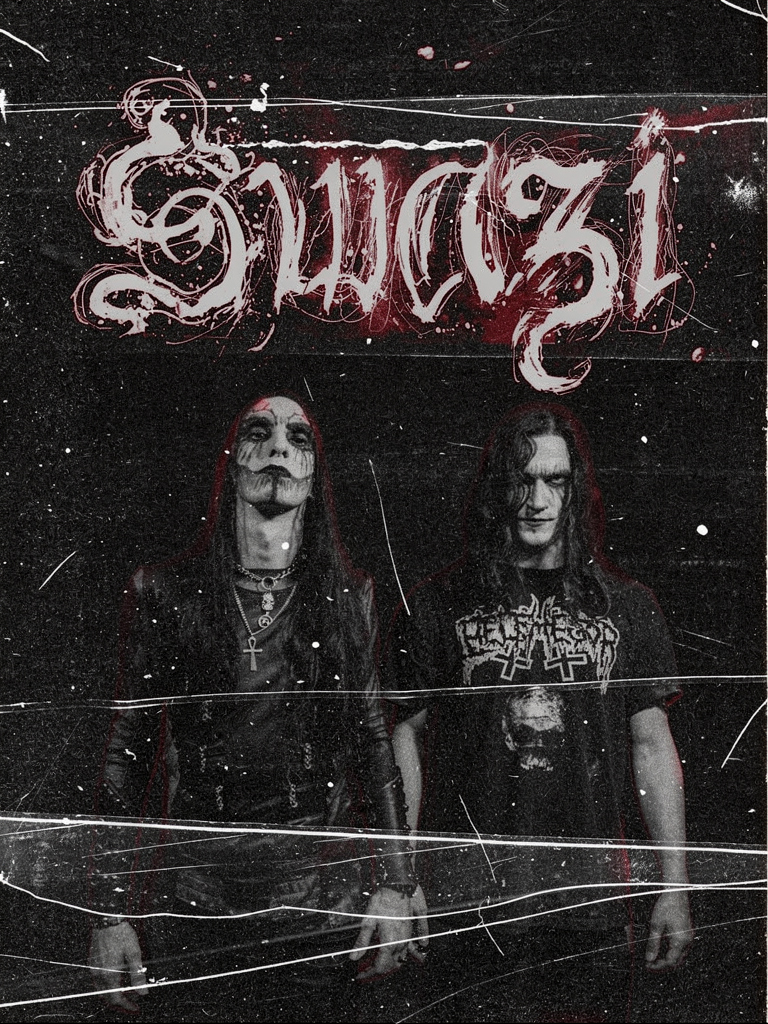
Swazi’s Spectres of the Past arrived in the middle of a particularly quiet moment for South African metal. The album came out of Cape Town during the global COVID-19 lockdown, built by two people who’d never planned to make something this ambitious. One was a saxophonist and film guy named J. The other was Sylus, a vocalist with a gift for theatrical command that most metal singers never develop. They didn’t set out to define a sound or capture an era. They just started writing, and kept writing, until something that felt true emerged from the chaos.
What came out was seventeen tracks spread across an hour. We spoke with J about how they arrived at this album, what they’re chasing sonically, and what metal actually means in a city where the scene has fundamentally shifted since the pandemic ended.
“What matters most is how the music makes you feel.
Bathory understood that.”
The origin story is simple enough. J had been working in film, and he’d been playing music his whole life. “I started saxophone when I was seven,” he says. “Played in multiple orchestras throughout my childhood. That love for orchestral music has always been with me, and it merges into what we created on this album.” He knew what he wanted to build. What he didn’t have was the right voice.
He found that voice watching Sylus perform live in Cape Town. There was something immediate about it. “He was by far the best metal singer I’ve seen locally, in terms of both his theatrical ability and his capacity to command an audience,” J recalls. “He has a naturally theatrical personality, but he’s introverted off stage. That’s a strong dichotomy, and it translates into everything he does musically.”
They shared the same instincts about music, the same influences pulling them in the same direction. Bathory. Dissection. Dimmu Borgir. Opeth. The usual suspects for anyone making dark, melodic metal. People hear “Swazi” and assume it’s rooted in cultural significance, a reference to the Swati people, perhaps, or something connected to the regional identity. The reality is less romantic. “Swazi is one of the worst weeds in South Africa,” J says plainly. “The way the letters come together is something I’ve always liked. It’s a unique word. It sounds unique. That uniqueness represents what we’re trying to do, alongside further connotations.”
Spectres of the Past didn’t come together in any conventional way. There was no master template, no predetermined length, no vision board pinned to a studio wall. “Initially, there was no thought about committing to any particular scale,” he says. “We just wrote until it felt done. When we felt the album was ready, that’s when we’d release it and start working hard on promotion.”
The seventeen tracks came from entirely different spaces and headspaces. “We started the record during COVID, and each track was created at totally different times, with different emotions, techniques, tools, and rooms,” J explains. “It’s all experimentation. That experimentation culminates in The Fallen Tower, the last track we actually created.”
That piecemeal approach might sound scattered, but for them it was essential. They wanted the listener to never quite know what was coming next. “We wanted each track to be totally different from the previous one, and for people to listen and think, ‘What on earth did I just listen to?'”J laughs. “Essentially, you’re supposed to play something like Diablo II and listen to Spectres of the Past in the background.” And the truth is the album isn’t meant to demand your full attention in the way a perfectly constructed journey would. It’s meant to unfold while you’re doing something else, revealing itself gradually, leaving moments of shock and discovery scattered throughout the hour.
“Since the end of COVID, all the metal has basically turned into hardcore.”
According to J, Cape Town had a metal community once. It wasn’t huge, but it was real. Before COVID, there were shows. There were venues that would host bands. There was momentum, however small. That’s changed, and he doesn’t entirely understand what happened: “Honestly, I have no idea,” he says. “Before COVID, there were a lot more metal shows. Since the end of COVID, all the metal has basically turned into hardcore. Maybe people got angry during lockdown and just started listening to that instead. There are people doing cool events, so there’s still some life,” he says. “It’s just not as prominent as it was.” He thinks the reasons are layered. Part of it’s economic. “The monetary incentive to create heavy music isn’t great from a local musician’s perspective, so fewer people do shows.” Part of it’s cultural. “The metal community are generally more reclusive people. You don’t see them much, so it’s harder to get them out unless it’s some international act.”
J spent years studying the bands that shaped him. Not just listening, but understanding. “I sacrificed so much of my life trying to learn how these guys make their music, through interviews, tabs, any information I could find online, with the intention of creating something unique,” he says. The goal was never to replicate. It was to understand the logic underneath, to see how masters of the form approached problems.
The reference list is long. Bathory. Dissection. Dimmu Borgir. Ensiferum. Opeth. Watain. Iced Earth. Behemoth. Interpol. The Prodigy. Electric Wizard. Children of Bodom. Danzig. The Misfits. “If you listen to those bands, you’ll hear similarities in our music,” J says. But the similarity isn’t surface-level. It’s structural. And what unites them most is an approach to production. “Bathory is one of the greatest bands of all time,” J says. “They have the biggest influence on us, alongside Dimmu Borgir. I hate music that’s too perfect, edited to the point where it sounds like everything else. What matters most is how the music makes you feel. Bathory understood that.”
“We intend to release at least seven or eight albums over the next five or six years.”
J and Sylus don’t want the same things from Swazi, but they want similar things. “Sylus is more theatrical, so he loves performing for live audiences,” J explains. “I prefer to create visuals and produce music, with the intention of blending the two together to create art.” Everything on Spectres of the Past came directly from them. The recordings. The mixing. The artwork. The videos. “Everything you hear and see is done 100 percent by us,” he says. “It might not be perfect, but we’re progressing. We’ll continue learning and working hard to create the best possible music we can.” And they’re not slowing down. “We’re busy with our second album,” he adds. “We intend to release at least seven or eight albums over the next five or six years.”
Spectres of the Past doesn’t feel like a band discovering who they are. It feels like people who already know, working in the only way they know how: imperfectly, honestly, without compromise. That’s harder to find than you’d think. It’s certainly harder to find in Cape Town right now, where the metal scene has become something quieter and more fragmented than it once was. Swazi arrived in the middle of that silence, and they’re not interested in fitting in.
Follow Swazi:
Linktree: https://linktr.ee/swazi.band.za
Instagram: https://www.instagram.com/swazi.bandofficial/
Spotify: https://open.spotify.com/artist/7yr6mYYsKMNfiaGhSoD2p0?si=Bg6Mut36TbiOgF1PfNWIOQ
Bandcamp: https://bandcamp.com/swazi6band
YouTube: https://www.youtube.com/@swazi_ZA
Facebook: https://www.facebook.com/swaziband


