


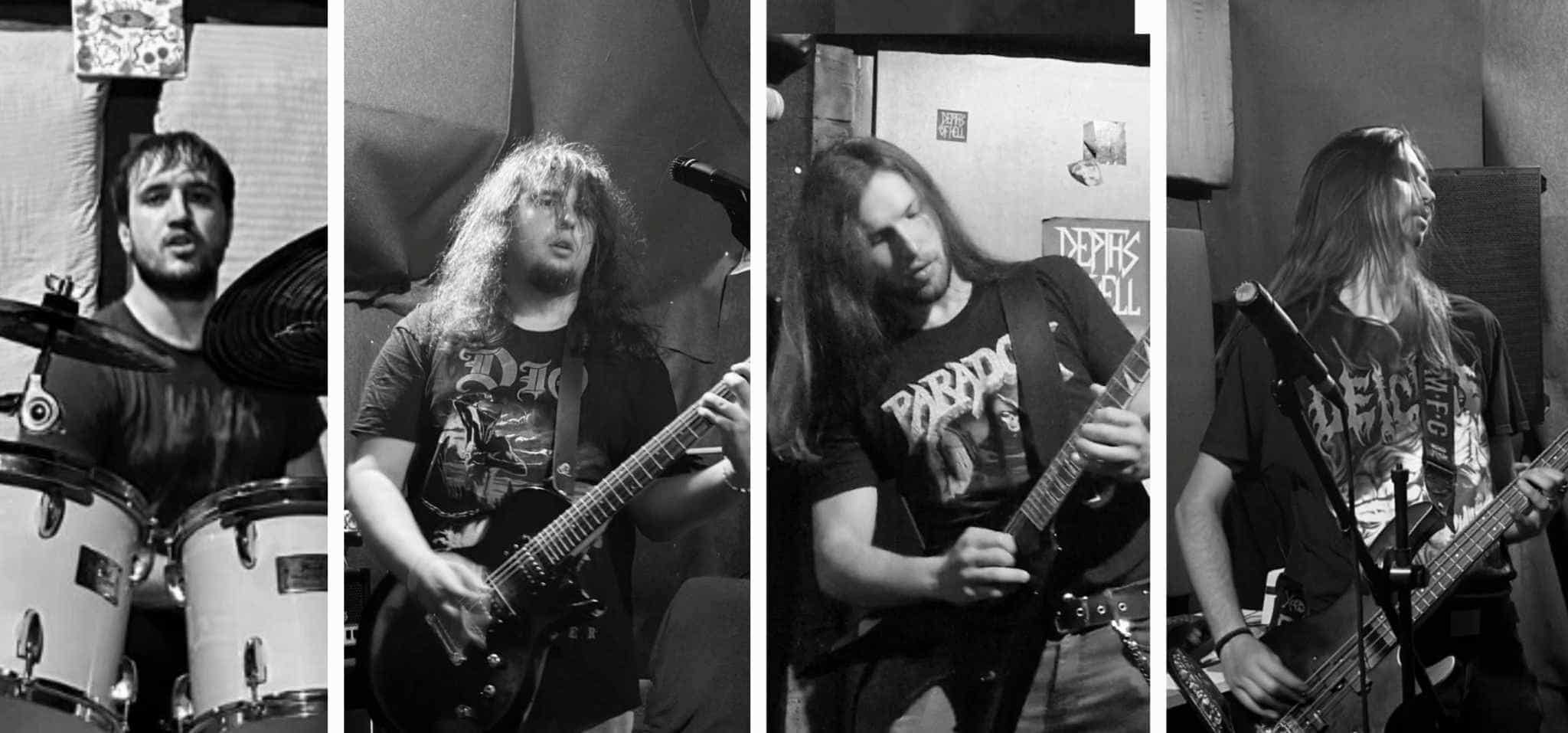
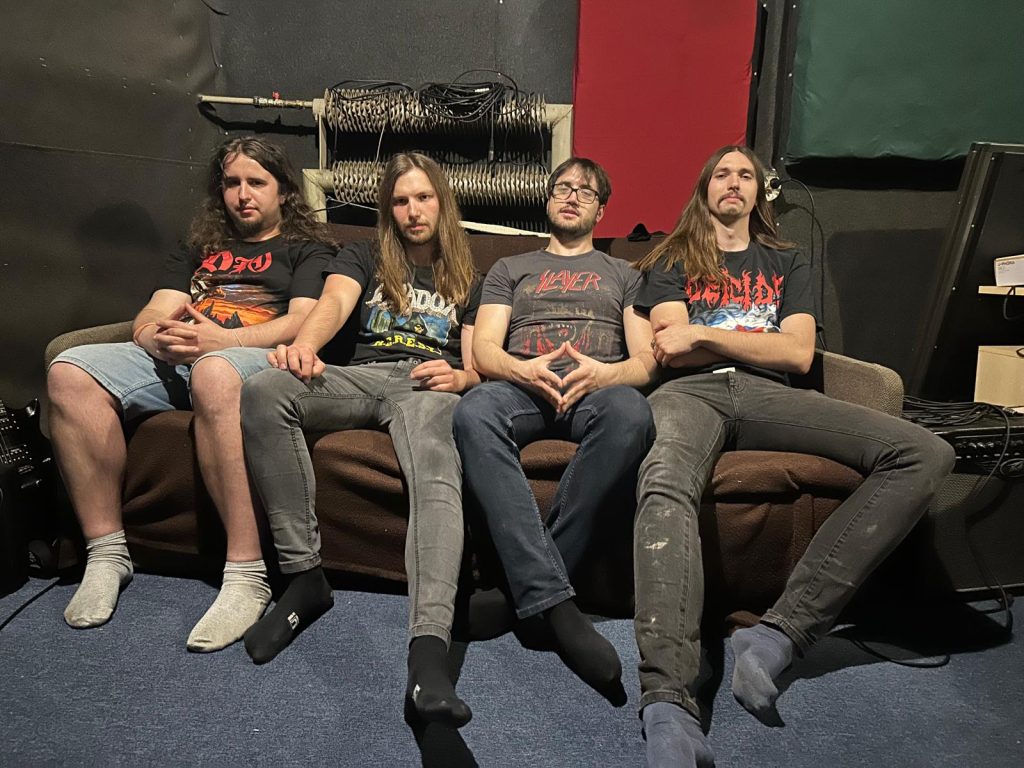
Depths of Hell are a thrash band from Silesia, Poland, playing fast, aggressive metal that sits in thrash but pulls from early death metal bite and the occasional classic heavy metal melody when it fits the song.
Everyone comes from a slightly different corner of the genre, which shows up in the writing, with technical guitar moments, rawer death/thrash instincts, and a drum approach they feel stands out in their lane.
We spoke with Dominik Olcha (guitars, vocals) about their local scene, their rehearsal-room demo Demonished and the ideas behind songs like “Contradiction of Human Existence” and “Wartainment.”
“The demo is raw, and you can feel it. It’s real, angry, and aggressive.”
You’re coming out of Zabrze in Silesia. What does your local environment do to you as a band, in terms of mentality, rehearsal life, and who you’re playing alongside?
Dominik Olcha: I think the Polish underground scene is doing pretty well, and we feel it even in our rehearsal building. A lot of bands practice here. You walk around and hear everything, from death and thrash metal to indie rock. People still want to play music. Silesia has lots of underground bands, but I don’t know the exact reason. It’s an industrial place – a bit dirty and polluted – but it also has huge history behind it. It’s also important for the Polish metal scene because of Kat. They were a huge band in the 80s and 90s and inspired many of us. You hear their covers at local gigs all the time. Maybe that heavy atmosphere is part of why we play what we play, but I’m not fully sure.
Your demo “Demonished” was recorded in your rehearsal room. What did that setup give you that a “proper” studio wouldn’t, and what did you have to fight to keep under control?
Honestly, the reason was simple: it was much cheaper. The challenge was huge, because we were learning everything as we went. It was difficult, but every minute was worth it. A studio would have given us better technical control during recording. Another challenge was finding the balance between being critical and being overcritical. The demo is raw, and you can feel it. It’s real, angry, and aggressive. Jakub did amazing on the drums, and Przemek added his own touch to the bass lines. We all felt good during the recording. For us, it’s a good mix of raw sound and precise instrumentals.
You and Szymon both handle vocals. How did you land on that split, and how do you decide who carries what in a song without it sounding like two separate worlds?
You could say we grew up together as vocalists. In the early days, we couldn’t sing at all, and we played lots of covers. Over time, we figured out what kinds of songs worked for our voices. We played thrash/death metal, but also classics like Iron Maiden, Metallica, and Anthrax – songs where melody matters. Szymon has a talent for melodic lines and can add a narrative character to the lyrics. He mixes raw vocals with more melodic parts, and he has a feel for it. I have more anger in my style, and my vocals are usually lower. We also mix our vocals a lot at concerts. Because we learned to sing together, our styles are close enough to fit without feeling identical. It sits between harsh vocals and clean singing.
“Metal is a good genre for criticizing, discussing, or asking questions about taboo topics, and religion and spirituality are definitely in that category.”
“Contradiction of Human Existence” is a big title for a four-minute track. What’s the specific contradiction you were aiming at, and where did the lyrics start from?
The lyrics are basically about religion. It’s spiritual chaos – the conflict between what is now and what will be. “Carpe Diem” versus “Memento Mori,” in a nutshell. Why do some people choose one vision of the afterlife and not another? Why do they choose this god or that god, or why do they choose no gods at all? It’s also about the cynical use of the fear of death by some priests – for power, money, and so on. Metal is a good genre for criticizing, discussing, or asking questions about taboo topics, and religion and spirituality are definitely in that category.
You can approach it in different ways: blasphemous or anti-dogmatic, where you flip concepts upside down (like “To Mega Therion” by Celtic Frost or “Welcome to Hell” by Venom), or more philosophical and psychological, where you look at the mental side (like “Piece of Time” by Atheist or “Spiritual Healing” by Death). Our lyrics are closer to the second style. We always liked talking about our worldviews because we all have slightly different opinions on some subjects. The lyrics came from that, and from our interest in the human mind.
“War has changed completely in the social media era. We can basically watch it live.”
“Wartainment” has a punchy wordplay feel to it. What were you reacting to when you wrote it, and what did you want it to leave in the listener after the first run-through?
I had a subject at university called “Infotainment.” I liked the wordplay and decided to use it as the title. War has changed completely in the social media era. We can basically watch it live. Photos of bodies, or even recordings of war crimes, get uploaded minutes after they happen. The media needs attention, and the easiest way to get it is through emotion. People are scared because they see what’s going on around the world – in Ukraine, in Gaza, in Sudan, and elsewhere. We’re also only a few years past the global pandemic. In my opinion, fear of a global conflict is the biggest it’s been since the Cold War.
I wanted to describe that feeling – the fear of war mixed with constant images of it on TV and on social media. You even see it in memes. They might not be the highest form of culture, but they show people’s emotions. Jokes about meeting your old buddy on the battlefield in Greenland don’t come from nowhere. People have those thoughts. That’s what the lyrics are about.
This artwork was done by Szymon Bukowski. How did you brief him, and what details mattered to you in that visual identity that people might miss at first glance?
He’s the guitarist for Mind Enslaver, a band we played many gigs with. He was doing artwork for friends, and we liked what he did. We wanted the cover to stay simple and minimal in colour. It’s the ugly hand coming from underground, from the Depths of Hell. Szymon did a really good job, and we’re proud it’s our cover. The key detail for us was restraint. We didn’t want to overdo it. We wanted it raw, so it fits the atmosphere of the demo.
How do you connect with metal outside Europe day to day, and have you come across any African bands or scenes that genuinely stayed with you long enough to influence your listening or thinking?
I really like Vale of Amonition. You can feel Africa in their music. Not some pop-culture version of it, but something that comes from people living there. I also listened to some folk metal bands. It’s a genre that usually leans Celtic or Viking, so it was interesting to hear African instruments used in metal compositions. There’s a lot of metal in Europe and the US, of course, but it’s good to hear it from other places too, with its own touch and personality. For me, one of the biggest inspirations is Sepultura. Obviously I’m talking about their thrash/death era, but “Chaos A.D.” and “Roots” are also good examples of bringing elements of your own culture into your music.
Demonished (2025 Demo) is on Bandcamp. Stream it there, and if you want to support Depths of Hell, pick up the download.


