


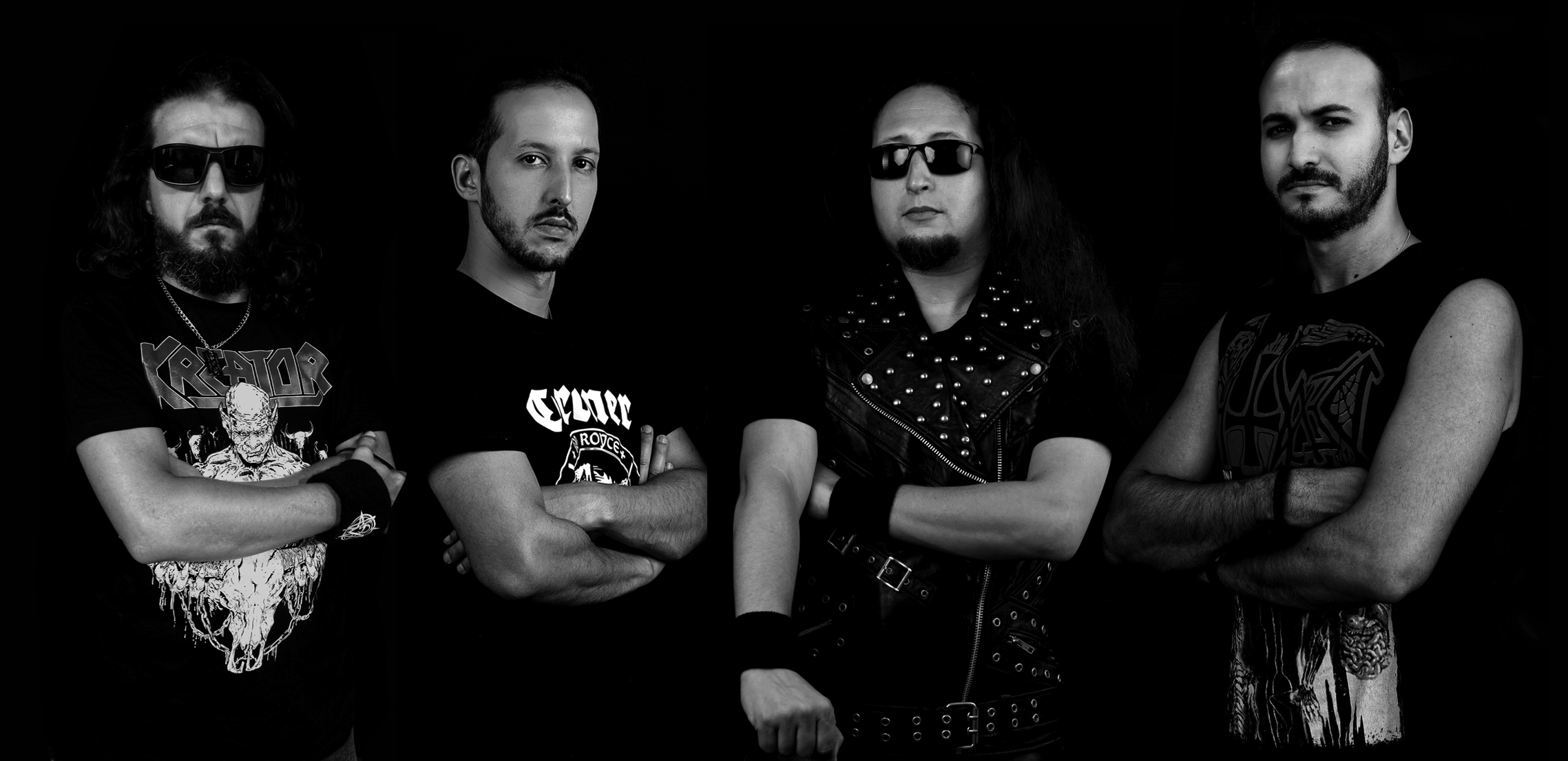
Numidian Killing Machine come from Algiers, where bassist Rafik Laggoune started the band in 2017 with a clear idea in mind. This was never going to be a loose collection of historical references. From the start, the project was built around ancient Algerian history, especially Numidia, the ancient North African kingdom that once covered parts of what is now Algeria and its neighbouring regions, but seen through a metal lens that pulls it into collapse, prophecy and a ruined future.
When Psychotronik Breakdown came out in 2023, it introduced that vision in full, then later gained a physical release through Germany’s Fetzner Death Records. By the time Numidian Killing Machine took the record to Institut français stages across Algeria in July 2025, the response was already there. The Algiers date drew more people than the room could hold, and demand for more shows kept building after the tour. In this interview, the band talk about language, concept, speed, physical editions, and how they continue to build their own version of Numidia inside extreme metal.
“Nobody ever asked about the pain we went through trying to get that Tifinagh alphabet onto digital platforms.”
Psychotronik Breakdown feels like a full world and not just “songs about history”. When you sit down to write, what is the first concrete thing you build that makes the whole concept real for you, before anyone hears a single riff?
First of all, we want the listener to sit down and focus on the concept and the lyrics when picking up the CD. It is not just about history, it is a whole story. I want the listener to feel the state of mind I am in when thinking about the concept of a song, and to go deeper into those ideas. It reflects a set of elements that were carefully selected to blend a precise past period with a reimagined future, a vision of what our civilisation has outlived.
The record opens with an intro titled in ancient Numidian Amazigh, and you keep that Tifinagh identity even when platforms cannot display it properly. What do you want that opening moment to do to the listener, and what are you actually saying there?
That is an interesting question. Nobody ever asked about the pain we went through trying to get that Tifinagh alphabet onto digital platforms (laughs). “ⵜⵣⴰⵍⵉⵜⵜ ⵏ ⵍⴳⵓⵉⵔⵔⴰ ⵓⵔⵉⵜⵎⵉⵔⴰⵏ”, translated as “T’Zallit N L’guirra Uritmiran”, means “Prayer of Eternal War”. It is a prelude that prepares the listener for what follows. It rises upward until it explodes into the next track, “Blood and Iron”. It is a kind of apocalyptic preaching about a faith withdrawn into darkness, at the moment when the last prayers have arrived, like a grain of sand in the infinite desert of time.
It is written and performed in the dialect closest to ancient Numidian Amazigh, which is Zenete, and more precisely in T’Chaouith, or Chaoui Amazigh, which is the closest one to that ancestral antique tongue.
When you write fast and aggressive material like this, how do you make sure each song keeps its own identity?
Despite the variety in our sound, we always keep it straight. As I said, we are following a concept, and that is what makes it homogeneous. As for the speed, we are influenced by the first wave of black and death metal from the 1980s, and also by a lot of German thrash. Bands such as Sodom, Bathory, Celtic Frost, Morbid Angel, old Bolt Thrower, Coroner, early Samael and old Immortal are present in our sound. And of course, there is an excessive use of alternate picking (laughs).
In July 2025 you took the Psychotronik set to Institut français stages across Algeria. What did those shows teach you about who your audience is right now, and what surprised you when you brought extreme metal into those rooms?
We were supposed to do the tour in 2024, but we had some difficulties back then. The audience was already very impatient to see the show because the album had done well in the underground metal scene around the world. Most of the metalheads there were really into extreme metal, so it went very well. The most crowded date was the one in Algiers, to the point that hundreds could not attend and stayed outside waiting for access to the theatre. After that, our social media profiles were flooded with demands for future dates.
You put the album out digitally first, then worked with Fetzner Death Records for the physical editions. What did working with a label change for you in practical terms, and what part of the album’s presentation mattered enough that you refused to compromise on it?
Fetzner Death Records did a good job producing the album. It was released both on CD and tape, with very good quality printing and a 16-page booklet, which is something not all bands aim for when putting out their very first release. With production costs getting more expensive these days, it still managed to come out in 500 CD copies and around 200 tape copies. We also had creative freedom in every sense. I did the booklet artwork myself, and the front cover was designed by the talented artist Amine Siamer. That also helped lift some of the timing pressure from the production company when it came to deadlines and the release date.
“We are not really changing our direction. Let us say we are perfecting it”
When you write about Numidia, how do you keep it rooted in something Algerians will recognise, while still pushing it into the post-apocalyptic future you are building?
A lot of Algerians today are more aware of their roots, and information about history is much more available now. At first, we translate facts into fiction. It is like bringing history into the metal universe and blending it with our influences. For example, the universe of “Warmaster” by Bolt Thrower influenced our release in the way we recount the Punic Wars through metal. We are also big fans of Unleashed and the way they illustrate Viking history in death metal while keeping it pure, without relying too much on traditional elements.
Of course, there was a category of people who expected us to use instruments like derbouka, guellal or goumbri, and they were disappointed, which I would say is a good thing (laughs).
What is the next step for Numidian Killing Machine after Psychotronik Breakdown, in terms of sound and concept, and what are you deliberately changing compared to that album?
We are currently working on our next release. More information about the release date and distribution will be communicated soon. We are not really changing our direction. Let us say we are perfecting it. After that, show dates will also be announced. Stay tuned. Eternal hails!
You can get Psychotronik Breakdown now on Bandcamp.


