


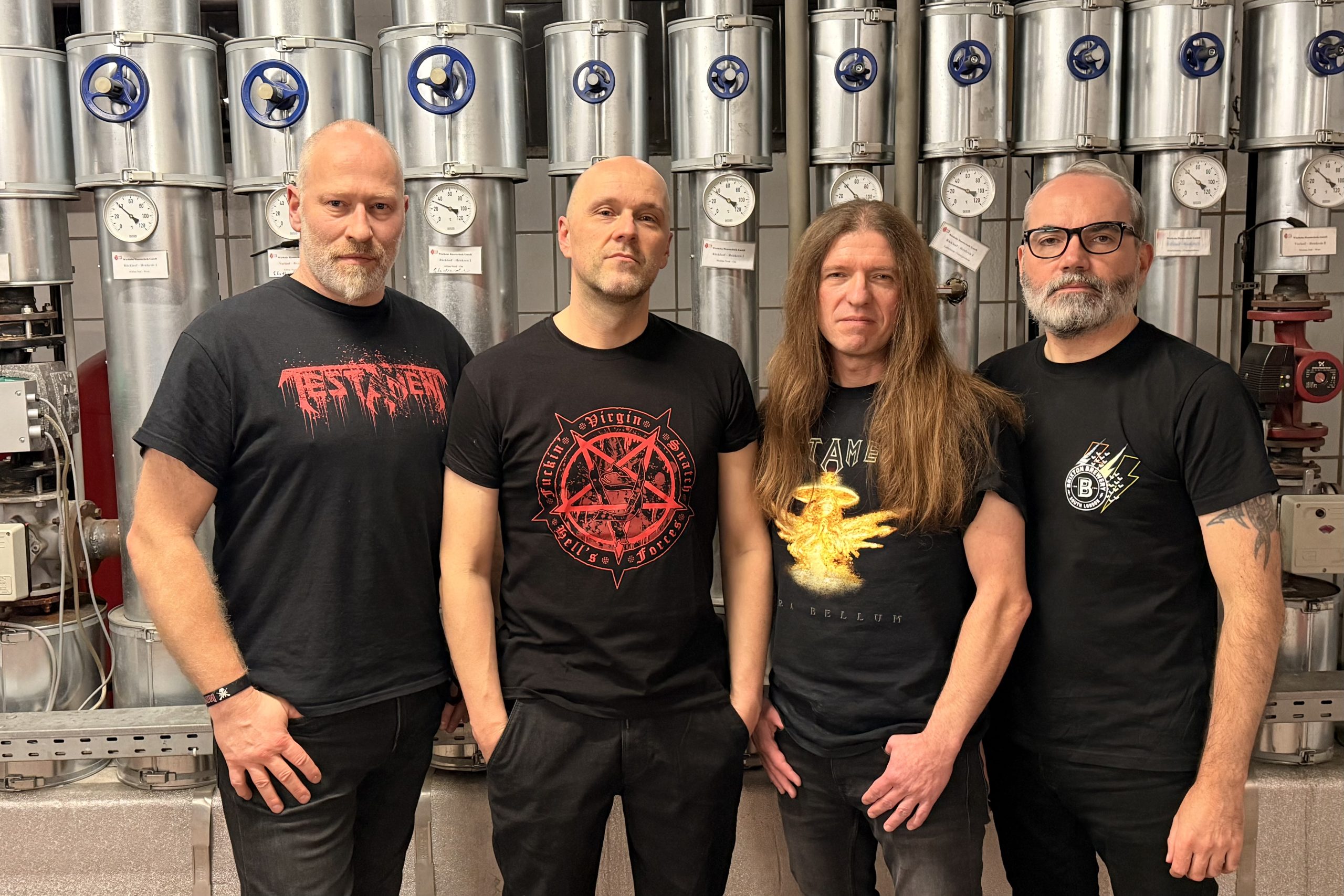
Servator have been part of the German underground since 1993. Based in Helmstedt (Lower Saxony), they sit in the overlap between death metal weight and thrash speed, with groove built into the way they write and play.
Their new album The Dark Triad came out on 17 January 2026 as an independent release. The title borrows from the “dark triad” traits – Machiavellianism, narcissism, psychopathy – and the lyrics zoom in on war, propaganda, hate speech, and the kind of people who thrive when everything’s burning.
I spoke with Mirco Brandes (bass/vocals) about staying active for decades with jobs and families in the background, why Servator still build songs in a rehearsal room, and what they wanted to tighten up on The Dark Triad as they gear up for shows like the HelmFest Warm Up on 7 March 2026.
You describe “Servator Metal” as your own lane between thrash and death with groove in the punch. What makes a riff or a song feel like “yours”?
Micro Brandes: In the early days it was just a big grin when we found a riff and a beat that hit hard. Nowadays we all have a sense of what fits our style. Usually Chrille [leag guitars] brings new riffs and the others build on them, creating the second guitar parts, the drum patterns, the basslines, and of course the vocal lines. It’s a dynamic process in the rehearsal room.
By the way, we often sketch the vocal lines by singing English words that come to mind in the moment. That probably sounds funny for native speakers. I develop the lyrics long after the songwriting is finished, but I try to keep the same phrasing we used in rehearsals.
The Dark Triad takes its title from a psychological concept, even if it’s not a full concept album. What pulled you into that theme, and how did it shape the lyrics?
The lyrics were already done when Chrille came up with the record title. We liked it straight away, and we could see how it connects with some of the lyrics. The Dark Triad is about three personality traits: Machiavellianism, narcissism, and psychopathy. If someone scores high in these traits, it can be linked to harmful behaviour and social distress.
Many regions on earth are in disorder or war, populistic parties gain support, and radical ideas have far too many followers. The lyrics deal with the kind of people who push us into tragedies, conflicts, and even war. The lyrics come from observation, with a little bit of fiction (“Black Halo” or “Pale Horse,” for example). Sometimes you don’t even want to watch the news, because things keep getting worse around the globe and you start to wonder if humanity learned anything from history.
“Drown in Blood” is a song against despots who lead their countries into war. “Burn After Bleeding” is about journalists who try to do their jobs in places where it’s dangerous to report the truth. “Trial by Wire” is about hate speech on the internet, especially on social media. “Defensive Mutilation” is about a killer who mutilates victims to make identification more difficult.
We’re lucky that none of this is lived experience for us.
You recorded again at Splash ’n’ Dash Studio with Reimund Junker. What does working with the same producer give you, and what did you want to push further this time?
Reimund has produced our records for several years now. We know him well. He’s a funny guy, but also very professional, and he understands how we want to sound.
The sound on our last album was good, but we sat down and talked about what could be better this time. The compression and overall volume level is a bit lower, but the instruments sound even better now. When we recorded the drums, we only triggered the kick drum. Everything else is the natural drum sound.
Reimund recorded the whole album in our own rehearsal room, which made it easier for us. We didn’t have the pressure of a studio clock or a strict deadline.
“We’re not a religious band, and we’re not anti-religious either. We question things, and this song is about that feeling of desperation when help is needed most and it still doesn’t come.”
You’ve put out lyric videos for “Drown in Blood” and “The Invocator.” Why those songs first, and what do they represent inside the album?
Those two songs were the last ones we wrote for the album, and we think they’re among the heaviest and strongest tracks on the record. “Drown in Blood” is our “Servator Metal” midtempo groove, and lyrically it’s a very current topic.
“The Invocator” is a bit faster and it’s a good contrast to the midtempo songs. The lyrics are about people who pray for help from above, but the prayers stay unanswered. We’re not a religious band, and we’re not anti-religious either. We question things, and this song is about that feeling of desperation when help is needed most and it still doesn’t come. Maybe that connects with our band name a little bit.
“People told us it was one of the best metal club gigs in Helmstedt.”
After the CD release party in Helmstedt, what feedback stuck with you most, and what surprised you about how people reacted to the new material?
We were really happy with the turnout. When we played, the room was full, and we got great feedback during the show and afterwards. The two support bands got a strong response too. People told us it was one of the best metal club gigs in Helmstedt.
Usually you only have HelmFest in summer if you want to see bands in Helmstedt that don’t have a nearby homebase. We sold a lot of merch and CDs, so we think people liked the newer material we played.
You’ve played the regional circuit for years and you’re doing the HelmFest warmup show. What does “building locally” actually look like for Servator in practical terms?
We don’t have many connections across the country, mainly because we didn’t do much self-promotion for years. So we didn’t get around as much as we wanted.
This time we’re trying to do things properly: a new Instagram account, more content there and on Facebook, a better design for our Bandcamp page, two lyric videos on our new YouTube channel, availability on all streaming platforms, and help from a promoter from Poland, Vlad Nowajczyk, and From the Depths Entertainment in the USA. And of course, being mentioned at AFRICA.ROCKS.
For African readers: do you have any relationship with African rock and metal right now?
To be honest, I only knew two bands from Africa: Arka’n Asrafokor and Myrath. I saw them at the last Rock Hard Open Air. But I’m always curious about new music from all over the world, and I hope we’ll hear a lot more strong bands coming out of Africa in the years ahead.
“Create something that comes from your heart and feels right. And stay heavy. No mainstream bullshit please.”
What’s the most useful thing you’ve learned about staying active long-term as an underground band that you could share with an independent African band?
If you love what you do, keep going, even if some people don’t like your sound. We never really had the ambition to become professional musicians, so it’s easier for us to say that. It’s hard nowadays to earn money with music. Create something that comes from your heart and feels right. And stay heavy. No mainstream bullshit please.
What’s moving behind the scenes right now for Servator?
We’re preparing for the next gig at the HelmFest Warmup show. There will be a little more than 200 people watching, and it’s already sold out. Maybe every band from the Helmstedt area takes part in that show. It’s a kind of family meeting. At the same time, we’re trying to promote the album as well as we can, and we’re waiting for more reviews and feedback around the world. In March, we will be featured on an underground CD sampler released by the German metal magazine Legacy. We hope to get more gigs in autumn to promote the album live. Then we’ll start writing new songs, but as I explained, that will take some time.
You can buy The Dark Triad on Bandcamp. It’s also available to stream on all major platforms.


