

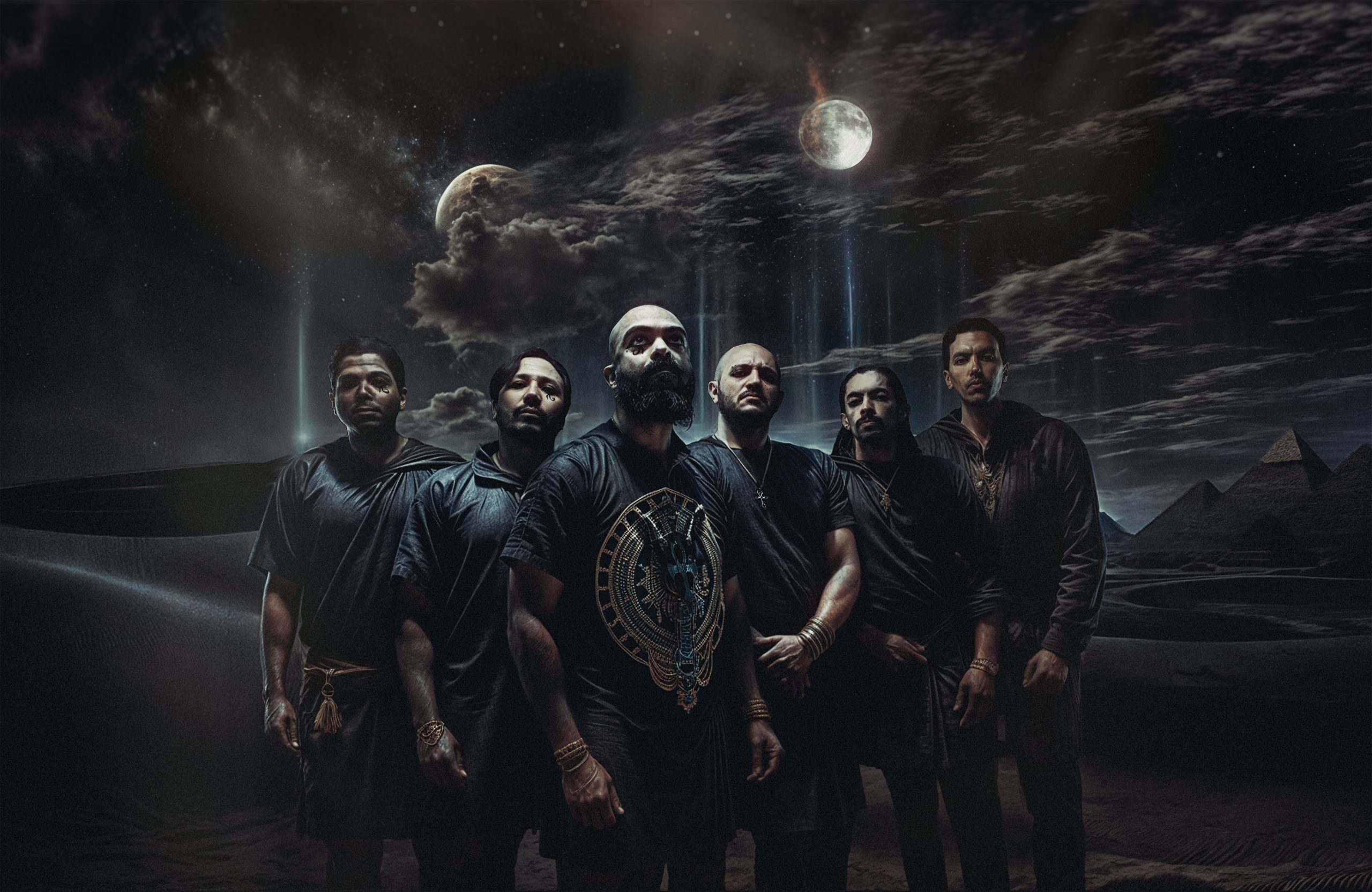
Scarab did not make Transmutation of Fate as a simple stop between albums. The Egyptian death metal band use the EP as a way to go back through twenty years of material, memory and pressure, then bring some of those older ideas into the present with a different understanding of what they are. Some of the riffs go back to the band’s early years, from the time around Blinding the Masses to the Martyrs of the Storm era. They were left behind for different reasons. Some did not fit where the band were at the time. Some fell out of the plan as the internal dynamic changed. Now, they return as part of a release built around alchemical transformation and the idea of the Magnum Opus: taking base matter and turning it into something higher.
For Sammy Sayed, who handles vocals, programming and orchestrations, the base matter was not only musical: “For us, the ‘base matter’ was our past”, he says. “The music on this EP comes from our twenty years together, carrying all the memories and emotional weight of those decades. The ‘gold’ is the final manifestation you hear now. We took those bits and pieces from our history, honoured where they came from, and chiselled away the dross to put them together in this exact state.”
That does not mean he wants to explain the whole thing away. Scarab have built the EP with intention, but Sammy still wants listeners to enter it without a manual. “As for how the tracks are arranged to reflect that, it is simple: read the lyrics, listen to the music, and find out for yourself. I would rather leave that entirely to the listeners to interpret freely. Sit through the four songs and see what you find. I am sure it will all make sense then.”
Before those older ideas could work, the band had to change. Sammy is clear that Transmutation of Fate did not come from a need to alter Scarab’s style. It came from a shift in the people making it: “We personally had to change and learn a lot of things so that this EP would sound the way it sounds now”, he says. “Transmutation of Fate did not really require a change in our musical style, but more of a total reset of our internal dynamic as people.” The last few years brought personal loss and major changes in his own life. That changed the way he heard and handled the material. “If we had recorded these songs back in the day, we simply would not have executed them the same way”, he says. “People who know Scarab well will still recognise our sound, but the way we play and deliver the music is completely different now, and there is more space for experimentation. What I personally hope is that people can feel the honest energy and magical aura of it as much as we do.”
That is why the EP carries the feeling of something being cleared. These are old parts of the band’s history, but they are not presented as archive material. “Some of these riffs have been floating in our subconscious since our earliest days”, Sammy says. “The simple truth is that we just were not ready to accept them back then, or they fell out of our plans as the band’s dynamic shifted over the years.” Returning to them became deliberate. He calls it “musical archaeology”, which fits the way Scarab speak about the EP: as something dug up, cleaned, recut and placed back into ritual use. “Returning to them allowed us to look those older ideas in the eye with emotional maturity and better technical understanding”, he says. “It was a way of taking the raw, sacrificed energy of our past and forging it into the present so that it does not die with us unaccomplished and unheard. We needed to let that energy out so we could finally step into our next chapter.”
“The weight of our heritage, the spiritual, mystical and magical landscape, runs through our blood”
Scarab have always carried Egyptian identity inside death metal, but Sammy rejects the idea that this is surface imagery. The band’s use of ancient references, neoglyphic concepts and phonetic incantations is part of how the music moves: “Our identity is not a gimmick”, he says. “The weight of our heritage, the spiritual, mystical and magical landscape, and the experience of living on the very land where all of this happened and channelling directly from it runs through our blood. It is an authentic, living current.”
That current is not separate from modern life in Egypt. For Scarab, the ancient and the present are not two different costumes. “Our music does not only come from listening to the records that influenced us”, Sammy says. “It also comes from a deep, atmospheric pressure unique to our reality. It is brutal, it is ancient, but it is entirely contemporary, real and lived. I hope this is what reaches everyone out there in general, both in Egypt and outside of it, because this is exactly how we feel about our music.”
That also changes how Sammy speaks about darkness. Death metal often works with violence, power and myth, but on Transmutation of Fate he does not separate those ideas from actual life. “On this release, like others, myth and real life are completely inseparable”, he says. “We deal with dark energies, but we do not use them as a gimmick. For us, embracing darkness archetypally is a necessary step to reach true understanding, power and resolution.” He links that directly to Kemet (a name for Egypt in the ancient era) and alchemy, and to the figure of Osiris: broken apart, gathered again and raised into another state.
“darkness is not something to avoid. It is a vital, non-negotiable part of our evolution”
“You cannot transform base matter into gold without first passing through the dark energy”, he says. “It is the archetype of Osiris, being broken apart by life, gathered back together, and resurrected into a higher state of power.” The point is not academic for him. The losses and chaos behind the EP are not decorative themes. “We are not bringing something that we do not already live and experience”, Sammy says. “The losses and chaos we faced in our real lives as humans are not some academic concepts. They are raw, visceral wounds. We integrate those heavy, lived experiences with these ancient archetypes because we recognise that the darkness is not something to avoid. It is a vital, non-negotiable part of our evolution. It is what refines us, transforming earthly pain into an enduring, universal strength.”
The EP also leaves room for weight to gather. It is still extreme death metal, but the arrangements are not in a hurry to fill every space. Sammy does not frame that as a calculated decision made from outside the music. He followed the ideas as they came, then understood the shape more clearly once the EP was finished: “I was just following the trail of thoughts and channelled ideas as I was putting the music together and producing the EP”, he says. “I learned a lot while working on it, also from the collective feedback from my bandmates.” Looking back, he sees patience as part of the heaviness: “I believe true heaviness is not about speed, it is about intent”, he says. “The heaviest, most devastating moments on this EP only carry that massive weight because of the silence, the space and the atmospheric tension that precedes them. Creating that space is like pulling back a bowstring. The more deliberate and patient the pull, the harder the arrow hits when you finally let it go.”
For younger African bands working with fewer resources, Scarab’s story has another lesson. The band began at a time when there was no clear route for an Egyptian death metal band to reach international labels, European festivals or a wider audience. They dealt with financial limits, lack of specialised extreme metal studios and no real map to follow. Sammy does not soften that: “When we started, there was absolutely no roadmap for an Egyptian death metal band to achieve international reach, sign to global labels, or play major European festivals”, he says. “We faced a lack of specialised extreme metal studios and heavy financial hurdles. If we had waited for the perfect conditions or the right infrastructure, Valley Of The Sandwalkers or Blinding The Masses would have never been recorded, and we probably would have given up.”
That is the part he wants other bands to understand. “Any kind of limitation can become your greatest creative asset”, he says. “If you have nothing, you have to build your own ecosystem from nothing. If you have something, which you probably will, then you have no excuse at all.” For Sammy, the work has to be honest before anything else. Technique, production and opportunity all count, but he keeps coming back to energy and intent: “Focus entirely on the absolute, uncompromising integrity of your art and your work ethic”, he says. “Speak your truth. If your music possesses an undeniable, fiery honesty, it will pierce through any barrier because energy is what counts, and if it is genuine, it will attract those who want something real in the middle of a vast sky of generic and repetitive music. Use any hardship you may be facing in your life to fuel the fire of your expression instead of letting it burn you out. We did that.”
“We cannot wait for everyone to hear what we are currently building”
With Transmutation of Fate now out, Scarab stand in a different place, but Sammy describes the band less as a line-up than as an emblem that has survived. “Standing here today, with the long road behind us and Transmutation of Fate finally unleashed into the great aether, I feel Scarab as an emblem has become a force that survived a lot without losing its core value or essence”, he says. “We have survived many storms, metaphorically speaking, alongside the pandemic cancellations and the massive internal shifts which marked the end of an era. With the return of Mohamed El Sherbieny on bass, Sherif Elias on keyboards and synth, and having Tarek Amr alongside Omar Abou Doma on guitars and Amir El Saidi on drums, this line-up represents the band’s spirit right now, ready to ensure the emblem of Scarab endures. We cannot wait for everyone to hear what we are currently building.”
Originally published in the June 2026 issue of AFRICA.ROCKS Digital Magazine.


